As an Amazon Associate I earn from qualifying purchases. This post includes a paid placement. The brand paid to appear here; the words are my own.
Puppy teething runs from roughly three months to six or seven, and it is not a phase you can wait out passively. Your puppy has 28 baby teeth that all have to come out, the adult set underneath pushes through sore gums, and chewing is what relieves it. The only real question is what they chew. Give them nothing suitable and they will pick your skirting board, and a habit formed at four months is much harder to undo at ten.
This is also the point where most owners buy the wrong thing, because the packaging that shouts loudest says indestructible. For a teething puppy that word is a warning, not a feature.
The One Rule That Matters More Than Any Product
A chew that will not flex is hard enough to break a tooth. Fractured teeth — usually the big upper premolar — are one of the most common reasons dogs end up at a veterinary dentist, and the culprits are predictable: antlers, hooves, real bones, hard nylon, and anything marketed as unbreakable.
Two tests, before it goes anywhere near a puppy. Press a thumbnail into it: if you cannot leave a mark, it is too hard. Then imagine it striking your own kneecap; if you would flinch, so would a tooth. A toy should give slightly under pressure. That is the property doing the work, and it is the one that gets designed out in the pursuit of durability.
Puppy teeth make this stricter, not looser. Deciduous teeth are thinner and more brittle than adult ones, so a chew an adult dog handles comfortably can crack a four-month-old’s. Buy for the mouth you have now.
What To Actually Buy
Three that get the balance right, and one is the standard answer for a reason.
KONG Puppy — the default

KONG makes this in a softer rubber than the classic red, specifically for a mouth full of baby teeth — their own description is that it is gentle on a puppy’s 28 baby teeth. The reason to start here is not the rubber though, it is the hollow: stuff it, freeze it, and you have converted a chew toy into twenty minutes of cold pressure on sore gums and something to do. Frozen is the part most owners skip and the part that actually helps.
It doubles as the answer to crate training and to being left alone, which is why it survives long after teething ends.
Nylabone Just For Puppies Triple Teething Ring — for the genuinely determined

Some puppies go through soft rubber quickly, and this is the honest middle ground. It is nylon, but the puppy formulation is deliberately softer than the adult Nylabones — which is exactly the distinction that matters and exactly the one that gets lost on a shelf. Do not substitute an adult Nylabone for this. Same brand, same shape, different hardness, and the adult one is in the tooth-fracture category.
Bacon-flavoured, textured, and it comes as three, which is useful because rotation keeps a puppy interested far better than one toy left permanently on the floor.
KONG Ring — for the ones that chew at the back
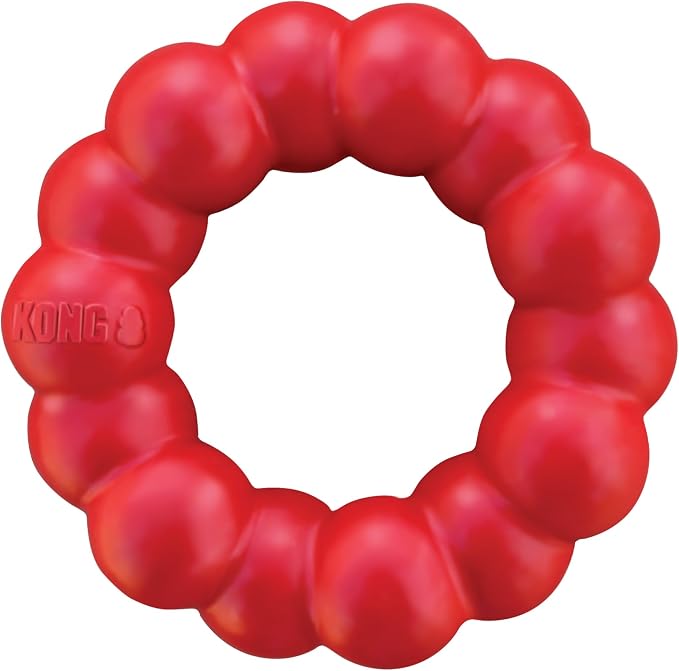
A ring shape lets a puppy get the toy between the back teeth rather than gnawing at the front, which is where a lot of the teething discomfort actually sits. Same natural rubber, and it is the one to add if you notice your puppy working at the sides of their mouth.
Rope Toys, Honestly
Rope is the default recommendation everywhere and it deserves more caution than it gets. Puppies swallow the strands. Swallowed thread does not pass like other material — it can catch at one end and then bunch the intestine along itself, which is a surgical emergency and a genuinely bad one.
That is not a reason to never own a rope toy. It is a reason to treat it as a supervised game rather than something left in the crate, and to bin it the moment it starts shedding. If you cannot supervise, the rubber options above are the ones to leave down.
What To Skip Entirely
Antlers, hooves, real bones and hard nylon are the tooth-fracture group. Tennis balls are worth knowing about too — the fuzz is mildly abrasive and grinds enamel over months, which matters for a dog who carries one everywhere rather than one who fetches occasionally. And anything small enough to fit entirely behind the back teeth is a choking risk regardless of what it is made of.
One more that is not about material: retire a toy when it is damaged. KONG say it plainly on their own packaging — no dog toy is truly indestructible, and a damaged toy should come out of play. A chunk chewed off a rubber toy is the thing that causes the blockage, not the toy itself.
A Few More Worth Having
These three come up often enough in this house to be worth listing, and they cover the parts a chew toy does not — the tug game, the settle, and the first nights alone.
Check price on AmazonCheck price on AmazonCheck price on AmazonPersonalised Toys, And A Disclosure
Sponsored. PrideBites make custom dog toys and accessories, personalised with a name or your own dog’s face, and they pay us for this placement. You are being told that here rather than in a footer.
It sits in a different category from everything above and it would be dishonest to blur the two. A personalised plush toy is a keepsake, not a teething chew. A determined four-month-old will get through soft fabric, and the stuffing and squeaker inside are the parts that cause a blockage. Treat one as a supervised toy or a gift, and keep the rubber options in this guide for the actual chewing.
If The Chewing Is Aimed At You
Mouthing hands is normal at this age and it is a separate problem from teething; a toy will not fix it on its own, because the puppy is not in pain, they are playing. The approach that works is the boring one — the game stops the instant teeth touch skin, every time, without drama. There is more on redirecting it in our guide to what to do when a puppy bites.
And if you are still in the first fortnight, the new adopter checklist covers what else needs to be in the house before the chewing starts in earnest. Teething arrives sooner than most people plan for.