| Factor | Detail |
|---|---|
| Short answer | There is no official size standard for a Mini Goldendoodle, so size depends on the parents. |
| Poodle parent | Miniature Poodle: 10 to 15 inches (about 25 to 38 cm), 10 to 15 pounds (about 4.5 to 6.8 kg) (American Kennel Club). |
| Golden Retriever parent | Males 23 to 24 inches (about 58 to 61 cm) and 65 to 75 pounds (about 29 to 34 kg); females 21.5 to 22.5 inches (about 55 to 57 cm) and 55 to 65 pounds (about 25 to 29 kg) (American Kennel Club). |
| What to do | Ask the breeder for the adult weights of both parents and of earlier litters. |
Are you thinking about a Mini Goldendoodle and wondering how big it will get? The honest answer is that nobody can say exactly.
A Mini Goldendoodle is a cross between a Golden Retriever and a Miniature or Toy Poodle. It is a crossbreed, not a recognised breed, so there is no breed standard that fixes its height or weight.
An earlier version of this page gave several different weight ranges that did not agree with each other. We have removed them, because we could not find a primary source for any of them.
What we can source is the size of the two parent breeds. A puppy’s adult size usually falls somewhere between the two.

How big are the parent breeds?
| Factor | Detail |
|---|---|
| Toy Poodle | No more than 10 inches (25 cm), 4 to 6 pounds (1.8 to 2.7 kg) (American Kennel Club). |
| Miniature Poodle | 10 to 15 inches (25 to 38 cm), 10 to 15 pounds (4.5 to 6.8 kg) (American Kennel Club). |
| Golden Retriever | Males 23 to 24 inches (58 to 61 cm), 65 to 75 pounds (29 to 34 kg); females 21.5 to 22.5 inches (55 to 57 cm), 55 to 65 pounds (25 to 29 kg) (American Kennel Club). |
A Golden Retriever is far larger than a Miniature Poodle, so a cross between them can land anywhere in a wide range. Size is not fixed by the “mini” label.

What affects how big a Mini Goldendoodle gets?
- Parents: the best guide to adult size is how big both parents are, and how big earlier puppies from the same parents became.
- Generation: puppies in the same litter can differ in size, because genes mix unpredictably.
- Food: feed a complete puppy food and measure it. Overfeeding causes weight problems, not a bigger frame. See our dry food guide.
- Exercise: regular, moderate play. Avoid forced running while a puppy is growing.

How to choose a size with confidence
- Ask the breeder for the adult weights and heights of the mother and father.
- Ask what size the breeder’s earlier puppies grew to, and whether you can meet one.
- Check which Poodle size was used. A Toy Poodle parent usually gives a smaller dog than a Miniature Poodle parent.
- Ask your vet to check your puppy’s growth at each visit.
See our F1B Goldendoodle guide for more on how the crosses are made, and the Toy Poodle temperament guide for the smaller parent.

Coat, care and temperament
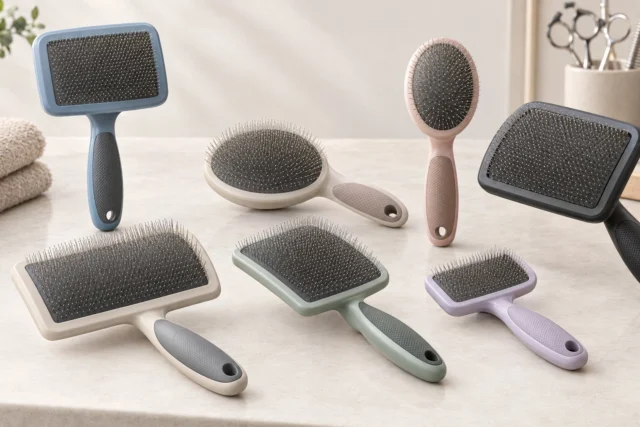
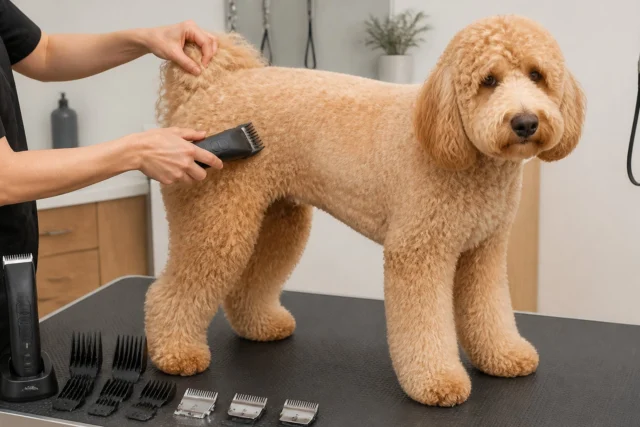
Goldendoodle coats can be straight, wavy or curly and need regular brushing to stop knots. See how often to groom a dog. No dog is guaranteed to suit an allergic person, even a low-shedding one, so spend time with the dog before you commit. Temperament varies from dog to dog, so meet the parents if you can.
Frequently asked questions
How big do Mini Goldendoodles get?
There is no official size. It depends on the parents. Ask the breeder for their adult weights.
How long do Mini Goldendoodles live?
No source gives a lifespan for the cross. The parent breeds are listed at 10 to 12 years for the Golden Retriever and 10 to 18 years for the Miniature Poodle (American Kennel Club, American Kennel Club).
Are Mini Goldendoodles hypoallergenic?
No dog is guaranteed to be. Spend time with the dog first if allergies are a concern.
Do Mini Goldendoodles need a lot of exercise?
They are active, so plan on daily walks and play. Ask your vet what suits your dog’s age.
Conclusion
A Mini Goldendoodle’s size comes from its parents, not its label. Ask for the parents’ adult weights, and expect some variation.