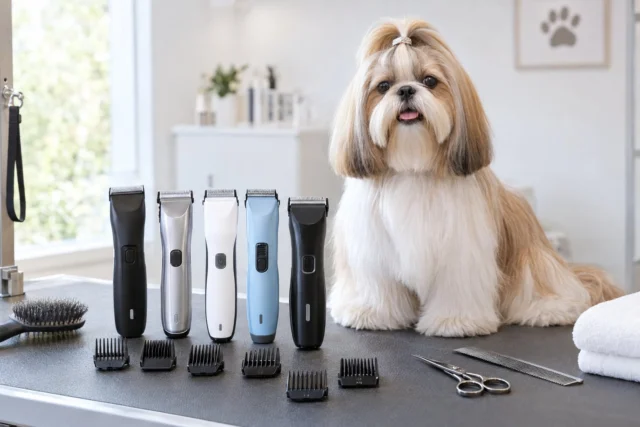
As an Amazon Associate I earn from qualifying purchases.
For a clean, well-brushed doodle coat, a #10 blade (about 1.5 mm / 1/16 inch) is the usual safe starting point. Most folks pair it with a guide comb for extra length.
A #30 blade (about 0.5 mm / 1/50 inch) only belongs under a comb attachment or in trained hands—never use it bare on the body.
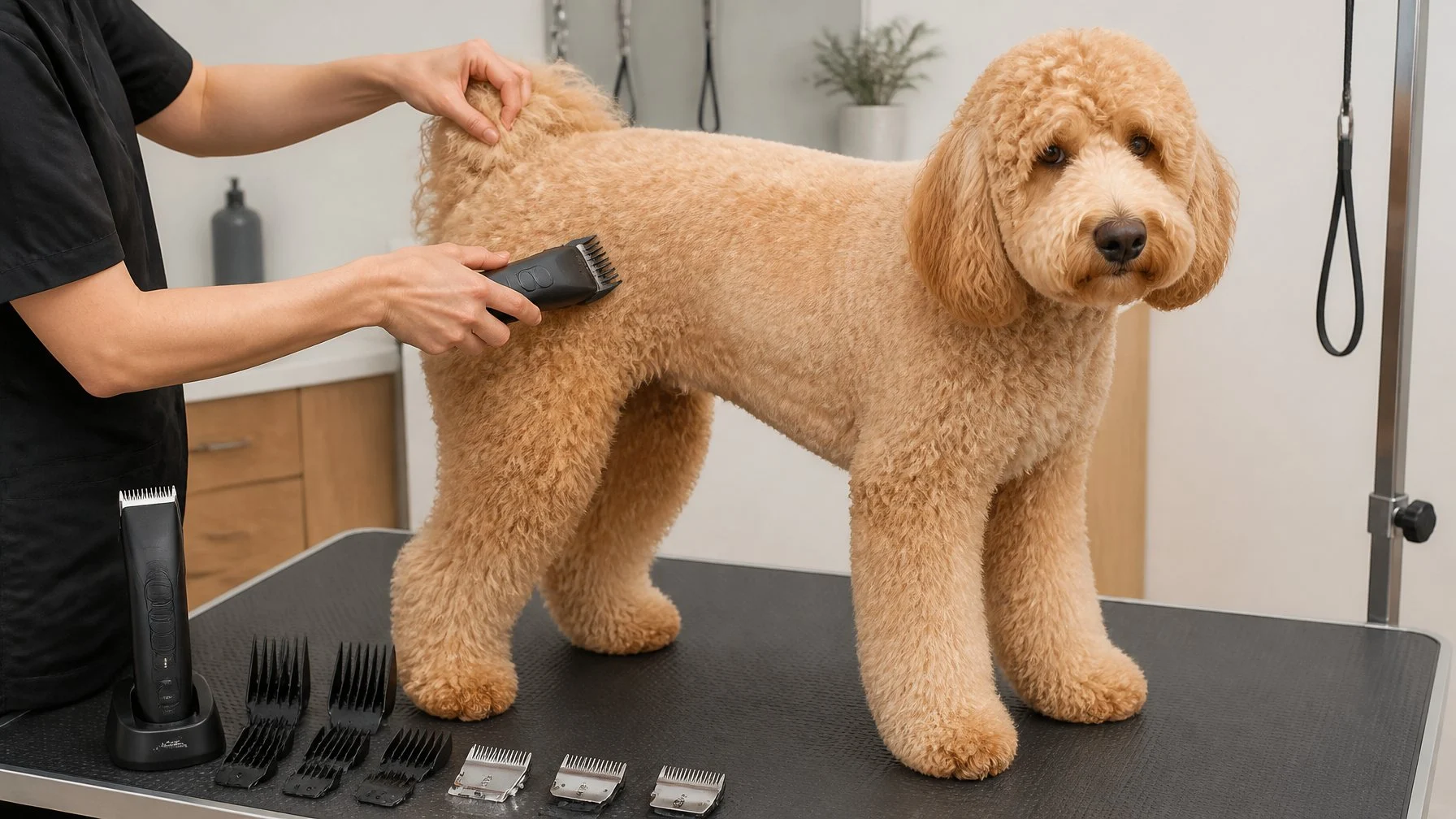
But the blade number isn’t the whole answer. Coat condition, matting, the finish you want, skin sensitivity, and the clipper system all change what’s actually safe on any given day.
Dog Fluffy has spent years helping owners of fluffy breeds groom calmly at home. The pattern is always the same: read the coat first, pick the blade second.
Start With the Coat Condition, Not the Blade Number
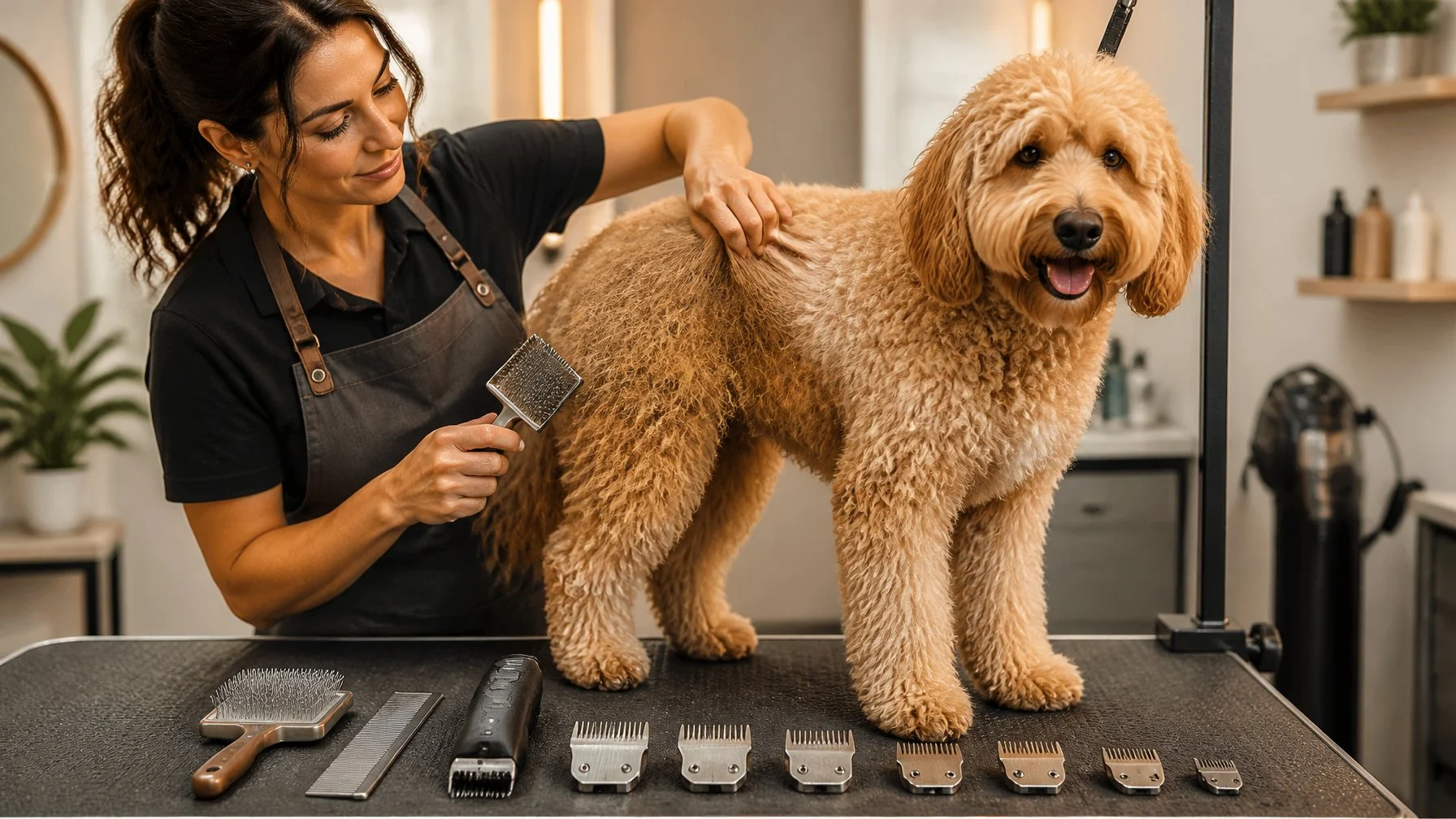
A Goldendoodle’s loose wave, a Labradoodle’s fleece, and a Bernedoodle’s heavy double-coat all take clippers differently. Clean, dry, fully brushed doodle fur lets a blade glide at its stated length.
Matted fur silently shortens every cut a blade makes. That’s just how it goes.
How Goldendoodle, Labradoodle, and Bernedoodle Coats Differ
Doodle coats aren’t just one thing. They’re usually in three camps, and each reacts differently under a blade.
- Wavy fleece (common in F1 Goldendoodles): softer, less dense, clips smoothly but shows blade tracks more easily.
- Tight curly coat (higher Poodle percentage): dense and springy, needs more torque, and a comb attachment often leaves the fluffiest finish.
- Heavy or double coat (some Bernedoodles and Labradoodles with Bernese or Lab influence): thicker at the root, holds moisture, and dulls blades faster.
Two dogs can share a breed label and still need totally different blades. Texture beats pedigree every time when picking a length.
Why Clean, Brushed Doodle Fur Clips More Evenly
A blade is meant for hair that stands up and separates. Dirt, oil, and tangles make curls lie flat and clump, so the blade skips, drags, and leaves uneven lines.
Bathing and drying first isn’t just a good idea—it’s the only way the blade length actually means anything.
- Wash and rinse thoroughly, then blow-dry while brushing.
- Line-brush from the skin outward, section by section.
- Run a metal comb through. If the comb snags, the coat isn’t ready.
Clipping a dirty coat will dull a blade in a single session.
What Mats Change About a Safe Clip
A mat is a knot of hair fused tight against the skin, pulling with every movement and trapping moisture underneath. That’s the definition that matters, because it explains why a long comb attachment can’t get under one.
Guide combs ride over the coat. If a mat sits below the comb’s cutting height, the comb catches and yanks.
The blade has to go shorter than the mat, not longer. For a pelted or heavily matted coat, that usually means a short blade close to the skin, done by someone who can feel where skin ends and mat begins.
Skin under mats is often thin, red, and already sore.
Match the Blade to the Job
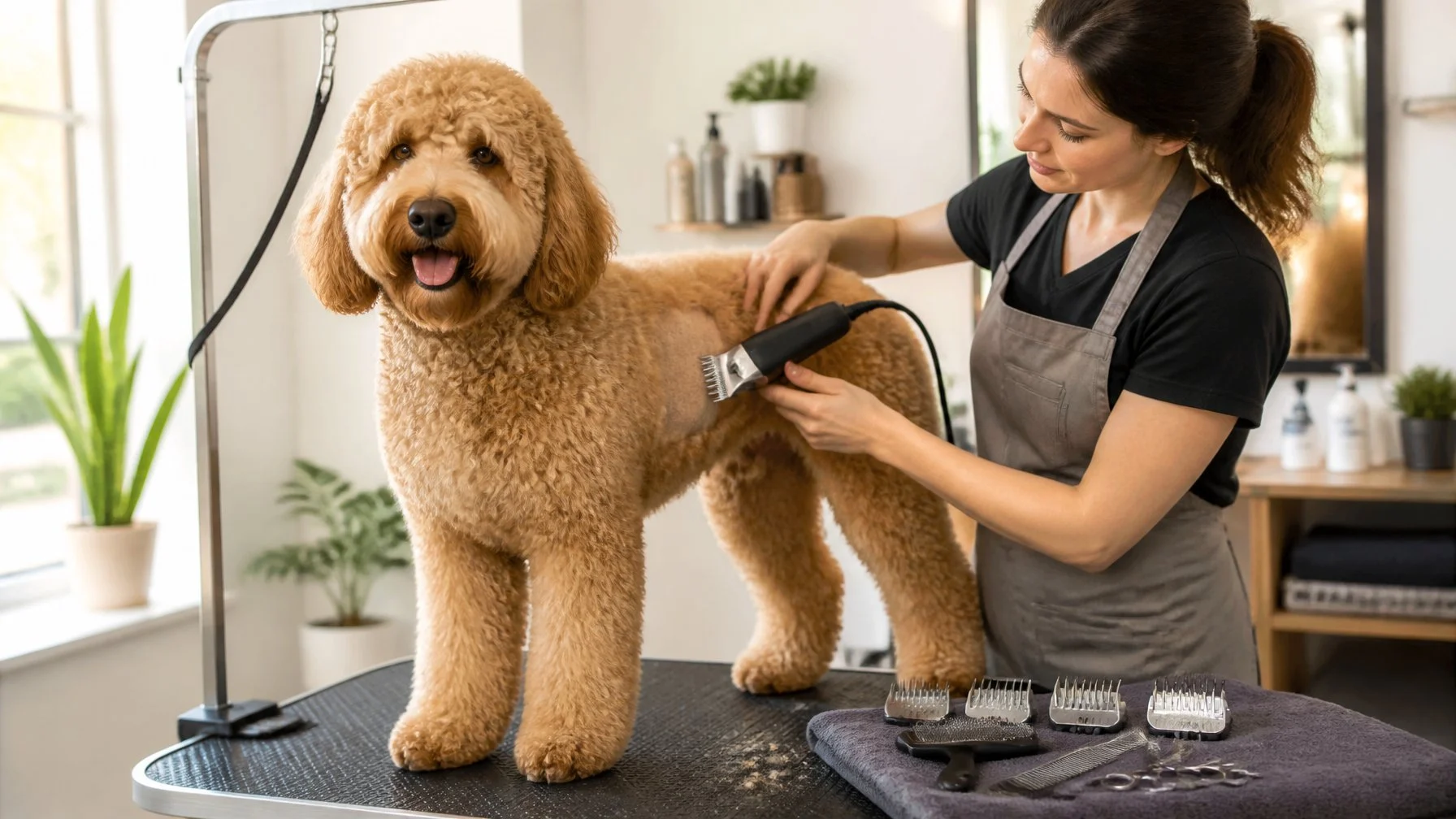
A #10 handles the body cleanly. A #30 works only under a comb or for trained trim work.
Faces, feet, and sanitary areas need a smaller detail trimmer instead of a full-size clipper. A 5-in-1 adjustable blade covers several lengths at once.
Body Clips and the Common #10 Starting Point
A #10 blade leaves about 1.5 mm (1/16 inch) of coat and is the default body length most home groomers start from. It’s forgiving, widely available, and fits every detachable-blade clipper.
Most owners don’t want a 1.5 mm buzz on the body, though. So the #10 gets paired with a guide comb for a longer, fluffier finish.
As noted in a dog grooming blade guide, higher numbers cut shorter: a #7F leaves around 3.2 mm and a #4F around 9.5 mm.
| Blade | Cut length | Typical use on a doodle |
|---|---|---|
| #4F | ~9.5 mm (3/8 in) | Longer body clip, wavy coats |
| #5F | ~6.3 mm (1/4 in) | Close but soft body finish |
| #7F | ~3.2 mm (1/8 in) | Short summer body clip |
| #10 | ~1.5 mm (1/16 in) | Body base, belly, sanitary |
| #30 | ~0.5 mm (1/50 in) | Under guide combs only |
Using a #30 Blade Safely Under Guide Combs
A #30 on bare skin is a shave. On a doodle body, that’s a burn and sunburn risk.
But under a metal or plastic guide comb, it becomes the cutting engine that gives a smooth, even fluff. A shorter blade under a comb produces a cleaner cut with fewer drag lines through a thick curly coat.
The comb sets the length; the blade just does the work.
- Metal guide combs snap on firmly and rarely flex. Better for dense coats.
- Plastic guide combs are lighter and cheaper but can pop off mid-stroke.
- Always check the comb is seated before switching the clipper on.
Face, Feet, and Sanitary Areas Need Their Own Approach
A full-size clipper near eyes and paw pads feels clumsy and loud. A small paw trimmer or detail trimmer handles these zones far more safely.
Feet get a #10 or a dedicated paw trimmer between the pads. Sanitary areas take a #10 with light pressure.
Faces are usually scissor work or a quiet trimmer—never a fast blade near the eyes.
How a 5-in-1 Blade Changes Cutting Length
A 5-in-1 adjustable blade shifts between roughly #9, #10, #15, #30, and #40 with a lever. No blade swapping needed.
Handy for home groomers who don’t want a drawer of fixed blades. The trade-off: 5-in-1 blades are narrower and generally cut slower through dense coat than a wide detachable #10.
They shine on feet, faces, and touch-ups, not full body clips on thick coats.
Choose Clippers That Can Handle the Coat
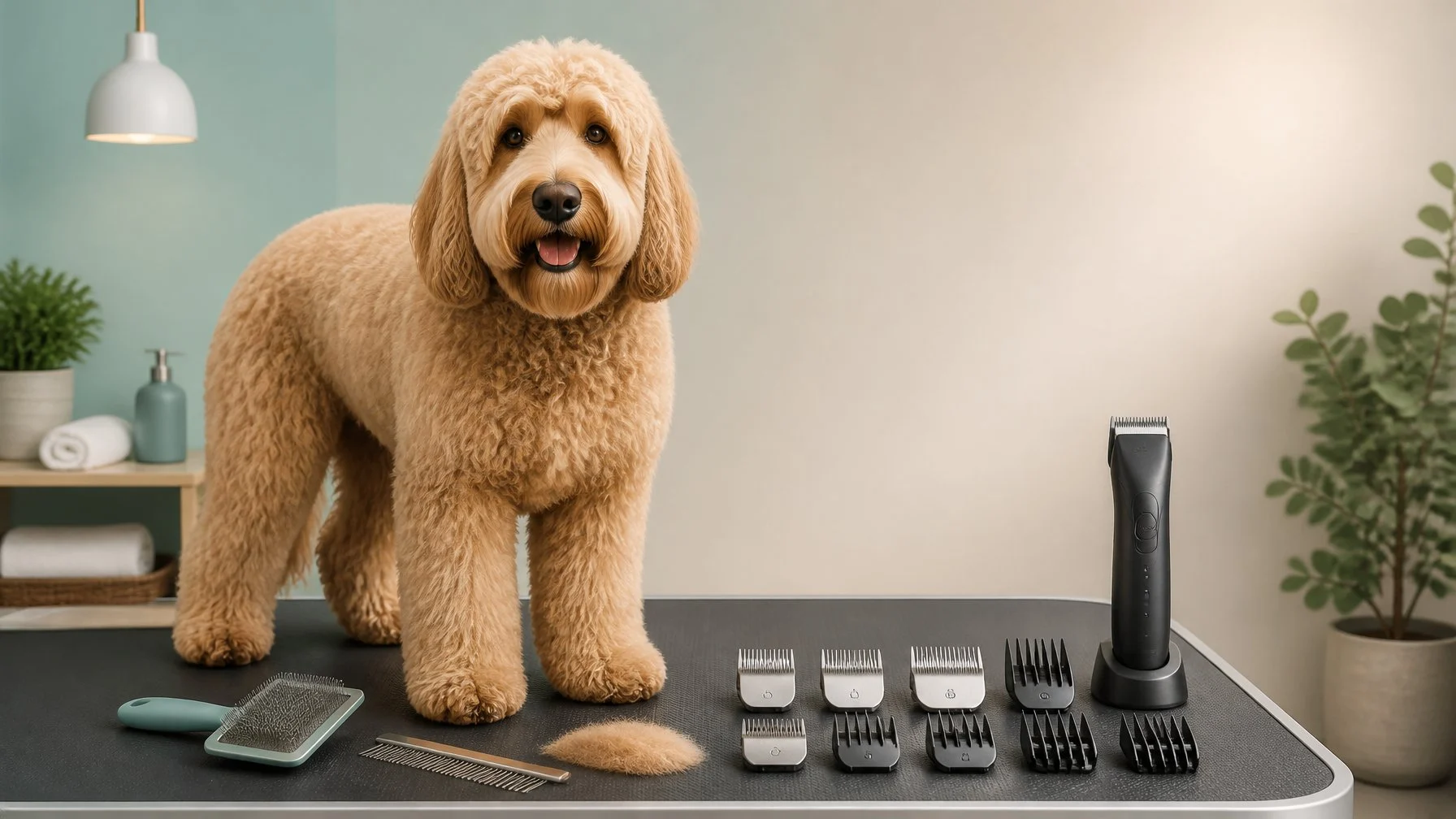
Cord versus battery affects session length. Motor torque matters more than the RPM number on the box.
Detachable blade systems open up every length a doodle coat might need. Noise level is its own separate problem for nervous dogs.
Corded Power Versus Cordless Flexibility
Corded clippers don’t fade halfway through a groom. For thick coats, that steady power really matters.
Cordless models move freely around a wriggly dog, which helps with anxious dogs who won’t stand still. Battery life is the catch: a lithium-ion battery around 2000 mAh might give you one full body clip, but dense coats drain it faster.
- Grooming one doodle occasionally? Corded is usually enough and costs less.
- Dog who paces or hates the cord? Cordless earns its price.
- Either way, keep a spare battery or a long, heavy-duty cord.
Motor Speed, Torque, and Why RPM Is Only Part of the Story
A 6500 rpm motor sounds impressive, but torque, not speed, is what pushes a blade through a thick curly coat without stalling.
A high-torque or brushless motor keeps the blade moving at full speed even when it hits a dense patch. A cheap rotary motor with a big RPM number on the label will bog down on the first thick shoulder.
Two-speed and multi-speed clippers help here. Lower speed for faces and sensitive spots, higher speed for body work.
Guides for doodle grooming clippers point out that single-speed clippers struggle on doodle coats for exactly this reason.
Detachable Blades Versus Built-In Blade Systems
Detachable blades clip on and off in seconds and are usually cross-compatible between major brands. That means one clipper body can run a #10, a #7F, a #4F, and a #30 as needed.
Built-in or fixed blades limit you to whatever combs came in the box. Fine for a light trim, frustrating for anything more.
For doodle coats, a detachable blade system is the more flexible long-term buy.
Quiet Tools for Anxious or Sensitive Dogs
Noise and vibration scare more dogs than the clipping itself. Sensitive dogs, and short-faced breeds like French Bulldogs who stress-pant heavily, often react to sound before the blade ever touches them.
Look for models rated around 50 dB or lower. Let the dog hear the clipper running across the room, then near the body, then on the body, over several short sessions.
Dog Fluffy leans hard on this approach: calm handling beats speed every single time.
Use the Right Blade Material and Keep It Cool
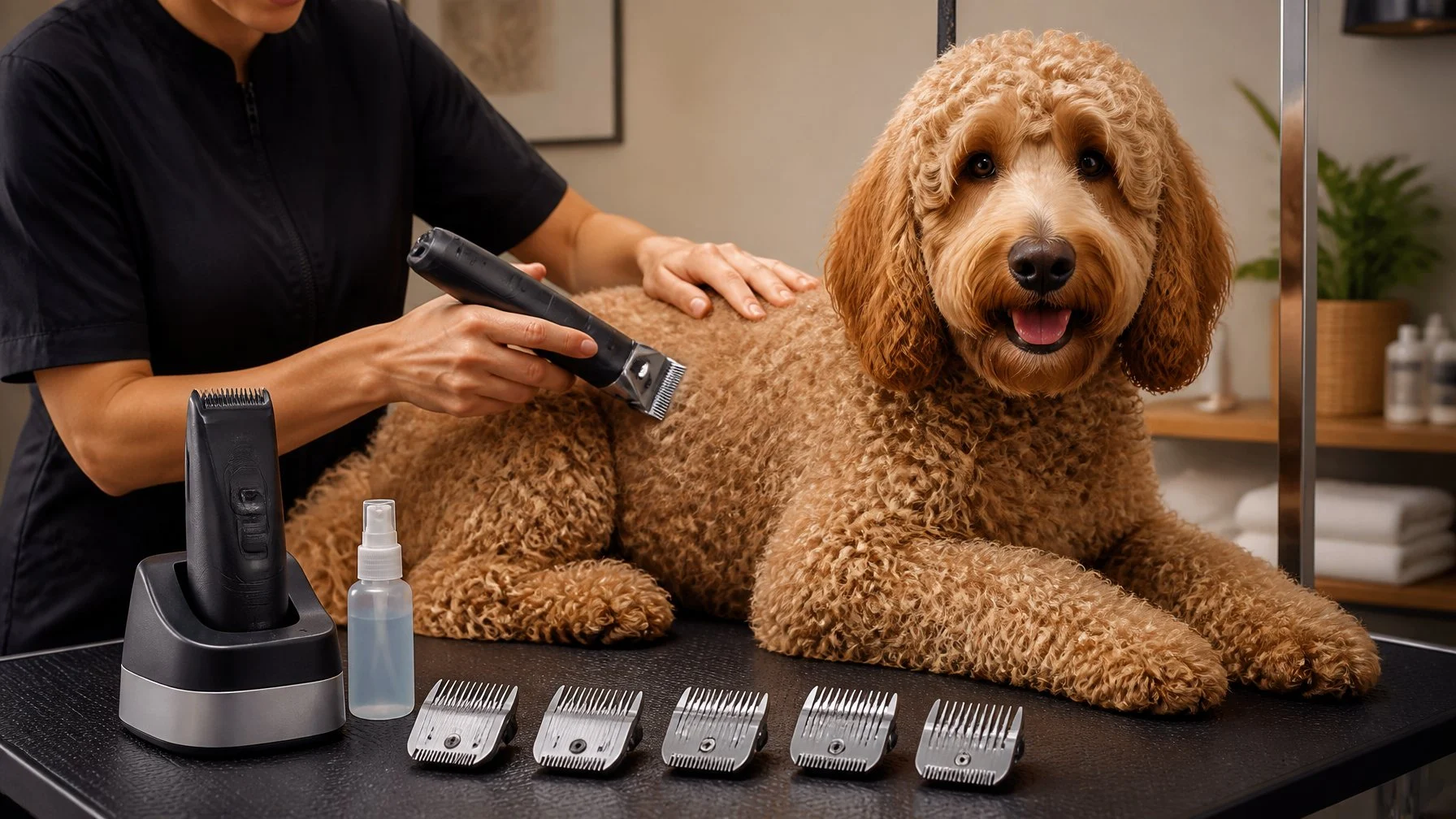
Ceramic blades usually run cooler than steel. Carbon steel holds an edge but heats up much faster.
Any blade left running through a thick coat can get hot enough to burn skin in seconds. A quick wrist test and a couple minutes spent oiling can stop most of those problems before they start.
Ceramic, Stainless Steel, and Carbon Steel Compared
Doodle hair is dense and insulating, so it traps heat around the blade way faster than most coats. One clipper comparison makes it pretty clear that blade material matters a lot here.
| Material | Heat | Edge life | Best for |
|---|---|---|---|
| Ceramic (CeramicEdge cutter) | Runs coolest | Holds edge well, chips if dropped | Long sessions, sensitive skin |
| Stainless steel | Moderate | Corrosion-resistant | General home use |
| Carbon steel | Heats fastest | Very sharp, needs oiling | Short precise work |
For a dog with sensitive skin, ceramic is the safer default.
How to Check Blade Heat Before It Irritates Skin
If the blade feels uncomfortable against your wrist, it’s too hot for a dog’s belly. Seriously, it’s that simple.
- Stop every 60 to 90 seconds during body work.
- Press the blade lightly against the inside of your wrist for two seconds.
- If it feels warm but tolerable, keep going.
- If it stings, swap to a second cool blade or set it on a metal tray to cool.
- Use coolant spray between sections on thick or heavy coats.
Clipper burn shows up as a red, irritated stripe hours later. By then, the damage is done and there’s no going back.
Cleaning, Oiling, and Replacing Worn Blades
A dull blade pulls hair instead of cutting it. That’s what makes dogs flinch and start hating grooming time.
- Brush hair out of the teeth after every section.
- Add 2 to 3 drops of clipper oil along the blade every 10 minutes of use.
- Wipe off excess so it doesn’t coat the fur.
- Replace or sharpen when the blade snags on clean, brushed coat.
A sharp blade at the right length is safer than a dull blade at a longer one.
A Calm, Safer Home Grooming Routine
Prep does more for the final result than any blade choice. Direction of clipping controls whether tracks show.
Certain coat conditions mean the clippers should go back in the drawer. Between full grooms, a few small tools keep the coat clipper-ready.
The Prep Steps Before Clippers Touch the Coat
Set up before the dog gets on the table. Rushing is exactly how nicks and slips happen.
- Brush and comb the whole coat until a metal comb passes cleanly from skin to tip.
- Bathe, rinse fully, and blow-dry while brushing.
- Comb again—drying always seems to reveal tangles that hid when wet.
- Lay out blades, guide combs, oil, coolant spray, and treats within reach.
- Check the blade is seated and the clipper runs smoothly before it touches the dog.
Ninety percent of a good home groom happens before the clipper switches on.
How to Clip With the Coat Without Leaving Tracks
Clip in the direction the hair grows. Going against it cuts way shorter than the blade number suggests and leaves visible lines, especially on curly coats.
Use long, steady strokes and don’t press down too hard. Overlap each pass by about a third so you don’t end up with ridges between rows.
- Start at the neck and work down the back.
- Move to the sides, then the chest.
- Save the belly and sanitary area for last, with the shortest safe blade.
- Keep the skin flat with your free hand, especially at armpits and hocks.
When Home Grooming Should Stop and a Professional Should Take Over
Some situations aren’t about skill. They’re about safety—full stop.
Book a groomer or vet if you run into any of these:
- Mats that don’t lift off the skin with a comb, or a pelted coat.
- Red, broken, scabbed, or hot skin under the coat.
- A dog who freezes, growls, snaps, or panics at the clipper.
- Lumps, ticks, or wounds discovered during brushing.
- Any need for a full shave-down on a matted coat.
A shave-down on pelted fur is a professional job, full stop. Skin underneath is often fragile and easy to cut.
Tools That Help Between Full Clips
Doodle coats look best when they’re groomed every 7 to 10 weeks. The weeks in between decide how easy that next groom is.
A basic dog grooming kit for home use covers most of it:
- Slicker brush plus a wide-tooth metal comb for line brushing.
- Detangler spray for dry, static-prone curls.
- Nail grinder for quiet, gradual nail work.
- Paw trimmer for between-pad hair.
- Vacuum grooming attachment if hair everywhere is the problem.
Waterproof ratings matter for anything you use near a bath. IPX6 handles heavy splashes. IPX7 tolerates short submersion, which makes rinsing way easier.
Plenty of owners get on well with detachable-blade systems from brands like Wahl, Andis, and Oster. Cordless options such as the Wahl Lithium Ion Pro or Andis Excel 5-Speed are popular too. These are just neutral examples of compatible systems, not endorsements. Dog Fluffy is an Amazon Associate and earns from qualifying purchases.
From Fluffy’s Bowl
From Fluffy’s Bowl: agree the length with the groomer before the clippers come out, in numbers rather than adjectives. “A bit shorter” means nothing across a counter. A blade number and a guard comb size mean the same thing to both of you, and it is the only version of that conversation you can hold them to.
Tools That Match The Advice Above
A doodle coat asks more of a clipper than a short coat does. These are the pieces this article keeps pointing at.
Andis UltraEdge #10 Blade (64071)
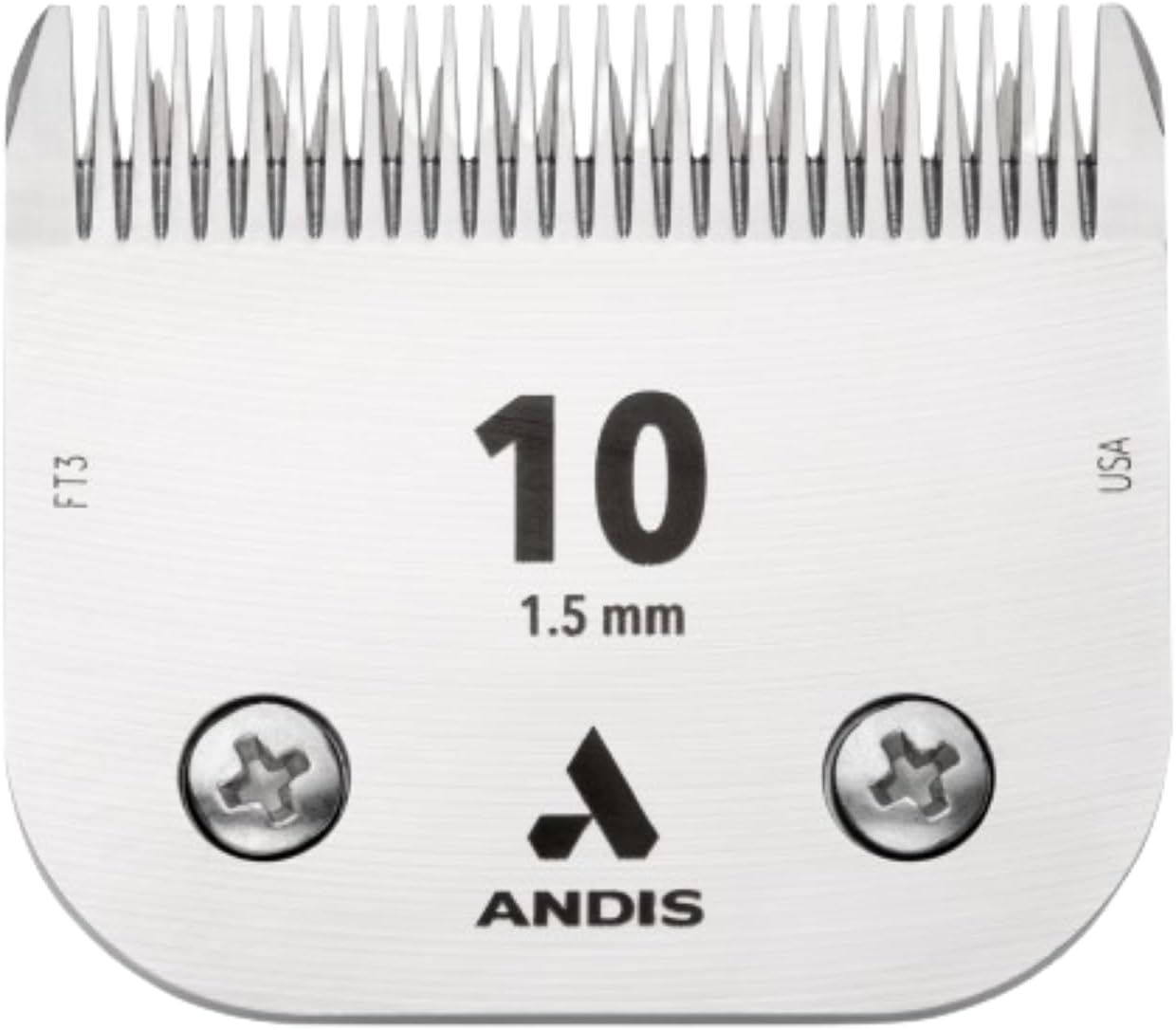
The starting point named earlier in this article, at about 1.5 mm. Check price on Amazon
| Things We Like | Things We Don’t Like |
|---|---|
| The common #10 body-clip starting point discussed above | On its own it is very short for a full doodle body clip |
| Fits the detachable-blade clippers below | Best used under a guide comb for a longer finish |
| Widely stocked, so replacements are easy to find | Needs oiling and heat checks like any steel blade |
Andis 24675 UltraEdge 2-Speed Clipper (corded)
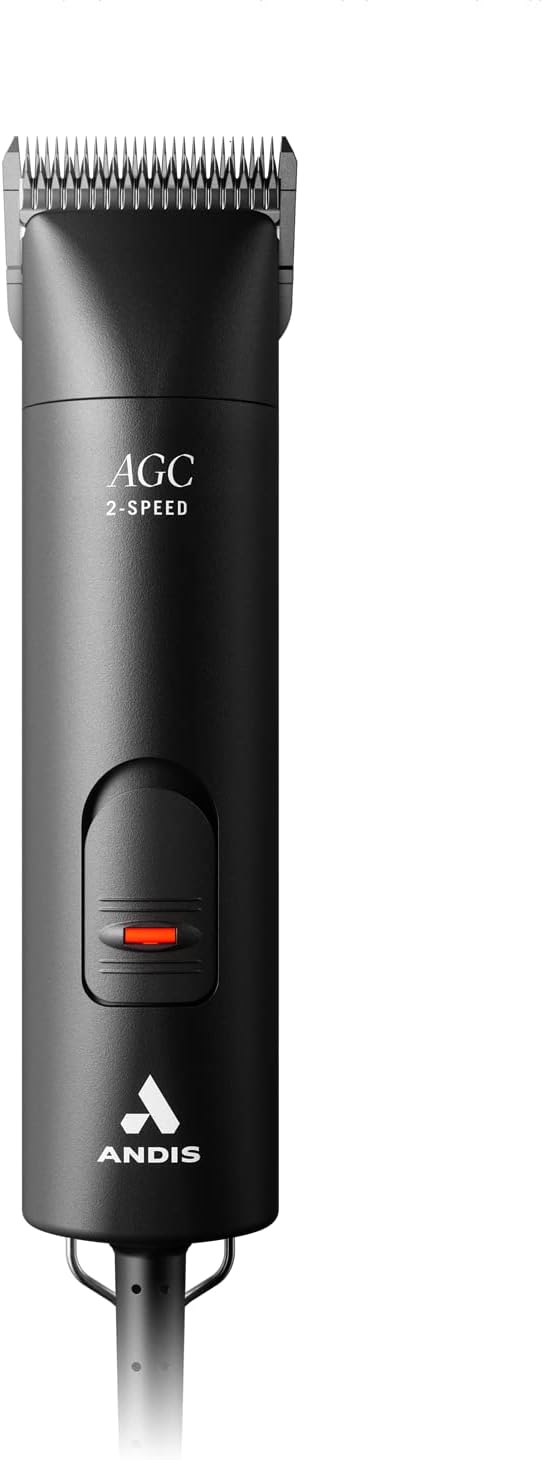
A two-speed rotary clipper for the heavier work described above. Check price on Amazon
| Things We Like | Things We Don’t Like |
|---|---|
| Constant output that does not fade partway through a groom | 120V — outside North America this needs the local-voltage version |
| Two speeds for bulk work and detail | The cord is one more thing to manage around a moving dog |
| Takes the same detachable UltraEdge blades | Heavier in the hand than a cordless over a long session |
Andis 560486 eMERGE Detachable-Blade Clipper (cord or cordless)
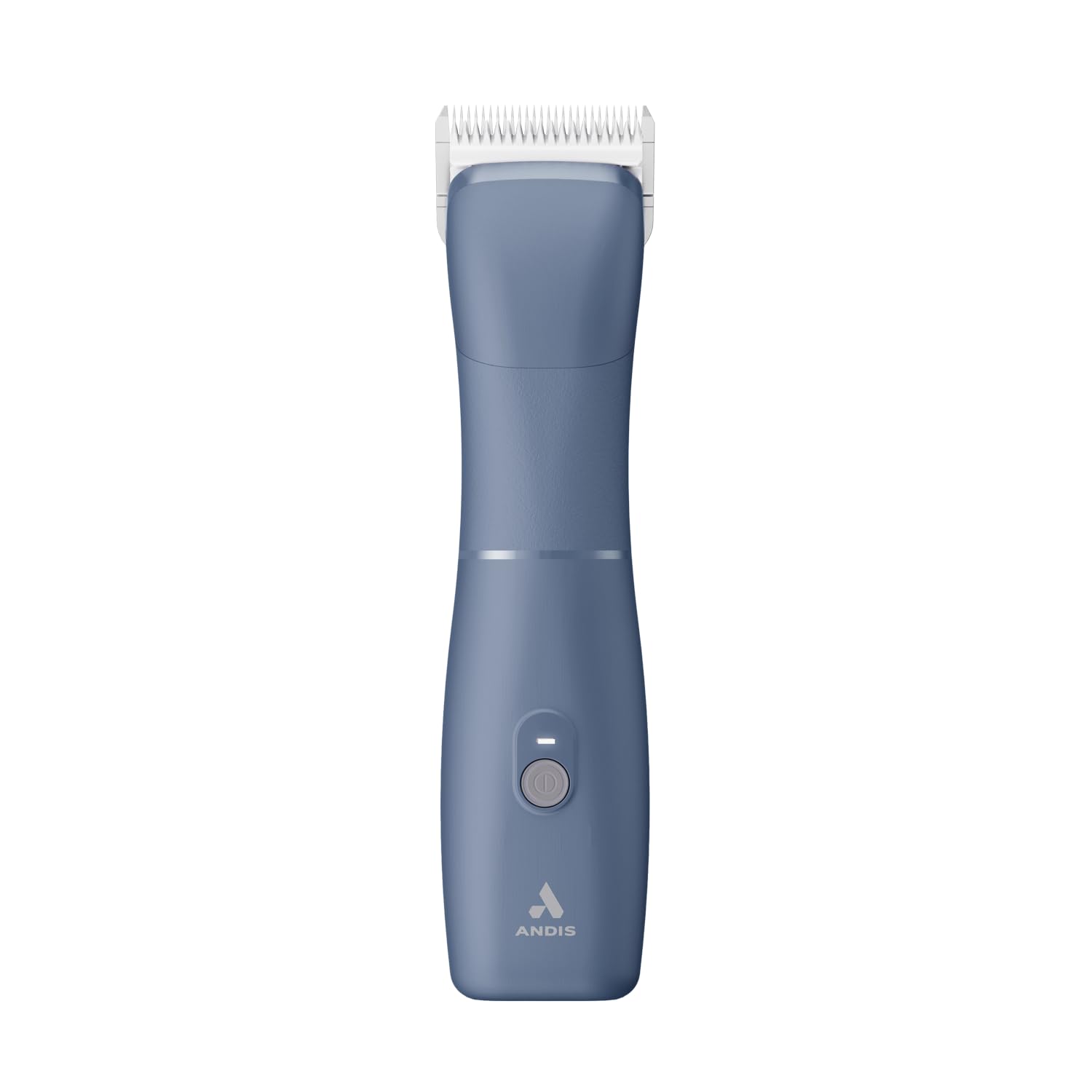
The same detachable-blade system, but it runs either way. Check price on Amazon
| Things We Like | Things We Don’t Like |
|---|---|
| Runs corded or cordless, so the choice above can be deferred | Much smaller review history than the corded model |
| Takes the same blades as the corded clipper | Battery packs lose capacity over the years |
| Smaller profile for face, feet and sanitary work | Costs more than a corded-only clipper |
Frequently Asked Questions
What clipper blade length works well for a Goldendoodle’s body coat?
A #10 blade at about 1.5 mm (1/16 inch) is a safe base, but most owners want a bit more length. Pairing a #30 or #10 with a guide comb around 10 to 20 mm (3/8 to 3/4 inch) gives a soft, fluffy body finish. A #5F at roughly 6.3 mm (1/4 inch) is a good middle ground for shorter summer clips.
Should a doodle’s face, feet, and sanitary areas use a shorter blade?
Yes for feet and sanitary areas, but not usually for the face. A #10 works well on paw pads, the belly, and around the sanitary area because it’s clean and quick. For faces, blunt-tipped scissors or a small, quiet detail trimmer are safer. Fast blades near eyes, ears, and lips just aren’t worth the risk.
Is a #7 or #10 blade shorter for grooming a doodle?
A #10 is shorter. Higher blade numbers cut closer, so a #10 leaves about 1.5 mm (1/16 inch) while a #7F leaves around 3.2 mm (1/8 inch). That’s roughly double the length. For a doodle body clip that still looks fluffy, the #7F is the gentler of the two options.
What guard comb length should be used for a fluffy doodle haircut?
Most fluffy doodle trims land between 13 mm and 25 mm (1/2 to 1 inch). A 19 mm (3/4 inch) comb is a popular all-round choice on a clean, brushed coat. Metal combs hold their shape better than plastic on dense curls. Always test a small area first before clipping the whole body.
Can a clipper blade safely go through a matted doodle coat?
Not with a long blade or guide comb. Combs ride over the coat and snag on mats, pulling the skin. Mats need a short blade worked underneath them, close to skin that’s often already sore. Heavily matted or pelted coats really belong with a professional groomer who can check the skin first.
How can someone choose a blade length based on a doodle’s coat condition and desired cut?
Let’s start with coat condition. If your doodle’s clean and fully brushed, you can use pretty much any blade length. If the coat’s a bit tangled, it’s better to go shorter than you planned. For mats, honestly, just stop and call a pro groomer. After that, pick your length for the finish you want. Want a fluffy look? Try a 19 mm (3/4 inch) comb. For a tidy vibe, the #5F blade is solid. If you’re after a short summer cut, reach for the #7F. Use a #10 for bellies and sanitary areas—don’t mess around there. What blade length actually works best on your doodle’s coat? Drop your answer in the comments so others can see what’s working in real life. This is general guidance, not veterinary advice—definitely check with your vet for your own dog’s situation.