Most brushing problems are the wrong tool, not laziness. A slicker brush on a short coat scratches the skin. A bristle brush on a Chow Chow does nothing at all — it slides over the top while the undercoat felts underneath. Here is what each brush actually does, and which coat it belongs on.
The Five That Matter
Pet shops sell a dozen variations. Almost every dog is fully covered by five tools, and most owners need two or three of them.
1. Slicker Brush
What it is: a flat or slightly curved pad of fine, angled wire pins.
What it does: works through the coat and lifts out loose hair and small tangles. The workhorse for anything long, curly or fluffy.
Best for: Poodles, Shih Tzus, Doodles, Bichons, and the feathering on Golden Retrievers and Spaniels.
Where it goes wrong: pressing too hard. Those pins are fine wire and they will scrape the skin — “slicker burn” is a real and avoidable injury. Let the weight of the brush do the work, and if the pins are leaving pink lines, you are pushing. Avoid bony areas like the hocks and the face.
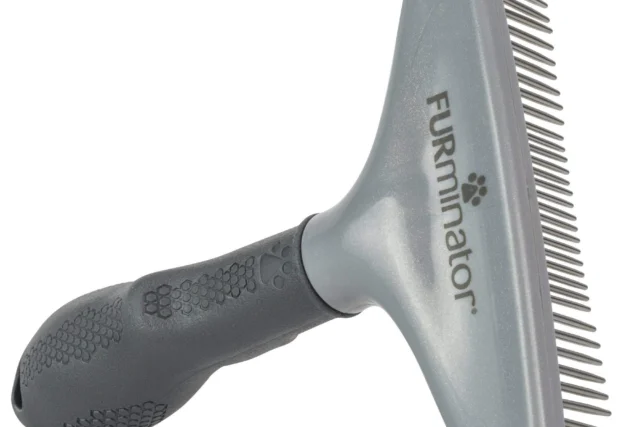
2. Undercoat Rake
What it is: a single or double row of long, widely spaced rounded teeth.
What it does: reaches past the guard coat and pulls dead undercoat out from underneath. Nothing else does this job properly.
Best for: every double-coated breed — Husky, Malamute, Samoyed, German Shepherd, Chow Chow, Pomeranian, Corgi, Golden Retriever.
Where it goes wrong: using it on a single-coated dog, where there is no undercoat to remove and the teeth just drag. Choose a tooth length that matches coat depth — long teeth on a short coat reach skin.
This is the tool that replaces the urge to shave. Clearing the dead layer is what restores airflow; clipping the guard coat off does the opposite.
3. Steel Comb
What it is: a metal comb, usually with fine teeth at one end and coarse at the other.
What it does: tells you the truth. A brush glides over a mat; a comb stops dead at it.
Best for: every long-coated dog, as the finishing check after brushing — and around the face, ears, armpits and behind the legs, where mats start.
The rule groomers use: you have not finished brushing until a comb passes cleanly from skin to tip. If you own one tool alongside your brush, make it this. It is also the cheapest, which is a pleasant change.
4. Pin Brush
What it is: widely spaced straight pins, usually with rounded tips, on a cushioned base.
What it does: smooths and separates long, silky coat without breaking it. Gentler than a slicker and far less effective on tangles.
Best for: long flowing coats kept in full length — a show-coat Shih Tzu, Maltese, Yorkshire Terrier, Afghan Hound.
Where it goes wrong: being mistaken for a general-purpose brush. On a matted or curly coat it skims the surface and leaves the real problem untouched.
5. Rubber Curry or Grooming Mitt
What it is: a rubber pad or glove with soft nubs.
What it does: lifts loose hair from short coats and massages the skin, which spreads natural oils. Also excellent for working shampoo in during a bath.
Best for: Labradors, Beagles, Boxers, French Bulldogs, Dachshunds — and for nervous dogs of any coat type, because it feels like being stroked.
What to Buy for Your Dog
- Double coat — undercoat rake + slicker. Add a steel comb for the feathering.
- Long or curly single coat — slicker + steel comb. That pair covers everything.
- Short smooth coat — rubber curry. That is genuinely all.
- Wire coat — slicker + steel comb, plus a stripping knife if you hand-strip.
- Silky show coat — pin brush + steel comb.
Buy the comb even if you buy nothing else. It is the only tool that tells you whether the rest of the job worked.
If you would rather buy the set in one go than assemble it piece by piece, the dog grooming kits guide covers what a decent kit should contain and what the cheap ones leave out. For a double-coated breed specifically, read why shaving a double coat backfires before you buy anything with a blade on it.
Two Tools to Think Twice About
De-shedding blades — the ones with a fine toothed metal edge. They remove impressive quantities of hair because they are cutting some of it, including guard hairs. Used weekly on a double coat they thin and damage the top layer over time. An undercoat rake achieves the same result without cutting.
Mat splitters and dematting rakes — hooked blades that cut through a mat. They work, and they sit very close to skin that is already being pulled tight by the mat. If a mat does not come out with fingers, conditioner and patience in a few minutes, it is a job for clippers or a groomer. A cut from a dematting tool is one of the more common home-grooming injuries.
Technique Beats Equipment
The best brush used badly loses to a cheap one used well.
- Line brush. Part the coat, brush the exposed layer from the skin outward, move up a centimetre, repeat. Brushing across the top of a long coat leaves the underneath untouched — which is exactly where mats form.
- Never brush a dry matted coat. A little conditioner or detangling spray reduces breakage and hurts far less.
- Work in short sessions. Ten calm minutes daily beats an hour of a dog trying to escape once a week.
- Finish with the comb. Every time. It is the only honest audit of the work.
If your dog flinches, snaps or hides when you reach for a brush, stop and check the skin before assuming it is behaviour. Pain from a mat, a hot spot or an ear infection is a common and easily missed cause — and worth a vet’s look.