As an Amazon Associate I earn from qualifying purchases.
Detangling spray for matted dog fur coats each hair with slip, so a comb slides through instead of ripping. Spray the dry mat, wait a few minutes, then use your fingers and a wide-tooth comb to tease it apart from the tips inward. Never cut at the base.
Before anything else, one safety rule matters more than technique: mats hide skin, and skin under a mat is often red, damp, or already broken. Scissors and clippers near a mat base have caused more emergency vet visits than most owners realise, because a dog’s skin lifts right into the knot.
Dog Fluffy’s grooming guidance takes the slower route: check first, spray second, comb last, and know exactly when to stop.
Check the Mat Before Brushing
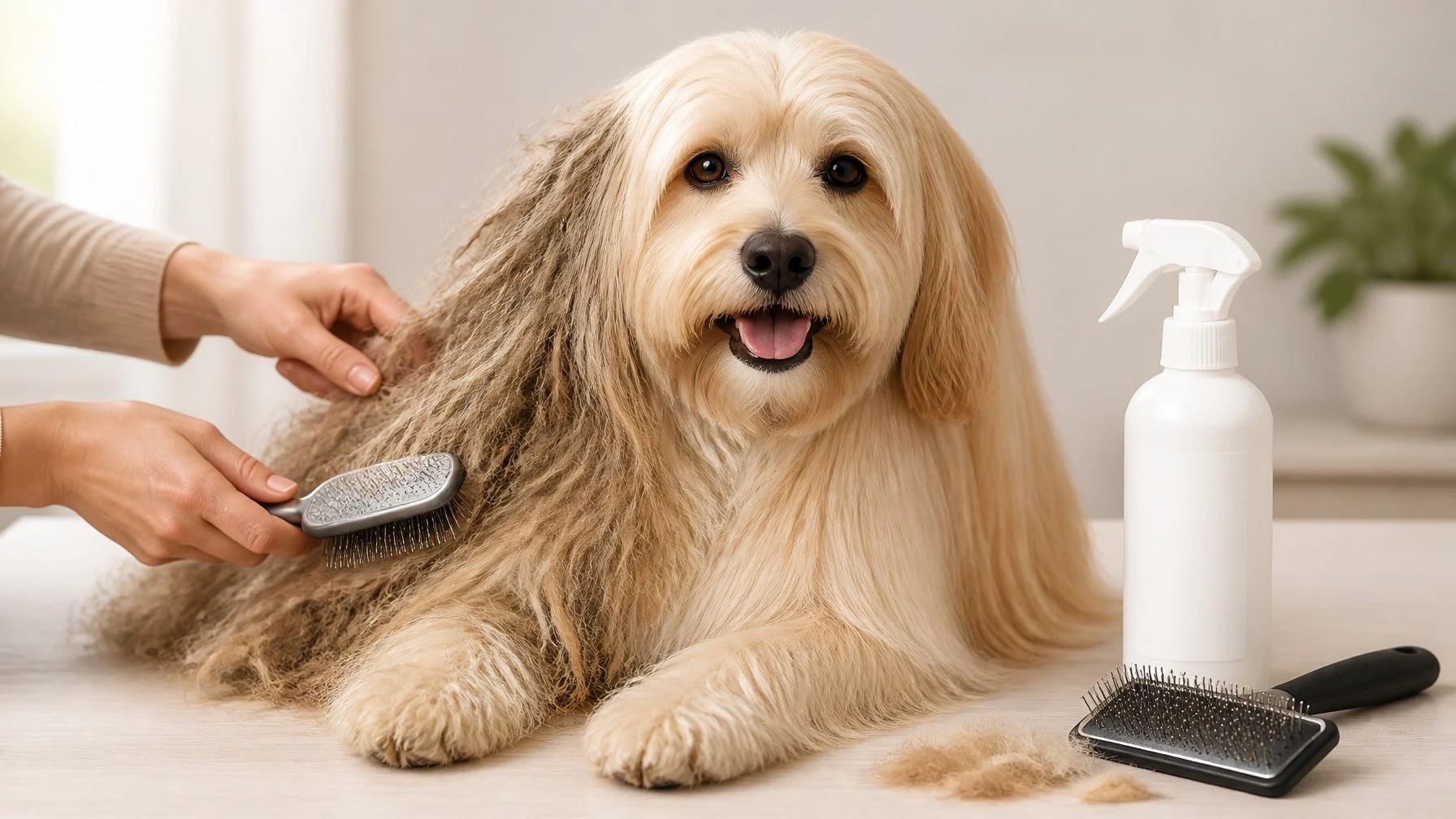
If a mat pulls the skin into a tent shape, that’s a vet or groomer job, not something to handle at home. Tight mats trap moisture and bacteria against the skin. They cluster in high-friction spots like armpits and ear bases. Even short-coated breeds like French Bulldogs get them where harnesses rub.
Why Tight Mats Can Hurt Skin
A mat is a clump of dead and living hair twisted into a dense knot that pulls on the skin and traps moisture underneath. That trapped damp is the real problem. Warm, dark, airless skin is where hot spots and yeast love to set up shop.
Do a quick check before touching a comb:
- Can two fingers slide flat between the mat and the skin? Good sign.
- Does the skin lift with the mat when you tug gently? Stop.
- Is the skin under it pink, weeping, smelly, or hot? Stop, and call the vet.
- Does the dog flinch, freeze, or turn their head toward your hand? Stop.
Dematting spray for dogs helps with the first case only. It softens fibres and adds slip. It does nothing for infected skin, and soaking an inflamed patch just makes it wetter.
The Stop Rule for Armpits, Ear Bases, and Joints
Some spots earn an automatic no. Skin over the armpits, groin, ear bases, and the front of the hock is thin, loose, and moves with the dog. It slides into a mat more easily than skin over the ribs.
The rule Dog Fluffy sticks to: if a mat sits in one of those four zones and doesn’t lift freely from the skin after five minutes of spray and finger work, it’s time for a professional. Same if it’s larger than a 2 cm (about ¾ inch) disc, or if a mat has felted flat against the body like a mattress.
Household scissors are the single most dangerous tool in this scenario. Dog skin is elastic and pulls up into the knot without warning. Grooming guides on safe at-home dematting are blunt about the laceration risk.
French Bulldog Coat and Skin Considerations
Short coats mat too, just differently. French Bulldogs shed dense undercoat hair that gets held in place by harness straps, collar edges, and the tail pocket, forming small gritty pads instead of long ropes.
Three spots deserve a weekly check on a Frenchie:
- Under the harness chest strap, where sweat and loose hair compact
- Inside skin folds and the tail pocket, which stay damp and are prone to soreness
- Behind and under the ears, where scratching tangles the short hair into knots
For dogs with sensitive skin, a hypoallergenic formula with aloe vera or chamomile extract is the sensible pick over a heavily perfumed mist. Frenchies with a history of hot spots or skin allergies do better with fragrance-free products. Anything that stings a raw patch will make grooming a fight for months afterward.
How to Loosen a Small Mat Without Pulling
The whole job comes down to three things: a dry coat and the right comb, spray plus patience, and knowing the exact moment to put the tools down.
Set Up the Coat and Tools
Work on a completely dry coat. Water shrinks and tightens a mat like a wool jumper in a hot wash. That’s why grooming guidance on detangling matted fur at home puts spray-then-wait before any bath.
What’s actually needed:
- A wide-tooth comb for finding and easing mats apart
- A slicker brush for smoothing loose hair afterward
- A dog detangling spray or leave-in conditioner for dogs
- Treats, and a non-slip surface at a comfortable height
Skip the mat splitter unless someone has shown you how to hold it. And skip scissors entirely.
Spray, Separate, and Comb From the Ends
Here’s the sequence that keeps the dog comfortable:
- Part the coat around the mat and check the skin underneath before spraying anything.
- Mist the mat directly with a dog grooming mist until it’s damp, not soaked. Add a little to the hair around it too.
- Wait 5 to 10 minutes. Most people skip this, but it’s the step that does the work.
- Hold the hair at the base, between the mat and the skin, so every tug pulls against your fingers instead of the dog.
- Use your fingers to split the mat into two or three smaller sections. Pick at the edges, don’t yank.
- Comb the outer tips first with the wide-tooth comb, then work up toward the base a few millimetres at a time.
- Re-spray if the comb starts to drag. More slip, less force.
- Finish with a slicker brush over the whole area and a treat, even if the mat isn’t fully gone.
Keep sessions to 5 or 10 minutes. Two short sessions beat one long one that ends with a stressed dog.
When to Pause and Book Professional Help
Stop the moment the dog vocalises, snaps, or the skin reddens. A mat is never worth the trust cost of pushing through pain.
Call a groomer or vet if:
- The mat covers a patch wider than about 5 cm (2 inches)
- The coat has felted into a solid sheet across the back or flanks
- There’s a smell, discharge, or visible sore
- The dog has multiple mats in different zones
- Two short sessions have made no progress
Professionals can clip safely under the mat with proper blades and a steady hand. Sometimes a short clip is the kindest option, even if nobody loves the haircut.
Choose a Spray That Fits Your Dog’s Coat
Three Sprays That Do The Job
The sections above describe what to look for. These are three that fit those descriptions — one for routine brushing, one for a dog whose skin is already unhappy, and one for knots that have gone past the everyday stage.
TropiClean Detangler Spray — the everyday one
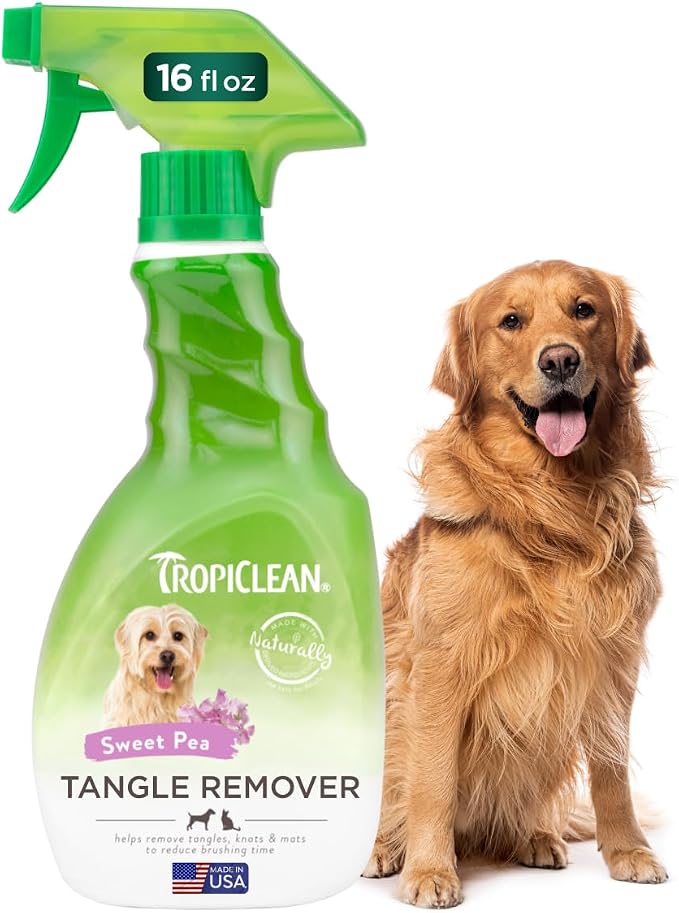
The one to keep by the brush rather than reach for in a crisis. It softens tangles enough that a comb passes without dragging, which is the whole point of maintenance spray: you are trying to stop mats forming, not rescue one that already has.
| Things We Like | Things We Don’t Like |
|---|---|
| 16 oz, ready to use, no mixing | Scented — fine for most dogs, not for an itchy one |
| Light enough for daily use without building up | Not strong enough for a mat that has already tightened |
| Widely stocked, so replacing it is easy | Sprayer can clog if the coat is heavily soiled |
Use it on a dry coat before you brush, not after. Spraying a coat you have already dragged a brush through is treating the symptom too late.
Pure Fur! Sensitive Skin Conditioning Spray — for an itchy dog
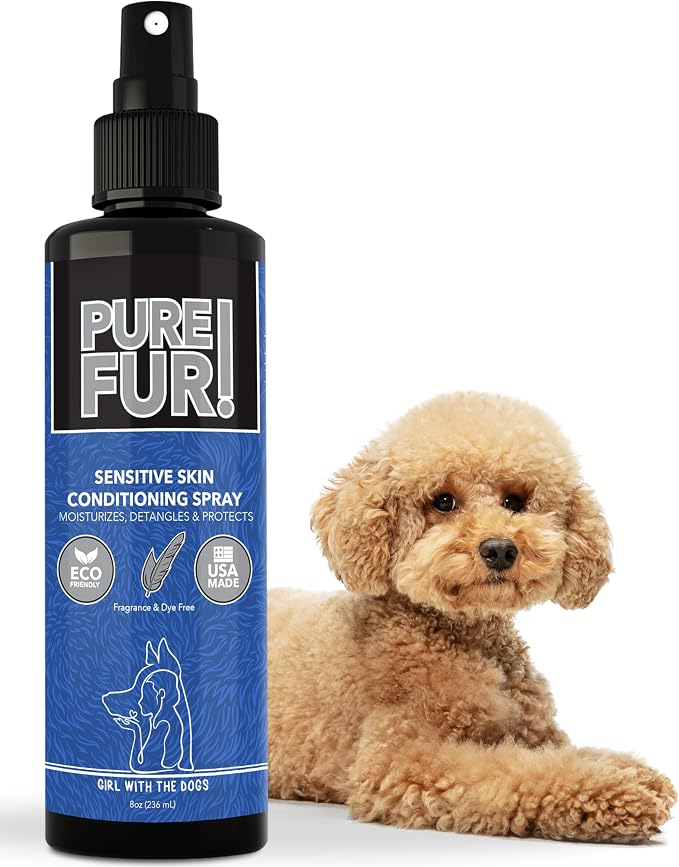
If the section above about sensitive skin describes your dog, this is the one. No sulfates or dyes, shea butter for the dryness that often sits underneath the matting, and rated safe from eight weeks — which matters, because puppy skin is where people reach for adult products.
| Things We Like | Things We Don’t Like |
|---|---|
| No sulfates or dyes, formulated for reactive skin | Heavier feel than a plain detangler |
| Safe from 8 weeks, so it covers a puppy | Smaller bottle than the everyday options |
| Shea butter treats the dryness that causes the tangling | Less slip than a dedicated dematting formula |
A note that matters more than the product: heavily fragranced sprays are a poor choice for a dog that is already scratching, however gentle the label sounds. Fragrance is a common irritant, and “hypoallergenic” on a bottle does not mean unscented.
The Stuff Leave-in Conditioner — for knots past the everyday stage
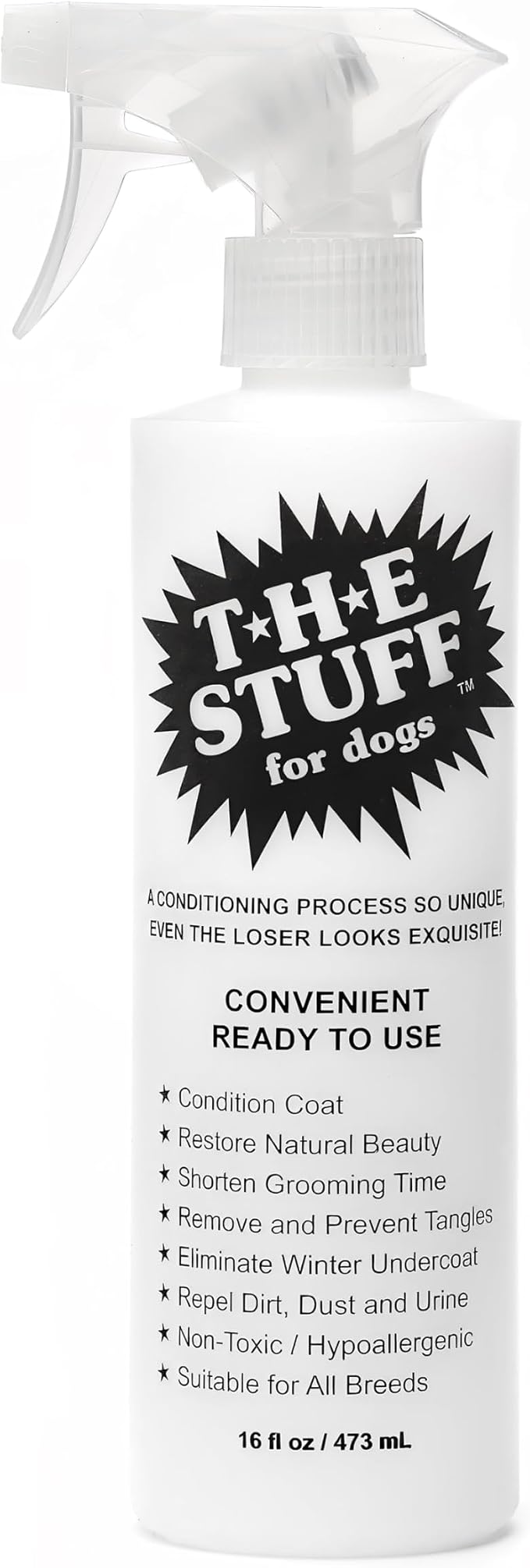
A heavier dematting formula for the knot you can already feel through the coat. It breaks the mat down enough to work from the ends inward, which is the technique described earlier on this page — the product does not replace the method, it just buys you slip while you use it.
| Things We Like | Things We Don’t Like |
|---|---|
| Dematting-strength formula, not just a finishing spray | Too heavy for daily use on a fine coat |
| 16 oz ready to use, no dilution step | Scented |
| Leaves the coat conditioned rather than sticky | Will not save a mat that is tight to the skin — nothing will |
If it does not shift after two patient attempts, stop. That is the stop rule set out above, and the answer at that point is a groomer with clippers rather than more spray.
Slip agents matter more than scent. Sensitive skin needs a shorter ingredient list. A light daily mist does a different job than a heavy dematting formula. Prevention beats all of it.
Dog Fluffy is an Amazon Associate and may earn a commission from qualifying purchases; nothing here is recommended that wouldn’t be used on Fluffy.
Ingredients That Add Slip Without a Heavy Feel
Slip is the whole point. A good detangling spray for dogs coats the hair shaft so teeth glide instead of catching. That’s why conditioning oils and silk proteins show up on so many labels.
Useful ingredients to look for:
| Ingredient | What it does |
|---|---|
| Coconut oil | Softens and adds slip to coarse coats |
| Shea butter | Conditions dry, brittle ends |
| Avocado oil | Light hydration, popular in gentle formulas |
| Lemon and linseed oil | Smooths and adds shine, common in natural formulas |
| Aloe vera | Calms skin while adding moisture |
Look for paraben-free and sulfate-free on the label. Heavy silicone-based sprays feel great on day one, but they build up on a curly coat and cause more tangling by week two.
Options for Sensitive or Itchy Skin
Dogs with itchy skin, allergies, or a history of hot spots need fewer ingredients, not more. Fragrance is usually the culprit.
Roles worth knowing:
- Burt’s Bees for Pets Detangling Spray uses lemon and linseed oil in a high natural-origin formula, which suits owners avoiding synthetics.
- Skout’s Honor Pet Detangler Spray pairs avocado oil with probiotics and is paraben- and sulfate-free, aimed at daily use on reactive coats.
- TropiClean Dog Detangler Spray is a leave-in conditioner marketed for doodles and all coat types.
A round-up of detangling sprays covers these formats in more detail. Patch-test any new spray on a small patch of belly hair 24 hours before a full grooming session.
Everyday Maintenance Versus Stubborn Knots
Light misting sprays and thick dematting sprays aren’t interchangeable. A finishing mist prevents tangles; a dematting formula rescues one that’s already formed.
- Daily mist: BioSilk for Dogs Silk Therapy Detangling Plus Shine Mist, CHI for Dogs Detangling Finishing Spray. These are light, non-greasy, and perfect before a quick brush.
- Stubborn knots: The Stuff Leave-In Dog Conditioner and Detangler, Chris Christensen Ice on Ice Detangler. They offer heavier slip and help you comb through tough tangles.
- Curly coats: Dood Woof Dog Detangler Spray and other doodle detangler sprays work best for Goldendoodle and Labradoodle textures.
Curly and wavy coats mat fast because the hair twists back on itself. Double coats mat where the undercoat sheds and gets stuck. Always match the product to your dog’s coat texture, not just the price.
Preventing New Tangles Between Grooming Sessions
Honestly, ten minutes of brushing three times a week is way easier than fighting mats for hours.
- Brush before every bath, not after. Wet mats just get tighter—don’t do it to yourself.
- Mist lightly with a leave-in dog conditioner before brushing, so the brush glides instead of snagging on dry hair.
- Check friction zones weekly: behind the ears, under the collar and harness, armpits, groin, and tail base. These spots mat up fast.
- Take off the harness and collar when your dog’s inside and you’re watching them.
- Dry the coat fully after swimming or rain, especially deep in the undercoat.
- Book a pro groom every 6 to 8 weeks for curly and long coats.
From Fluffy’s Bowl
From Fluffy’s Bowl: spray the mat, then leave it alone for a minute before touching it. The instinct is to spray and immediately start combing, and that is why people conclude detangler does not work. It needs time to get into the knot. One minute of doing nothing is worth more than five of pulling.
Frequently Asked Questions
How do you use a detangling spray on a dog with matted fur?
Spray the dry mat directly until it’s damp, not dripping. Wait about 5 to 10 minutes so the product can soften the fibers. Hold the hair at the base, split the knot gently with your fingers, and comb from the tips inward. If the comb starts to drag, spritz again.
Which ingredients should dog owners look for in a dog detangler?
Look for slip agents and gentle conditioners like coconut oil, shea butter, avocado oil, aloe vera, and lemon or linseed oil. Paraben-free and sulfate-free are good signs. If your dog has curly hair, skip heavy fragrance and strong silicones—build-up just causes more tangles down the road.
Can a detangling spray remove severe mats, or does a groomer need to help?
Sprays help with small, loose tangles that lift easily from the skin. If you’re dealing with mats that are felted flat, wider than about 5 cm (2 inches), over a joint or ear base, or covering irritated skin, it’s time for a groomer or vet with clippers.
Is homemade dog detangler safe for sensitive or itchy skin?
Diluted coconut oil is usually gentle, but homemade mixes spoil quickly since they lack preservatives. Avoid essential oils, vinegar, or human conditioner—those can sting. For allergies or hot spots, use a hypoallergenic pet formula and check with your vet first if you’re unsure.
What’s the safest way to brush out mats after applying detangling spray?
Always work on a dry coat with a wide-tooth comb. Hold the hair at the base so you don’t pull the skin. Start at the tips and work up in small sections. Use a slicker brush after. If your dog flinches or the skin looks red, stop right away.
Which detangling sprays work well for curly-coated dogs, including Doodles?
Leave-in formulas made for curls really shine. TropiClean Dog Detangler Spray, Dood Woof Dog Detangler Spray, and Doodle Detangler Spray all focus on Goldendoodle, Labradoodle, and Bernedoodle coats. Chris Christensen Ice on Ice skips the residue and works well for regular brushing. A quick mist between grooms often matters more than picking the “perfect” product. What’s actually working on your dog’s coat? Which spot mats up the fastest? Drop your thoughts in the comments, and share this with a friend whose doodle is due for a brush. This is general guidance, not veterinary advice—always check with your vet for your own dog’s situation.