As an Amazon Associate I earn from qualifying purchases.
A French Bulldog and pit bull mix is a crossbreed, not a breed. There is no standard to tell you how a puppy will turn out, and it can take after either parent. Expect a sturdy, short-coated, people-focused dog somewhere between a French Bulldog (under 12.7 kg / 28 lb) and an American Pit Bull Terrier (roughly 14–27 kg / 30–60 lb). It needs early, reward-based socialisation with other dogs. If it inherits the Frenchie’s short face, it will also have that breed’s breathing and heat problems. One more thing before you look for a puppy: in some countries, including the UK, a dog that looks like a pit bull type can be illegal to own without an exemption, whatever its paperwork says.
Check the law where you live first
Pit bull types are restricted or banned in some places. In the UK, the government lists the Pit Bull Terrier among dog types that are against the law to own, sell, give away or breed from. The key line for cross owners is that “whether your dog is a banned type depends on what it looks like, rather than its breed or name” (GOV.UK). So a French Bulldog cross that resembles a pit bull could be judged a banned type. The owner has to prove it is not. Other countries, states and cities have their own rules. Check your local government’s guidance before you buy, adopt or move with one of these dogs.
Where the French Bulldog comes from

According to the AKC, a toy-size Bulldog became popular in mid-1800s England, especially with lace makers in Nottingham. When many lace workers moved to northern France, they took their dogs with them. Over the following decades the little bulldogs were crossed with other breeds, “perhaps terriers and Pugs”, and developed their famous bat ears. Paris adopted the Bouledogue Français, and by the end of the 19th century it had spread across Europe and to America. It was bred as a companion, and that still shows in its temperament.
Where the pit bull comes from

“Pit bull” is used loosely. The breed most people mean is the American Pit Bull Terrier, registered by the United Kennel Club (UKC). The closely related American Staffordshire Terrier is registered by the AKC. The UKC traces the breed to 19th-century England, Ireland and Scotland, where fanciers crossed Bulldogs and terriers to combine “the gameness of the terrier with the strength and athleticism of the Bulldog”. The AKC is blunt about the shared bull-and-terrier history: these breeds “got their start as fighting and baiting dogs of the 18th and 19th centuries”, pastimes long since outlawed. Immigrants took the dogs to America, where they also worked on farms.
What does a French Bulldog pit bull mix look like?
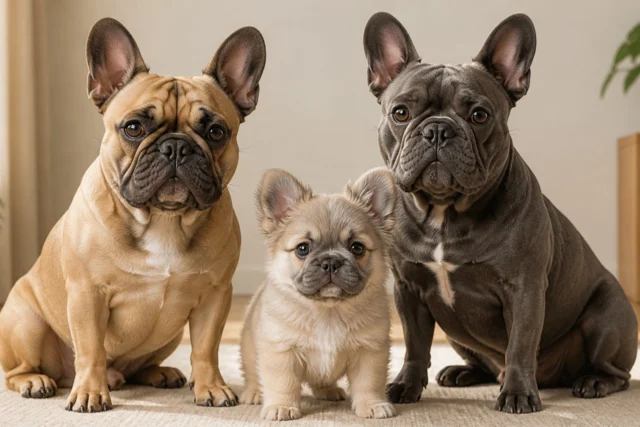
Both parents are short-coated, muscular bull breeds, so most crosses are stocky with a broad head and a smooth coat. Beyond that, size and face shape can land anywhere between the two:
- French Bulldog (AKC): 28–33 cm (11–13 in) tall, under 12.7 kg (28 lb). Large, erect bat ears and a very short nose.
- American Pit Bull Terrier (UKC): males about 46–53 cm (18–21 in) and 16–27 kg (35–60 lb), females about 43–51 cm (17–20 in) and 14–23 kg (30–50 lb).
- American Staffordshire Terrier (AKC): 43–48 cm (17–19 in), 18–32 kg (40–70 lb), with males at the heavier end.
A puppy’s adult size is hard to predict from a cross, and the parents’ own sizes are the best guide. The most important trait to look at is the muzzle. A longer nose generally means easier breathing. A flat, Frenchie-type face brings the airway risks described below. Coat colour can come from either side. Our French Bulldog colour chart covers the Frenchie side.
Temperament of the French Bulldog pit bull mix

Both parents are affectionate with their families. The AKC gives both the French Bulldog and the AmStaff 5 out of 5 for affection with family, and describes the Frenchie as “playful, alert, adaptable”. On people, the UKC says pit bulls are “extremely friendly, even with strangers” and that “aggressive behavior toward humans is uncharacteristic of the breed and highly undesirable.”
Other dogs are where the two sides differ. Frenchies score 4 out of 5 for getting on with other dogs on the AKC scale. On the pit bull side, the UKC states that “most APBTs exhibit some level of dog aggression”. The AKC warns that dog aggression “can develop even in well-socialized Am Staffs” and that one “should never under any circumstances be left alone with other dogs.” Plan for a cross to inherit that tendency:
- Introduce new dogs slowly, on neutral ground, and keep early meetings short.
- Supervise play with other dogs, and separate dogs when you are out.
- Feed dogs apart and pick up high-value chews when other dogs are around.
- If you see stiffening, staring or growling at other dogs, talk to your vet and a qualified, reward-based behaviourist early rather than waiting.
Training and socialisation
Both parents learn readily when the motivation is right. The AKC calls Frenchies “people pleasers” who respond to “the proper motivation (such as food)”. For AmStaffs, it says early socialisation and puppy classes are “a necessity” given their “strong will, physical strength, and exuberance”. The American Veterinary Society of Animal Behavior (AVSAB) recommends “only reward-based training methods … for all dog training”. It also advises socialising puppies in their first three months, even before vaccinations are complete. Ask your vet how to do that safely where you live.
- Enrol in a reward-based puppy class. Avoid any class that uses choke, prong or shock collars.
- Teach a reliable recall, “leave it” and settling on a mat early, while the dog is small.
- Expect some chewing and digging. The AKC notes these can be hard to resolve in AmStaffs. Provide legal chew and dig outlets rather than punishing.
- House-train with frequent trips outside and a reward when your puppy goes in the right place. See our guide to potty-training setbacks in bulldogs if progress stalls.
If you live in a flat or need an indoor back-up while your puppy learns, puppy pads are one option. Put them in one consistent spot and move gradually towards the door. Product picks on this page were chosen by comparing published specifications against what the dog needs. We have not tested them, so check current listings before buying.
Check price on AmazonAffiliate link — Dog Fluffy may earn a commission, at no extra cost to you.See the Amazon Basics dog and puppy potty training pads on Amazon.
Exercise
The parents need very different amounts of exercise. The AKC says a short daily walk or play session keeps a French Bulldog fit, and that the breed “should never be allowed to exert themselves in hot or humid weather”. It describes the AmStaff as “an athletic, energetic dog” that “requires a lot of exercise”. Match the plan to the dog you actually have:
- Watch the breathing, not the clock. Loud breathing, a wide flat tongue, or lagging behind means stop, find shade and let your dog cool down.
- Exercise in the cool part of the day in warm weather.
- Mix walks with brain work such as sniffing games, food puzzles and short training sessions.
- Be careful around water. The AKC warns that Frenchies “cannot swim” because of their front-heavy build, and a cross may share it. Use a dog life jacket and stay close.
Many crosses love to fetch. A soft disc thrown low and short, so your dog does not have to leap and twist, is a gentler choice than a hard flying disc. Stop each session while your dog is still breathing easily.
Check price on AmazonAffiliate link — Dog Fluffy may earn a commission, at no extra cost to you.See the Hyper Pet Flippy Flopper frisbee on Amazon.
Health
A cross can inherit problems from either parent, and mixing does not cancel out a short face. On the Frenchie side, a Royal Veterinary College study of UK veterinary records found French Bulldogs far more likely than other dogs to be diagnosed with:
- narrowed nostrils (stenotic nares)
- Brachycephalic Obstructive Airway Syndrome (BOAS)
- ear discharge
- skin-fold dermatitis
The authors linked many of these to “the conformational extremes that define the French Bulldog breed” (O’Neill et al., 2021). The AKC adds that flat-faced breeds are more sensitive to anaesthesia, and lists eye conditions and skin allergies in Frenchies.
On the pit bull side, the AKC says responsible AmStaff breeders screen for hip dysplasia, heart disease, and skin and coat allergies. It also names a genetic test for cerebellar ataxia, a progressive loss of coordination.
- Ask a breeder or rescue which health tests both parents had, and to see the results.
- Ask your vet to check your dog’s airway early if it snores, breathes noisily, or tires fast. The AKC advises having a Frenchie’s airway evaluated in these cases.
- Keep your dog lean. Excess weight makes breathing and joint problems worse.
For more on the Frenchie side, see brachycephalic syndrome in French Bulldogs and preventing overheating. This section is general information. Your vet is the right person to assess your own dog.
Grooming and shedding
Both parents have short, easy coats. The AKC recommends weekly brushing with a medium-bristle brush, rubber mitt or hound glove for Frenchies, and a quick weekly brush for AmStaffs, with a bath only when the dog gets dirty or smelly. It says the Frenchie’s coat “sheds minimally”. If your cross has facial wrinkles, keep the folds clean and dry. Trim nails regularly, because overly long nails are painful. Check ears often, given the Frenchie side’s tendency to ear problems. For more tips, see dealing with French Bulldog shedding.
Is a French Bulldog pit bull mix right for you?
This mix can suit an owner who wants an affectionate, people-oriented companion and has time for daily training and socialisation. It suits people who can manage introductions to other dogs carefully and who will keep a close eye on breathing in warm weather. It is a poor fit if you need a dog that will reliably mix with other dogs at a park, if you live in a hot climate with no cool indoor space, or if the law where you live restricts pit bull types. As with any dog, meet the parents if you can, ask about health testing, and talk to your vet before you commit.
Frequently Asked Questions
How big does a French Bulldog and pit bull mix get?
Anywhere between its parents. French Bulldogs are 28–33 cm (11–13 in) and under 12.7 kg (28 lb). American Pit Bull Terriers are roughly 43–53 cm (17–21 in) and 14–27 kg (30–60 lb), and the related AmStaff can reach 32 kg (70 lb). The parents’ own sizes are the best guide for a particular puppy.
Is a French Bulldog pit bull mix legal in the UK?
It may not be. In the UK, whether a dog is a banned Pit Bull Terrier type “depends on what it looks like, rather than its breed or name”. A cross that resembles a pit bull could be seized unless it has a Certificate of Exemption. Other countries and cities have their own rules, so check locally first.
Is a French Bulldog pit bull mix good with other dogs?
It can be, but plan carefully. The UKC says most American Pit Bull Terriers show some level of dog aggression. The AKC says an AmStaff should never be left alone with other dogs, even when well socialised. Socialise early with rewards and supervise every interaction.
Do French Bulldog pit bull mixes have breathing problems?
They can, especially if they inherit the French Bulldog’s flat face. UK veterinary records show French Bulldogs are far more likely than other dogs to have BOAS and narrowed nostrils. Ask your vet to check the airway if your dog snores, breathes noisily or overheats easily.
How much exercise does this mix need?
It depends which parent it takes after. Frenchies need only a short daily walk or play session and must not exert themselves in hot or humid weather. AmStaffs need a lot of exercise. Increase activity gradually, and stop as soon as breathing becomes loud or laboured.
Do French Bulldog pit bull mixes shed?
A little. Both parents have short coats. The AKC says the Frenchie’s coat sheds minimally and that a weekly brush keeps either breed tidy.