As an Amazon Associate I earn from qualifying purchases.
Cheap dog clippers aren’t always worse. Price alone doesn’t decide quality.
But really cheap models? They can pull fur, stall in thick coats, heat up quickly, and sometimes run out of battery before you’re done. For a short-coated French Bulldog and quick tidy-ups, a budget clipper might be all you need.
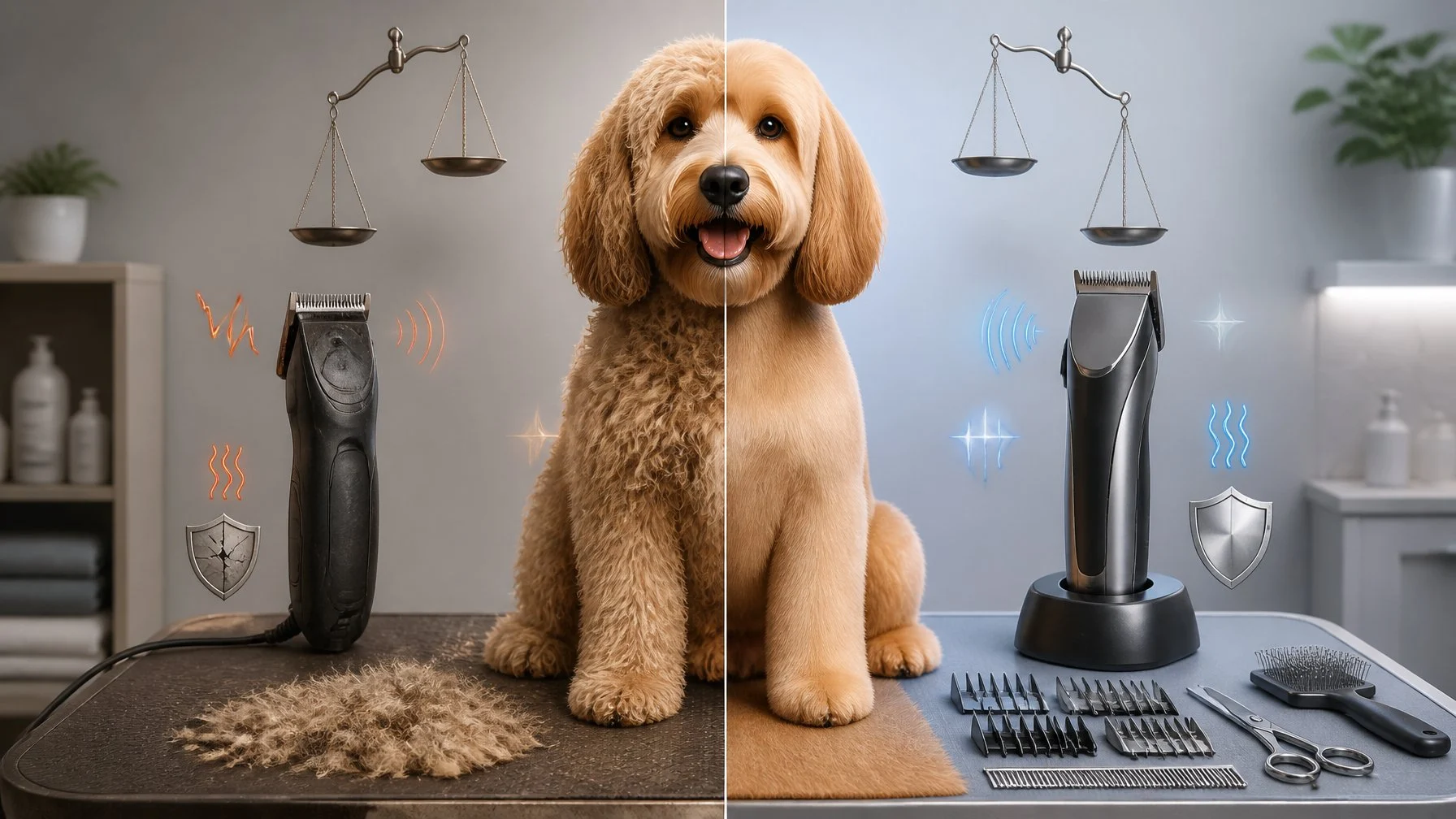
The real question isn’t “cheap or expensive” but “does this tool match this dog’s coat?” A $20 trimmer that glides over a Frenchie’s smooth back will seize up on a Samoyed’s undercoat in seconds.
Dog Fluffy has spent years sorting honest dog grooming guidance from marketing noise. The pattern is clear: motor torque, blade heat, and battery life matter way more than the price tag.
The Short Answer: Price Is Not the Whole Story
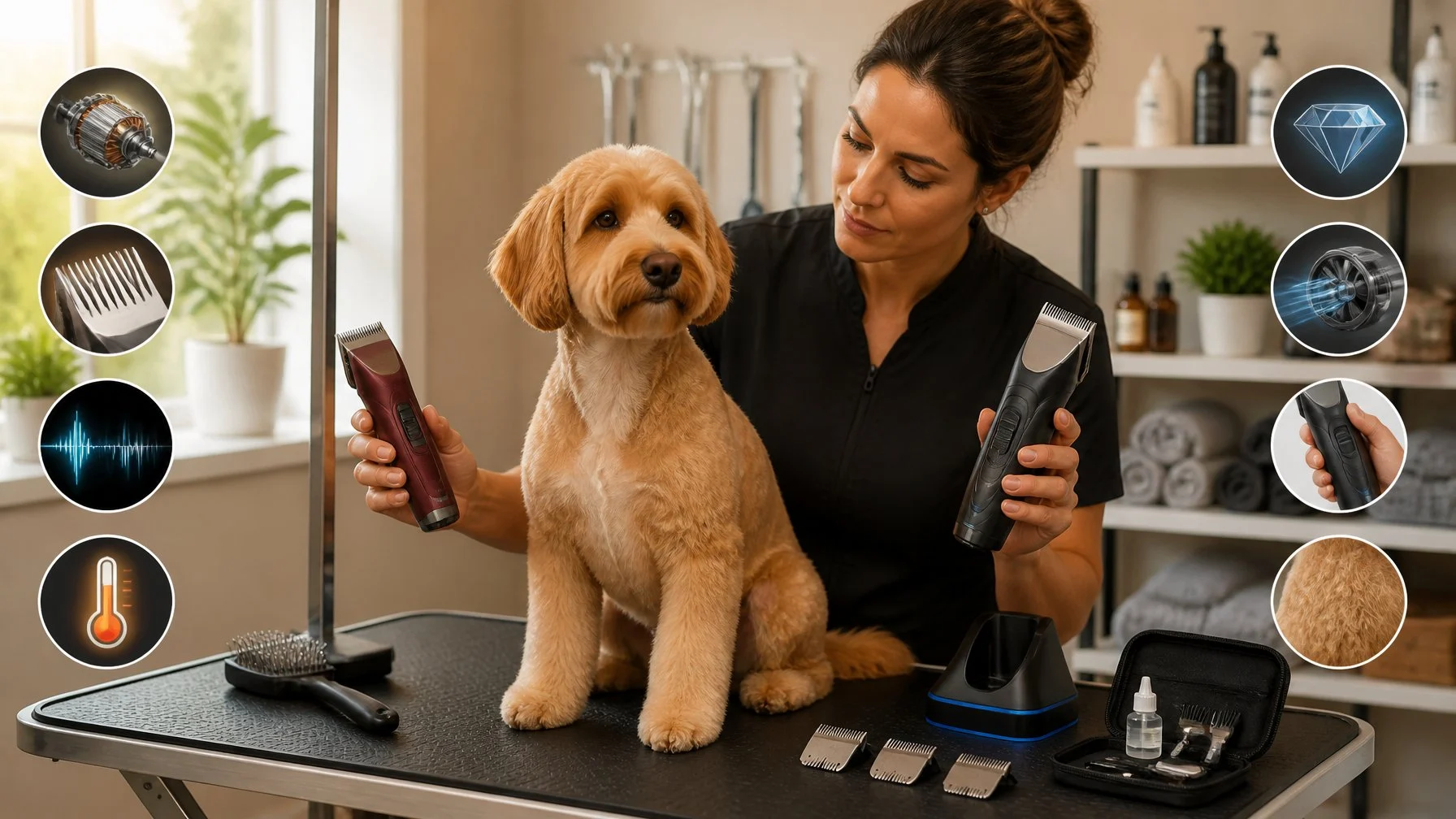
Budget clippers get cheaper by cutting corners on motor torque, blade material, and battery capacity. That’s exactly what fails on thick coats.
But for short single coats, quick touch-ups, and small dogs, those savings often don’t cost the owner anything.
Where Budget Clippers Usually Cut Corners
Manufacturers have to trim something to hit a low price. It’s almost always the parts you can’t see.
The usual sacrifices:
- Motor speed and torque. Professional units hold their speed under load, while budget pet clippers run much slower and bog down in dense fur.
- Blade material. Basic stainless steel heats up fast. Ceramic stays cooler for longer sessions.
- Heat management. Cooling fins and heat guards usually get dropped. A blade hotter than about 48°C (118°F) is unsafe against skin.
- Battery cells. Cheap batteries fade after a few months, and many can’t run while charging.
- Build tolerance. Loose blade seating means more vibration, snagging, and that awful fur-pulling feeling.
Go Pet Zone points out that really cheap clippers (around $25 in the US, 2026) typically last under a year. Models in the $80–$150 range can run for three to five years. That is the shape of the false-economy trap — though treat those figures as one site’s market observation rather than a measured lifespan, because nobody publishes controlled durability testing on pet clippers. The mechanism underneath it is better documented than the numbers are, and it is covered further down: heat, blade care and how the motor behaves under load.
My own dog Fluffy is a French Bulldog, so she is the easy case — there is barely any coat to cut, and the clippers only ever come out for a sanitary tidy. The first cheap set I bought still gave itself away within about a minute. Not by cutting badly, but by getting hot. On a short coat you are working close to skin, and a blade that warms up that fast is a problem long before it is a poor haircut. That is the thing I would tell anyone shopping on price alone: the failure you actually meet first is heat, not a ragged finish.
When a Low-Cost Model Can Still Be a Sensible Buy
Here’s the thing: most home groomers aren’t doing full-body poodle scissoring every weekend.
A cheap dog hair clipper makes sense when:
- The dog has a short, smooth single coat (French Bulldog, Boston Terrier, Pug).
- The job is just tidy-up work, like around the sanitary area, paw edges, or a stray tuft.
- Sessions are short—under 15 minutes—so heat doesn’t build up.
- The dog is small, so there’s not a lot of area to cover.
- Full grooms still go to a pro a few times a year.
Reddit groomers make a fair point in clipper recommendation threads: pro-grade 5-in-1 systems are overkill for most home users. Sometimes buying more clipper than your dog needs is just wasteful.
Why Dog Fur Makes the Tool Matter
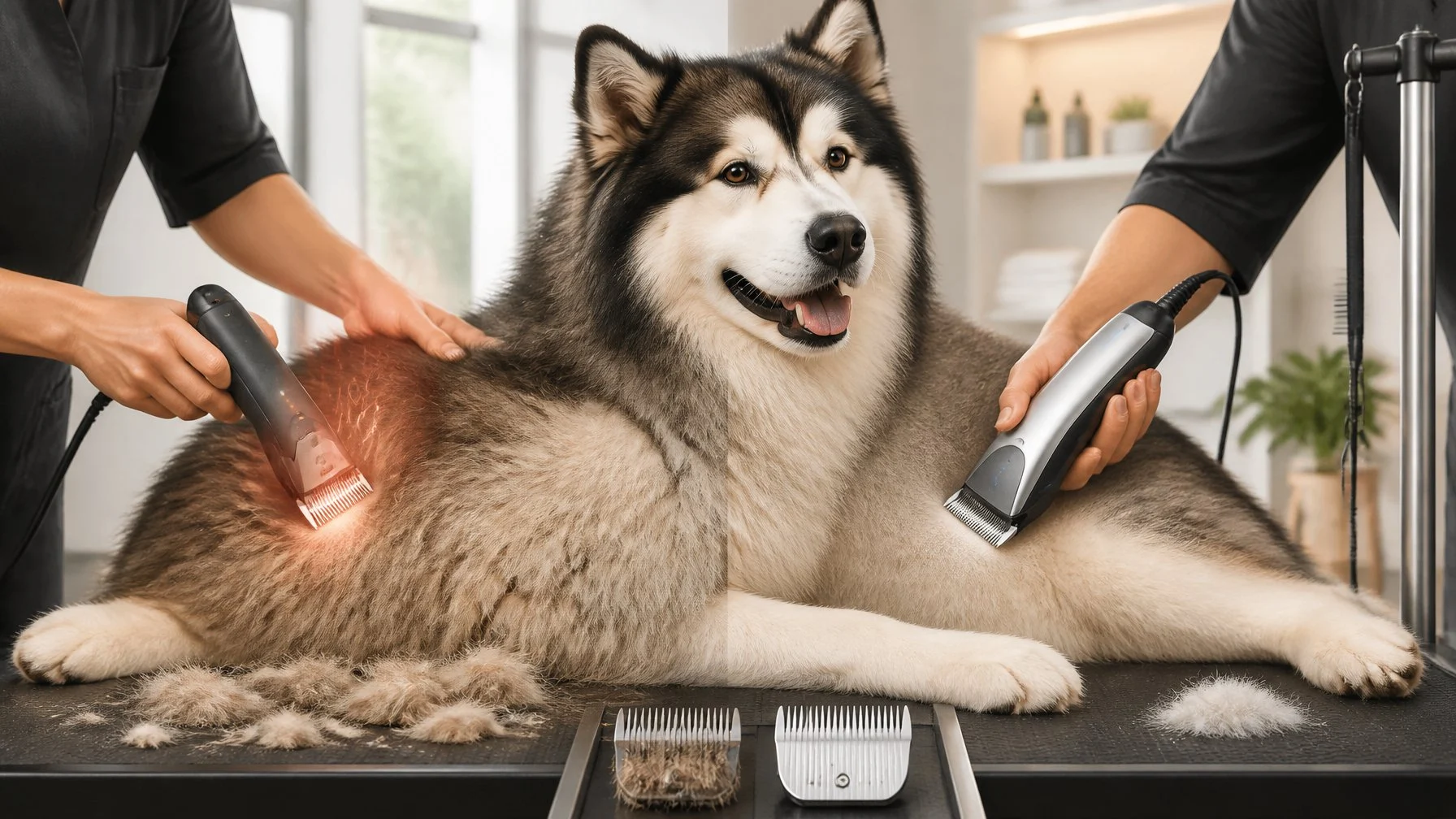
Dog hair and human hair are totally different, which is why a bathroom trimmer stalls on a Husky. Coat density changes the power requirement, and some fur—like a matted double coat—shouldn’t meet a home clipper at all.
Dog Clippers Vs. Human Clippers
Dog clippers use wider blade spacing and higher-torque motors so dense fur doesn’t jam between the teeth. That’s really the main difference.
Human clipper blades sit much closer together. That works for scalp hair but is terrible for an undercoat, which packs into the gap and stops the blade dead.
The manufacturers say so themselves. Wahl, which makes both human and animal clippers, cautions against using human clippers on animals because “the blades on these clippers are designed to cut human hair”, and describes the gap between the two as “the type of blade and motor used”, with animal clippers carrying “thicker, more durable blades designed to better handle different types of animal coats”.
Heat follows from that rather than being a separate flaw. A blade built for fine hair, pushed through a dense coat, meets more resistance — and friction is precisely what the same manufacturer’s care guidance says oiling exists to reduce. Wahl does not publish run-time or overheating figures for human clippers on dogs, so treat the 40-minutes-and-it-cooks version of this warning as workshop lore rather than a measurement. The mechanism is documented; the number is not. And a hot blade on thin Frenchie skin is a burn risk, not just an annoyance.
So no, the clippers in the bathroom drawer aren’t a money-saving hack.
Thin French Bulldog Coats Versus Dense Double Coats
A French Bulldog has a short, smooth single coat. There’s no undercoat to fight. Almost any functional pet clipper can handle a light tidy-up around the tail base or belly.
Double coats are a different animal. Samoyeds, Huskies, Pomeranians, and Golden Retrievers have a dense, woolly undercoat beneath a longer guard layer. That fur resists the blade, creates friction, and heats things up quickly.
Two things follow from that:
- Double coats need stronger motors and cooler blades, so the budget threshold goes up.
- Double coats generally shouldn’t be shaved at all. The coat helps regulate temperature and protects the skin. Removing it can cause patchy regrowth and sunburn.
Brushing and de-shedding tools do more for a fluffy double coat than any clipper will. Dog Fluffy’s grooming resources dig into that side of coat care.
What a Clipper Should Never Be Asked to Cut
Some jobs are just not for any home clipper, cheap or not.
Skip the clipper entirely for:
- Tight mats against the skin. The skin lifts into the mat. Blades catch it. That’s how home grooming ends in stitches.
- Over skin folds. Frenchie face and tail folds are uneven and easy to nick.
- Around hot spots or broken skin. Irritated skin needs a vet, not a trim.
- Wet or dirty fur. Dirt dulls blades fast and damp fur clogs teeth.
- Directly over warts, lumps, or scars. Hard to see under fur, easy to slice.
The one place I will not use clippers on Fluffy is the folds. A Frenchie’s skin gathers around the tail and face, and it moves when the dog moves — you cannot see where the skin ends and the coat begins until you have already put a blade there. The first time I tried to neaten the area around her tail pocket I stopped almost immediately, because the skin lifted towards the blade instead of staying flat. It went to a groomer instead, who did it in a couple of minutes with the skin held properly. That was the right call, and it stayed the rule: anywhere the skin folds or bunches, that is a groomer’s job.
Features That Separate Good Value From False Economy
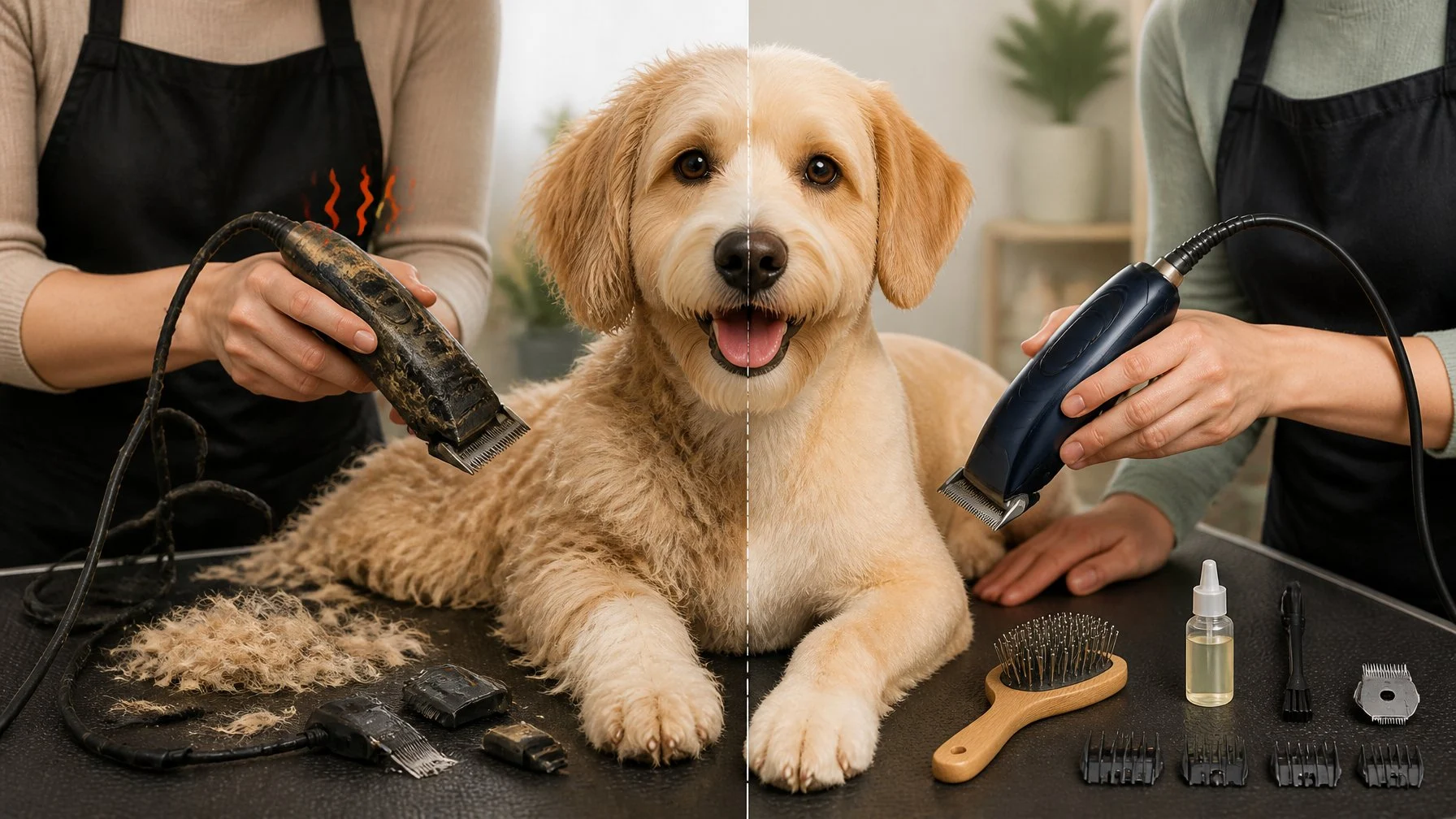
Four specs decide whether an affordable dog clipper is a bargain or a waste: motor behavior under load, blade material and heat, battery honesty, and whether the length attachments actually fit the coat.
Motor Power, Noise, and Heat
Motor torque, not just speed, decides whether a clipper glides through fur or drags and pulls. A motor that slows down in thick fur will tug, and that’s what teaches a dog to hate grooming.
Most mid-range clippers use rotary motors and handle general body work pretty well. Brushless motors run cooler and quieter but cost more.
Noise matters, especially for anxious dogs. Dog-appropriate clippers usually run around 50 to 65 decibels. Cheap units often vibrate loudly through plastic, which feels worse to the dog than the sound alone.
Quick test: run the clipper on your forearm for a minute. If it buzzes hard or heats up fast on bare skin, it’ll be worse on a dog’s coat.
Ceramic and Titanium Blade Options
Blade material is the second-biggest cost driver, and it’s the one that really affects safety.
| Blade type | Heat | Sharpness life | Suits |
|---|---|---|---|
| Stainless steel | Heats fast | Moderate | Occasional short-coat trims |
| Titanium | Heats faster, very hard | High | Frequent, longer sessions |
| Ceramic | Stays coolest | Very high | Long sessions, multiple dogs |
Ceramic blades stay much cooler than standard steel, which is why you see them on better clippers. For a Frenchie’s thin, fold-prone skin, that cooler running temperature is worth more than an extra comb attachment.
Some budget kits include a ceramic-tipped blade. Those are often the smarter buy at the low end.
Battery Runtime, Charging, and Corded Backup
Battery claims are where cheap clippers stretch the truth the most.
Watch for:
- Real runtime under load. A “120-minute” rating usually means idle running, not actual cutting.
- Lithium-ion, not old NiMH. Lithium holds charge longer and fades less quickly.
- Corded operation while charging. This single feature can save a half-finished groom.
- Charge time. Some low-cost units take five hours for 40 minutes of use.
If a clipper dies halfway through, that’s not just inconvenient. It leaves the dog half-trimmed and less patient next time.
Length Settings and Comb Attachments
Guide combs snap over the blade to set cutting length, letting one blade do several coat lengths safely. They’re the beginner’s safety net.
Cheap kits often include eight combs made of flimsy plastic that flex or pop off mid-stroke. Four sturdy combs beat eight brittle ones every time.
For most home grooming, this covers it:
- A 3 mm or 6 mm comb for close tidy-up work.
- A 9 mm or 12 mm comb for body work on longer coats.
- An adjustable taper lever on the blade for fine tweaks.
Test each comb before use. If it wobbles on the blade, don’t put it near the dog.
Picking a Budget Clipper for Your Dog’s Coat
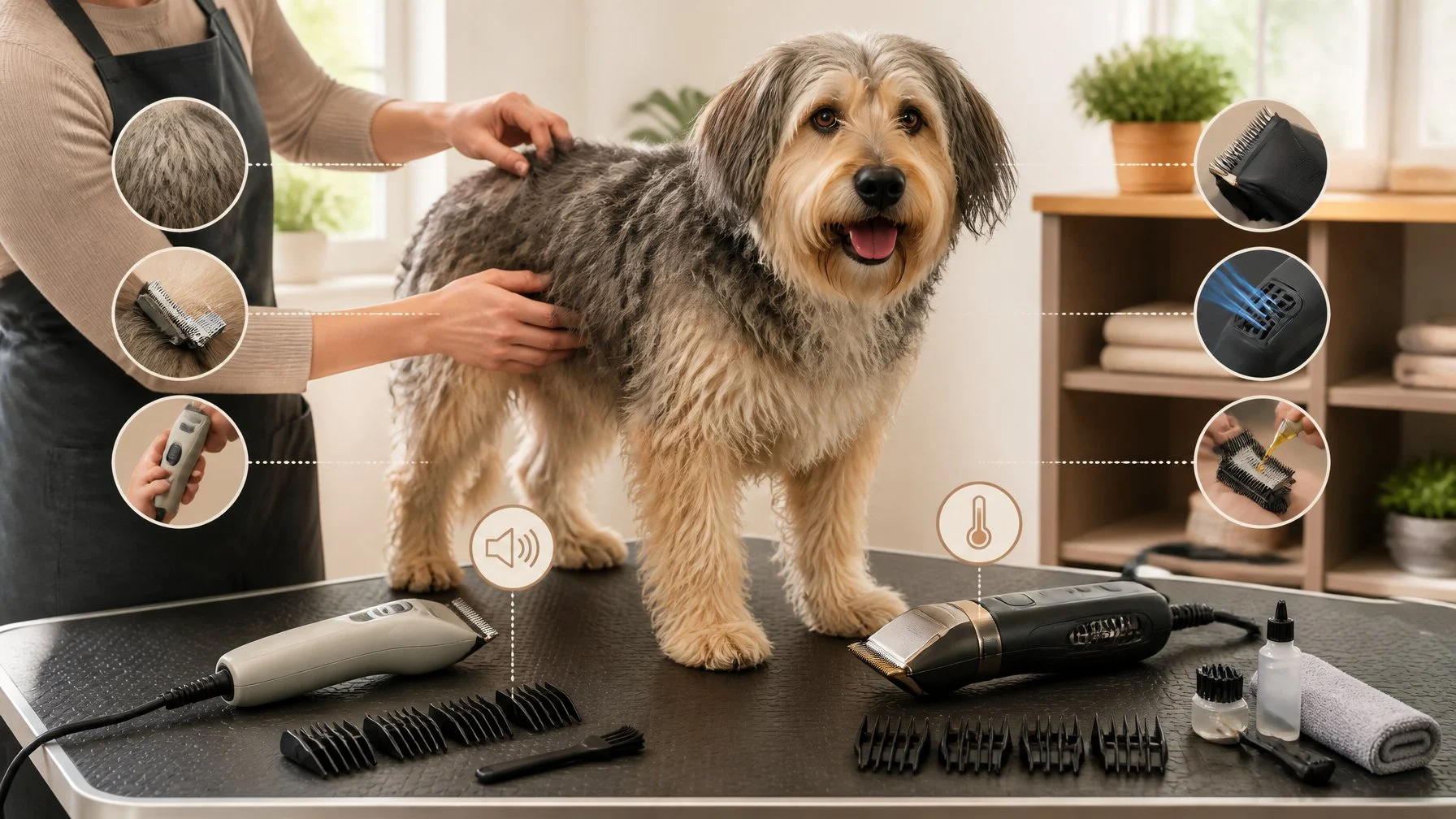
Choosing a clipper for your dog? It really comes down to a quick checklist, some coat-specific needs (especially for flat-faced breeds), and a way to judge those off-brand names without just trusting star ratings.
What the Three Price Tiers Actually Look Like
Rather than argue about price in the abstract, here is what each tier buys. Prices move constantly, so check the current listing rather than trusting any figure written months ago.
- Entry, around the $30 mark: oneisall Low Noise Dog Clippers Grooming Kit. Quiet, light, and genuinely fine for a short-coated dog, a sanitary trim or a nervous first-timer. It will bog down in a dense or long coat, which is exactly the limit this article is about.
- Middle, around $50: oneisall Dog Clippers for Thick Heavy Coats. The step that matters is torque rather than features — this is the tier where a clipper stops stalling in a dense coat.
- Professional: Wahl Professional Animal Bravura. Its 5-in-1 adjustable blade covers #9 through #40 and it runs about 90 minutes cordless. You are paying for a motor that holds speed under load and a blade system that lasts years rather than months.
The honest summary: if your dog is short-coated or you are only tidying feet and sanitary areas, the cheap one is not a false economy at all. If your dog carries a dense double coat or a long single coat that mats, the cheap one will cost you more — in stalled cuts, in heat, and in replacement.
A Simple Buying Checklist for Home Grooming
Work through these steps before spending a cent:
- Identify the coat type. Is it a short single coat, long single coat, curly, or double coat? This sets the power bar.
- Estimate session length. Under 15 minutes? Heat won’t matter much. Over 30? Cooler blades are a must.
- Check blade material. Ceramic or ceramic-tipped blades are a small but mighty upgrade.
- Confirm corded backup exists. Cord-and-cordless models mean you never worry about dead batteries.
- Count usable combs, not just total combs. If you can, handle them. Flimsy combs are useless.
- Look for replacement blade availability. No replacement blade? It’s a throwaway product.
- Check the noise figure. “Low noise” means nothing without a decibel number.
Go Pet Zone’s advice on affordable dog clippers hits the same point: a clipper that can’t handle thick fur isn’t really cheap—because you’ll just have to buy another.
What French Bulldog Owners Should Prioritize
French Bulldogs don’t need much clipping. Their coat is short and smooth, so clipping doesn’t help much.
But a tidy-up now and then? Sure. So, your priorities shift a bit:
- Cool-running blades. Frenchies have thin, sensitive skin. Heat is the enemy, not lack of power.
- Low vibration. These dogs get nervous fast. A shaky clipper just adds to the stress.
- Small trimmer head. Handy for paws and around the tail—forget the big body clippers.
- Avoid the folds. Face, neck, and tail-pocket folds are for cleaning, not for the clipper.
If the skin’s already red, flaky, or itchy, stop. Dog Fluffy’s wellness guides cover skin allergies and hot spots—irritated skin needs care before any grooming tool comes near.
How to Judge an Unknown Clipper Brand Without Chasing Hype
Search for cheap clippers and you will meet a dozen brands you have never heard of, most of them selling near-identical grooming kits. The name tells you nothing either way — an unfamiliar brand is not automatically bad, and a familiar one is not automatically good. The specification is where the answer is.
Judge any unknown brand like this:
- Check blade material. If it’s not listed, it’s probably just basic steel.
- Look for a stroke rate or motor type. “Powerful motor” is just empty marketing.
- See if you can buy a replacement blade. If yes, the brand expects it to last.
- Read the one and two-star reviews first. Watch for patterns: “pulled,” “died,” “hot,” “stopped charging.”
- Ignore total review count. More reviews doesn’t mean better quality.
Use Any Clipper Safely and Make It Last
Good technique bridges most of the gap between a cheap clipper and a pricey one. Coat prep, calm handling, blade care, and knowing when to quit—those matter more than what you spent.
Prepare the Coat Before Switching It On
Don’t clip a dirty, damp, or matted coat. Dirt dulls blades in minutes, and wet fur just clumps and drags.
Here’s the order that works best:
- Brush the whole coat out well.
- If it’s dirty, bathe the dog.
- Dry completely, right down to the skin.
- Brush again to fluff up the fur.
- Now you can clip.
Clean, dry, brushed fur cuts so much easier. That means less work for the clipper and less pulling on your dog.
Keep Nervous Dogs Comfortable During a Trim
Anxious dogs remember bad sessions. It’s better to keep things short and boring than thorough and stressful.
What helps?
- Run the clipper near your dog before you touch them, then give a treat.
- Start on the shoulders or back, not the face or paws.
- Work in five-minute bits, with breaks.
- Stop while your dog’s still calm, not after they’re fed up.
- Use a non-slip mat. Slipping feet freak dogs out more than the noise ever does.
With flat-faced breeds, keep an eye on their breathing. If they start panting hard, take a break—don’t just push through.
Clean, Oil, and Store the Blades
A can of Andis Cool Care Plus does four jobs at once — it cools, cleans, lubricates and prevents rust — and it is the single cheapest thing that extends blade life. Spray the blade with the clipper running, for two or three seconds, then wipe. Blade heat is the most common cause of clipper burn, and it builds long before the blade looks dirty.
Oiling the blade before every session is hands-down the cheapest way to make your clipper last. Skip it and the blade gets dull, drags, and heats up fast.
After each groom, do this:
- Brush loose fur from the blade teeth with the cleaning brush.
- Wipe the blade with a dry cloth.
- Put two or three drops of clipper oil along the teeth.
- Run the clipper for ten seconds to spread the oil.
- Wipe off the extra and store it somewhere dry.
If you clean and oil the blade every time, it can outlast the motor. Neglect it and you’ll be pulling fur in a month.
This is not folk wisdom, it is what the manufacturers themselves publish. Wahl’s clipper and trimmer care guidance says blades should be oiled frequently “to reduce friction that causes heat, prevent rust, run smooth, and ensure long life”, and lists cooling the blade as its own step alongside cleaning, oiling, disinfecting and storing. Heat is treated as the thing maintenance exists to prevent — which is exactly why a cheap clipper that runs hot is a maintenance problem before it is a quality problem.
One storage habit worth more than it sounds: with a corded clipper, coil the cord rather than winding it around the body. Wahl warns that wrapping the cord around the clipper “can cause strain, which over time, can lead to the loosening of the wires and/or electrical shortages”. A budget corded clipper that dies in its first year has often been killed this way rather than by its price.
When to Stop and Book a Professional Groomer
Some situations just aren’t for home grooming. Calling a groomer isn’t giving up—it’s smart.
Call a pro when:
- The coat has mats right down to the skin.
- You’ve got a double-coated breed that needs a full de-shed.
- Your dog panics, snaps, or just won’t settle.
- You spot lumps, sores, or hot spots anywhere.
- The blade keeps stalling no matter how much you prep the coat.
Groomers rotate blades as they heat up. That’s not just better tools—it’s a whole system.
Fluffy is a French Bulldog, so I am not going to pretend I have clipped a Poodle down to the skin. The habit that has been worth more than any tool: run the clipper for thirty seconds with it nowhere near the dog, every time, before you start. It lets you feel whether the blade is heating and lets the dog hear the noise before anything touches them. Two things solved by doing nothing for half a minute.
What Professional Groomers Do Differently
The gap between a salon result and a home one is mostly method, not money — and three of the differences cost nothing to copy.
- They rotate blades instead of pushing through. A groomer working a full coat keeps several blades of the same size and swaps to a cool one when the first warms up. At home the equivalent is simply stopping: a two-minute pause with the blade off the dog does the same job.
- They check blade temperature against their own skin, constantly. The test is the back of the wrist, and the rule is blunt — if it is uncomfortable on you, it is burning the dog. This is why clipper burn shows up on short-coated breeds most: less coat between blade and skin.
- They finish drying before they start cutting. Damp fur clogs the teeth, drags, and dulls a blade faster than anything else. A high-velocity dryer is the tool that most separates professional results from home ones, and it is not a clipper feature at all.
Two points where copying them is the wrong instinct. Professionals work on a table with a grooming arm because a still dog is a safe dog — but a loop is a restraint you stand beside, never a tether, and a dog that steps off an edge while noosed can hang itself. And a groomer takes a matted coat off short deliberately: the blade has to pass under the mat, so the mat sets the length, not the owner. Neither of those is a preference. Both are safety.
Frequently Asked Questions
Dog owners ask the same stuff again and again: pulling, safety, using human clippers, pro brands, thick coats, lifespan—let’s run through them.
Do low-cost dog clippers pull fur or make dogs uncomfortable?
Sometimes, yeah. But usually it’s the blade or prep, not the price tag. Dull, dry, or clogged blades snag fur no matter what you paid. Oil the blade before every session, only clip clean and dry coats, and swap the blade when cutting slows down. Loose guide combs? They tug too.
What should dog owners look for in a budget clipper?
Blade material, corded backup, and spare blade availability. Ceramic or ceramic-tipped blades stay cooler than plain steel, which really matters for thin-skinned dogs. Cord-and-cordless models are just less stressful. If the company sells a spare blade, that’s a good sign it’s not disposable.
Can regular human hair clippers safely be used on a dog’s coat?
Nope. Human clipper teeth are too close together and clog up in dog fur almost instantly. The motors aren’t built for that load, so they bog down and run hot. Nobody publishes a figure for how fast, so treat any specific number you see as folklore — the effect is real, the stopwatch is not. Even on a short-coated Frenchie, they’ll pull and get hot. Just not worth it.
Why do professional groomers often choose brands like Andis or Heiniger?
Those brands make high-torque motors, detachable blades, and heat management that can handle dog after dog. Groomers rotate blades every few minutes to keep things cool. That kind of workflow needs reliable blade swaps and tight tolerances. Most folks at home just don’t need that level.
Are cheaper clippers strong enough for thick, curly, or double coats?
Honestly, not really. Thick undercoats like Samoyeds or Huskies need lots of torque, and weak motors just stall, overheat, and pull. Double coats shouldn’t be shaved anyway—they protect the dog’s skin and help with temperature. For those breeds, invest in de-shedding tools and good brushes, and leave big grooms to the pros.
How long do budget dog clippers usually last with home grooming?
Go Pet Zone says that really cheap clippers, like the $25 ones (US pricing, 2026), often stop working within a year. Models that cost between $80 and $150 can hang in there for three to five years, which is a pretty big jump.
If you clean and oil your clippers after every session, you’ll get way more life out of them. Blades that don’t get regular care go dull in just a few weeks, no matter how much you spent.
What clippers are you using at home, and how are they holding up on your dog’s coat? Toss your experience in the comments—other owners really do check those for advice.
This isn’t veterinary advice, just general info. Always ask your vet about your own dog’s needs.