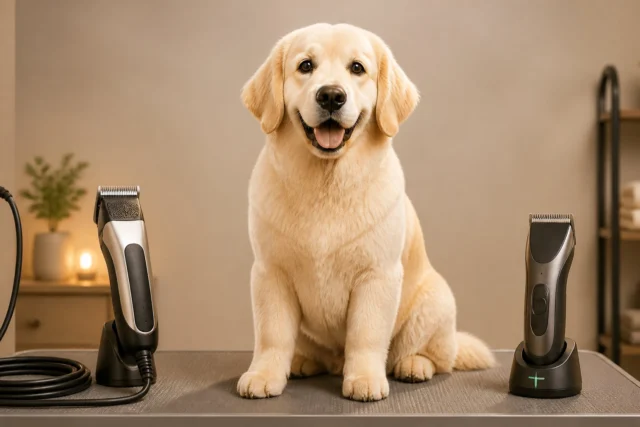
Scissors are the safer choice for trimming a dog’s face. They give control over exactly how much hair comes off around the eyes, muzzle, and whiskers, with no vibration and no hot blade against thin skin. Clippers work better for bulk removal on the cheeks and under the chin, where the skin is flatter and the hair is thicker.
Most good face trims use both tools, and the split depends on coat type more than breed. A Shih Tzu’s fine, straight face hair behaves nothing like a Goldendoodle’s tight curls, and a French Bulldog’s wrinkled muzzle needs a different approach again. Dog Fluffy has walked owners through grooming a range of fluffy breeds, and the same pattern shows up over and over: the tool matters less than knowing which part of the face it belongs near.
How Clippers and Scissors Affect a Dog’s Face
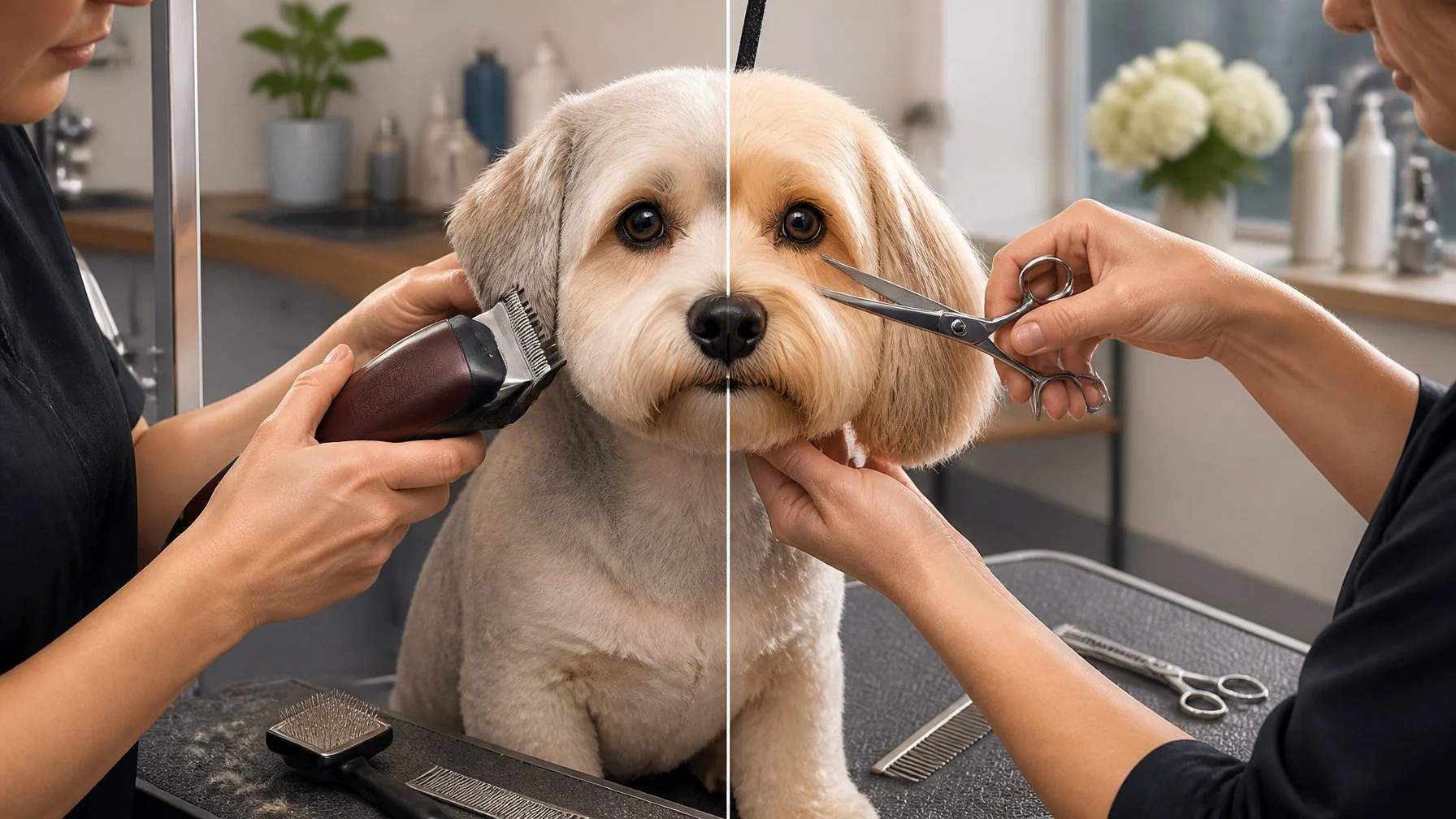
Scissors cut where the skin moves and folds. Clippers cut fast across flat, open areas. The finish that looks most natural comes from using each one where it belongs, then blending the join.
Why Scissors Give More Control Around Eyes and Whiskers
Scissors let a groomer take off 2 mm (about 1/16 in) at a time and stop the second the dog shifts. Clippers don’t offer that. One head turn while a blade is running near the eye corner and the cut is already made.
Whiskers matter too. They’re touch sensors, not decoration, and dogs use them to judge distance in low light. Scissor work makes it easy to trim the hair around the whisker pads while leaving the whiskers themselves alone.
That difference in control is why detail work near the mouth and eyes stays with shears. A scissor cut stops the instant the hand stops; a running blade does not.
Rounded-tip shears are worth the extra few dollars. There are several types of dog grooming scissors built for different jobs, and the small curved-tip pair is the one that lives near the face.
Where Pet Clippers Can Remove Facial Bulk Safely
Clippers earn their keep on the cheeks, the throat, and the flat plane under the jaw. Those areas hold the most hair and sit over firm tissue, so a guarded blade glides without catching skin.
A short definition worth remembering: a clipper guard is a plastic comb attachment that holds the blade a set distance from the skin, so the cut length stays even across a whole area.
Safe clipper zones on most fluffy faces:
- Cheeks, from the ear toward the muzzle
- Under the jaw and down the throat
- The top of the head, between the ears
Skip the clipper entirely at the eye corners, the lip line, and inside the ears. And check the blade temperature against a wrist every 30 seconds or so. Hot blades cause the kind of dog skin problems after grooming that show up as red patches a day later.
Why a Mixed-Tool Trim Often Looks More Natural
The professional habit is clippers first, scissors last. Bulk comes off quickly, then shears soften every edge the clipper left behind.
Bulk first, detail last. The order matters more on a dog than the tools do, because skin folds, whiskers and a limited supply of patience all argue for getting the weight off quickly, then spending the remaining calm on the edges that show.
Scissors | Pet clippers | |
|---|---|---|
Best face zone | Eye corners, muzzle, whisker pads | Cheeks, throat, under jaw |
Control per cut | 1–2 mm increments | Fixed by guard size |
Speed on thick coat | Slow | Fast |
Risk on loose skin | Low with rounded tips | Higher, blade can catch folds |
Finish | Soft, blended | Even, blunt edge |
Noise stress | Silent | Vibration and hum |
Match the Tool to Coat Type, Length, and Face Shape
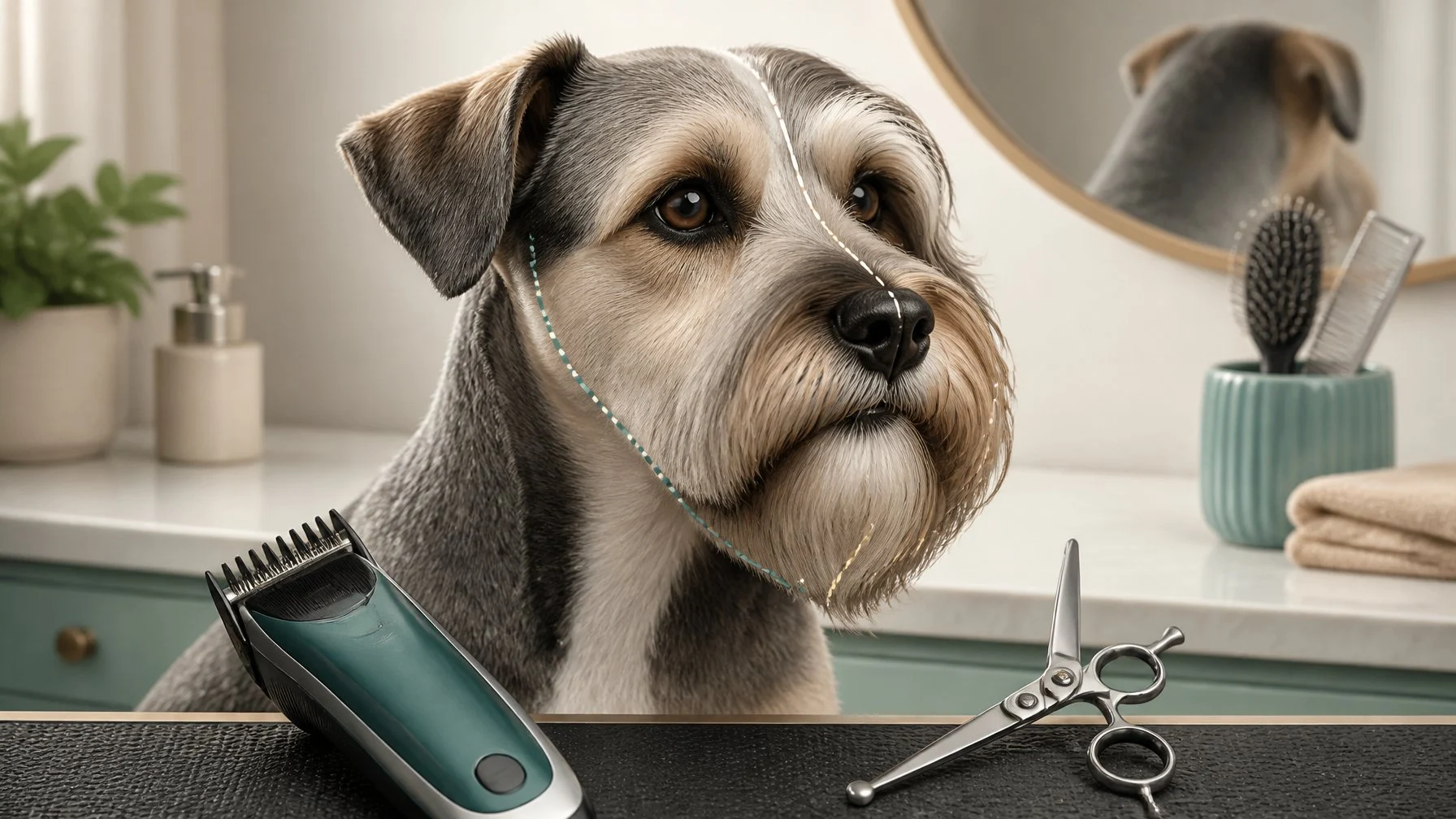
Fine hair around tear-stained eyes needs thinning shears and patience. Coarse double coats hide mats a clipper will drag through. Curly doodle and Shih Tzu face hair springs back after cutting, and flat-faced breeds carry wrinkles that no blade should ever touch.
Fine Facial Hair and Tear-Stained Eye Corners
Fine hair mats faster than thick hair when it’s damp, and tear staining keeps the inner eye corner permanently damp. Pomeranians, Shih Tzus, and small doodles all deal with this.
Thinning shears help here. They remove some hair without leaving a hard line, so the area dries out without looking chopped. Cut with the blades pointing away from the eye, never toward it.
Clean the stained hair before cutting. Dried crust makes hair stiff, and stiff hair pulls the skin when scissors close on it.
Thick or Coarse Coats That Hide Mats
Samoyeds, Huskies, and Chow Chows carry a dense undercoat that hides tangles right under the surface. Run a comb through the cheek hair first, because a clipper hitting a hidden mat pulls the skin instead of cutting.
If the comb stops, stop too. Work the mat out by hand or split it with the tips of the scissors before any blade goes near it. Blade choice matters on these coats, and the best dog grooming clippers for thick coats are the ones with enough motor torque to avoid stalling mid-pass.
Curly Goldendoodle and Shih Tzu Face Hair
Curly hair lies about its length. Pull a curl straight and it might be 5 cm (2 in); let it go and it looks like 2 cm (under 1 in). Cut curly face hair 1 cm (about 3/8 in) longer than the target, then reassess after it springs back.
The rounded teddy-bear face most doodle owners want is scissor work almost entirely. Clippers flatten curl and leave a shaved look that takes weeks to grow out. Choosing what blade for a doodle coat makes more sense for the body than the face.
Shih Tzu owners face a different call: keep the topknot long and tied, or go short. Either works, and the shih tzu haircut options are worth deciding before the scissors come out.
Flat-Faced Bulldogs and French Bulldogs Need Extra Space
Bulldogs and French Bulldogs don’t need much face hair removed. They need the folds cleaned. The nose rope and the wrinkles beside the eyes trap moisture, and a clipper blade dragged across a fold can nick skin that’s already irritated.
Use scissors only, and only on hair that grows into a fold. Wipe the fold dry afterward. For owners building a kit, the fluffy frenchie grooming tools list covers what’s worth having for a wrinkled face.
A Safer At-Home Face-Trimming Routine
Good light, rounded tips, and a clear rule about where clippers stop will prevent most home-grooming accidents. So will knowing the moment to put the tools down.
Set Up a Calm, Well-Lit Grooming Space
Light from two directions beats light from one, because a single lamp throws shadows that hide unevenness and skin folds. A window plus a lamp works fine.
Set up on a non-slip surface at waist height. A dog sliding on a smooth table tenses up, and a tense dog moves at the worst moment.
Steps for the setup:
- Brush the whole face out with a fine comb before any cutting, so the true hair length shows.
- Wipe the eye corners and lip line with a damp cloth, then dry them.
- Lay out rounded-tip scissors, a comb, and treats within reach so nothing needs fetching mid-trim.
- Let the dog sniff and hear the clippers running before they touch skin.
- Start on the cheek, the least sensitive spot, and work toward the muzzle.
If the dog fights the table, the fix is training, not force. The guide on how to calm dog for grooming covers desensitisation that actually holds up.
Use Rounded-Tip Scissors for Detail Work
Straight-tip shears have no place near a dog’s eye. Rounded or ball-tip scissors carry a blunt bead of metal at the end, so a sudden head turn bumps the skin instead of piercing it.
Hold the scissors flat against the face, blades parallel to the skin, never pointing in. Anchor the free hand on the dog’s head so the tool moves with the dog if it shifts.
Small snips. 2 to 3 mm (roughly 1/8 in) per cut around the eyes. It’s slow, and slow is the point.
Keep Clippers Away From Loose Skin, Lips, and Eye Edges
Clipper blades catch loose skin. That’s the whole risk. Pull the skin taut with the free hand before every pass, and never run a blade over an area you can’t flatten.
Hard no-go zones:
- Eye corners and the skin under the lower lid
- The lip line and the corners of the mouth
- Inside the ear flap
- Any wrinkle or fold
Corded machines hold their power better on thick face hair, though cordless is easier to angle around a muzzle. The corded vs cordless dog clippers trade-off comes down to how long a session runs.
Stop for Mats, Redness, or a Stressed Dog
A tight mat against the skin is a groomer’s job, not a home job, because the skin underneath is often raw and pulls up into the mat. Cutting blind into one is how dogs get nicked.
Stop immediately for:
- Skin that’s red, weepy, or hot to the touch
- Any lump or scab hidden under hair
- A dog that’s panting hard, whale-eyeing, or trying to leave
- A mat that won’t lift away from the skin with a comb
Ten minutes is plenty for a first face session. Come back tomorrow. Nothing about a face trim needs finishing in one go.
How to Explain the Look You Want to a Groomer
Groomers work faster and cut closer to the mark when an owner names a shape, gives a minimum length in millimetres, and says outright which tool to limit. Photos help more than words.
Ask for a Rounded Teddy-Bear Finish or a Clear Eye Line
Bring a photo. “Teddy bear face” means round cheeks, a full muzzle, and hair scissored into a soft circle, and most groomers know the term instantly. “A clear eye line” means the hair above the eyes is short enough to see through, with the rest left long.
Those two requests point at different amounts of scissor work, so naming which one saves a lot of guessing.
Describe How Short Is Too Short for Your Dog
Give a number. “No shorter than 15 mm (about 5/8 in) on the muzzle” is a request a groomer can follow; “not too short” is not.
Mention anything the groomer can’t see: a dog that scratches its face when the hair is buzzed, sun-sensitive pink skin on the nose bridge, or a history of clipper rash. A hair length dog grooming blade chart makes it easy to convert a length into the blade number a groomer will recognise.
Request Scissor-Only Work or Limited Clipper Use
Owners are allowed to say “scissors only on the face.” Groomers hear it regularly.
The technique that gets asked for most is scissor-over-comb: the comb lifts a section of hair away from the skin, then the scissors cut above the comb’s teeth. It gives fine control in small increments, and the comb doubles as a guard between the blades and the skin.
Ask for scissor-only when the dog is noise-sensitive, has skin folds, or wears a curly coat where clipper lines show. Ask for guarded clippers on the body and scissors on the face when time or budget is tight.
Know When a Professional Groomer Is the Safer Choice
Some jobs shouldn’t start at home. Book a groomer when the face is matted to the skin, when the dog has bitten or snapped during handling before, or when a first trim is happening on a young puppy.
A puppy first groom sets the tone for every session after it, and a bad one is hard to undo. Professionals also carry blade coolant, styptic powder, and a second pair of hands.
Choose Control Over a Close Cut Near the Face
Scissors near the eyes and muzzle, clippers on the cheeks and throat, and a comb through everything before either tool touches skin. That’s the whole method.
A scissors cut on the face gives a natural finish that grows out evenly, while a clipper cut gives speed and consistent length on the flat areas where speed is safe. Coat type decides the balance: fine hair needs thinning shears, coarse double coats need a comb-check first, curly coats spring back shorter than they look, and wrinkled faces need scissors only.
Ten minutes at a time, good light, and a willingness to stop early will do more for a dog’s face than any single tool upgrade. For owners building a full routine, the wider grooming library covers coat care beyond the face.
Frequently Asked Questions
Five questions come up constantly around face trims: which tool is safer, whether clippers belong near the eyes at all, what scissors to buy, how short the eye hair should go, and when a matted face becomes a groomer’s job.
Are scissors or clippers safer for trimming a dog’s face?
Scissors are safer near the face. They cut in small, controlled increments, make no noise, and produce no heat against thin skin. Clippers carry a vibrating blade that can catch loose skin, folds, or lips if the dog moves. Most groomers use clippers on the cheeks and throat, then switch to rounded-tip scissors for everything around the eyes and muzzle.
Can pet clippers be used around a dog’s eyes and muzzle?
Clippers should not run against the eye corners, the lower lid, or the lip line. Those areas have loose, thin skin that a blade can pull into the teeth. Clippers work on the flat cheek and the top of the head, where the skin can be pulled taut. Everything closer than about 2 cm (3/4 in) to the eye belongs to scissors.
What type of scissors should be used for a dog face trim?
Rounded-tip or ball-tip grooming shears in a 11 to 14 cm (4.5 to 5.5 in) length. The blunt bead on the tip prevents puncture wounds if the dog turns suddenly. Curved shears help shape a round teddy-bear face, and thinning shears soften hard lines around tear-stained eye corners without leaving a visible cut edge.
How short should the hair around a fluffy dog’s eyes be?
Short enough that the dog can see forward without hair touching the eyeball, roughly 5 to 10 mm (about 1/4 to 3/8 in) above the lid. Cutting shorter than that leaves stubble that pokes the eye as it regrows. On breeds with topknots, tying the hair up is often a better option than cutting it.
Should a matted dog face be trimmed at home or by a groomer?
A groomer should handle it. Mats pull the skin up into the tangle, so the skin sits much closer to the scissors than it appears. Groomers use clipper blades that slide underneath the mat safely and can spot the raw, irritated skin hiding beneath. Home attempts on a tight facial mat are the most common cause of grooming nicks.
What tool does your dog tolerate better on the face, scissors or clippers? Drop it in the comments, other owners find those answers useful.
This is general guidance, not veterinary advice – always check with your vet for your own dog’s situation.