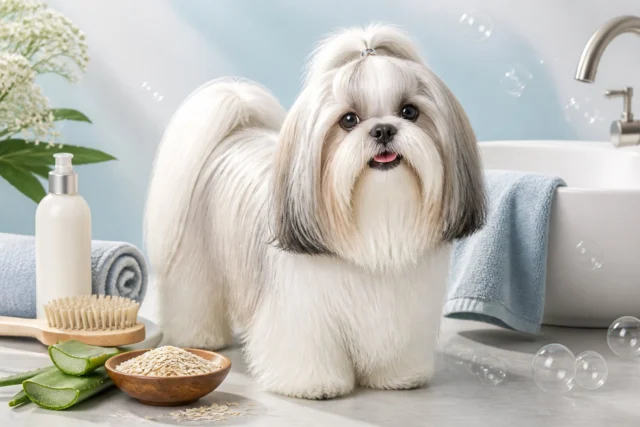
Shih Tzu
The Shih Tzu was bred for one job — to sit in a lap and be company — and it is still the thing the breed does better than almost anything else. No herding instinct, no working drive, no need for a garden. For the right household that makes it close to ideal. For the wrong one it makes for a dog that is bored, vocal and expensive to keep looking the way people imagine it will.
Two things decide which of those you get, and neither is temperament. The first is the coat: a full-length Shih Tzu coat is a daily commitment, and the owners who enjoy the breed most are usually the ones who gave up on floor-length hair early and settled on a shorter clip. The second is the face. The flat muzzle that makes the breed look the way it does also gives it less airway than a longer-nosed dog, and that single fact drives most of the health advice further down this page.
This page is the overview of the breed — where it came from, what it looks like, what tends to go wrong, and what it is like to live with. Where a question deserves a longer answer, it links to one.
Key Takeaways
- Size: 9–10.5 inches at the shoulder, 9–16 lb. Small, but solidly built rather than fragile.
- Coat: hair rather than fur, so it sheds little — but it grows continuously and mats if it is not brushed. Low-shedding is not low-maintenance.
- Health: the flat face and the large, exposed eyes account for most veterinary visits. Both are structural, not bad luck.
- Temperament: affectionate, people-oriented, and prone to protesting when left alone. Not a dog for an empty house.
- Exercise: modest. Two short walks suit them, and heat is a bigger risk than distance.
Start Here: the Questions Most Owners Arrive With
This page is the overview. Almost every question worth asking about the breed has a full answer of its own, and these are the ones people ask first.
- Do they shed? Less than most, but “low-shedding” is not “no-shedding” — how much a Shih Tzu really sheds, and why the hair you do lose ends up in the coat rather than on the sofa.
- Are they hypoallergenic? No breed is, and what that actually means for an allergy sufferer is a more useful question than the label.
- How big do they get? Expected weight and when they stop growing.
- What will it cost? Purchase price, and the running costs that outlast it.
- How long do they live? Typical lifespan, and what shortens it.
- What goes wrong medically? The conditions the breed is prone to — the flat face and the eyes account for most of it.
- How much grooming? More than you think. The kit that actually gets used, and how to stop mats forming.
- Can they be left alone? Honestly, and for how long.
Breed Origins and History
The Shih Tzu has a fascinating history rooted in ancient Tibet and China. They are known for their charming looks and royal connections.
Ancestral Lineage
The Shih Tzu’s lineage dates back to ancient Tibet. They are believed to be descendants of Tibetan holy dogs, which were lion-like in appearance. These dogs were called “foo dogs.” The breed is a mix of Pekingese and Lhasa Apso dogs, leading to their fluffy and robust stature.
In the early days, monks in Tibetan monasteries bred these small dogs for companionship and protection. The Shih Tzu, often called the Lion Dog, was known for its regal presence even back then. They are among the oldest and smallest of the Tibetan breeds, often referred to as the “Chrysanthemum Dog” due to their flower-like facial hair.
Historical Significance
The Shih Tzu played a vital role in Chinese royal families. During the Ming and Qing dynasties, these dogs were cherished by the emperors. They lived in palaces, were groomed with great care, and often accompanied their royal owners. Their noble demeanor and distinctive appearance added to their popularity.
Interestingly, the breed was nearly lost during the Chinese Revolution. Dedicated breeders in England and the United States saved the Shih Tzu from extinction. Now, the Shih Tzu continues to be a beloved breed among dog owners worldwide. Their resilience and charm make them a standout in the canine world.
Physical Characteristics
Small, square and heavier in the hand than they look. The features that define the breed visually — the coat and the flat face — are also the two that shape day-to-day ownership, so they are worth understanding rather than admiring.
Size and Build
The breed standard puts them at 9 to 10.5 inches at the shoulder and 9 to 16 pounds, slightly longer than they are tall. That is a wide weight range for a small dog, and where an individual lands in it matters — the top of the range on a dog built for the middle is the single most common avoidable health problem in the breed. What a healthy weight looks like at each stage, and when they stop growing, are worth knowing before you judge by eye.
Coat and Colour
Shih Tzus grow hair rather than fur. It keeps growing instead of reaching a set length and dropping, which is why the breed sheds so little — and why the hair it does shed stays in the coat and turns into mats rather than landing on the floor. That trade is the whole grooming story: very little shedding, in exchange for brushing that cannot be skipped.
Colours run through gold, white, red, silver, brindle and combinations of them, and many change considerably as the dog matures — a dark puppy often lightens by its second year. Coat colour has no bearing on health or temperament.
The Flat Face, Honestly
The Shih Tzu is brachycephalic — the skull is shortened, but the soft tissue inside it is not, so the same amount of tissue has to fit a smaller space. In practice that means a narrower airway, less efficient panting, and a real vulnerability to heat. Snoring and snuffling are normal for the breed; laboured breathing, gagging after eating, or noise that has recently got worse are not, and warrant a vet.
The same shortened skull leaves the eyes large and comparatively unprotected, which is why eye injuries and infections are among the most common reasons a Shih Tzu sees a vet. An undershot jaw is standard for the breed and usually harmless, though it does make dental crowding more likely.
None of this makes the Shih Tzu an unhealthy breed. It does mean that a flatter face is not a feature to select for — where you have a choice, the dog with a little more muzzle and open nostrils is the better bet.
Health and Wellness
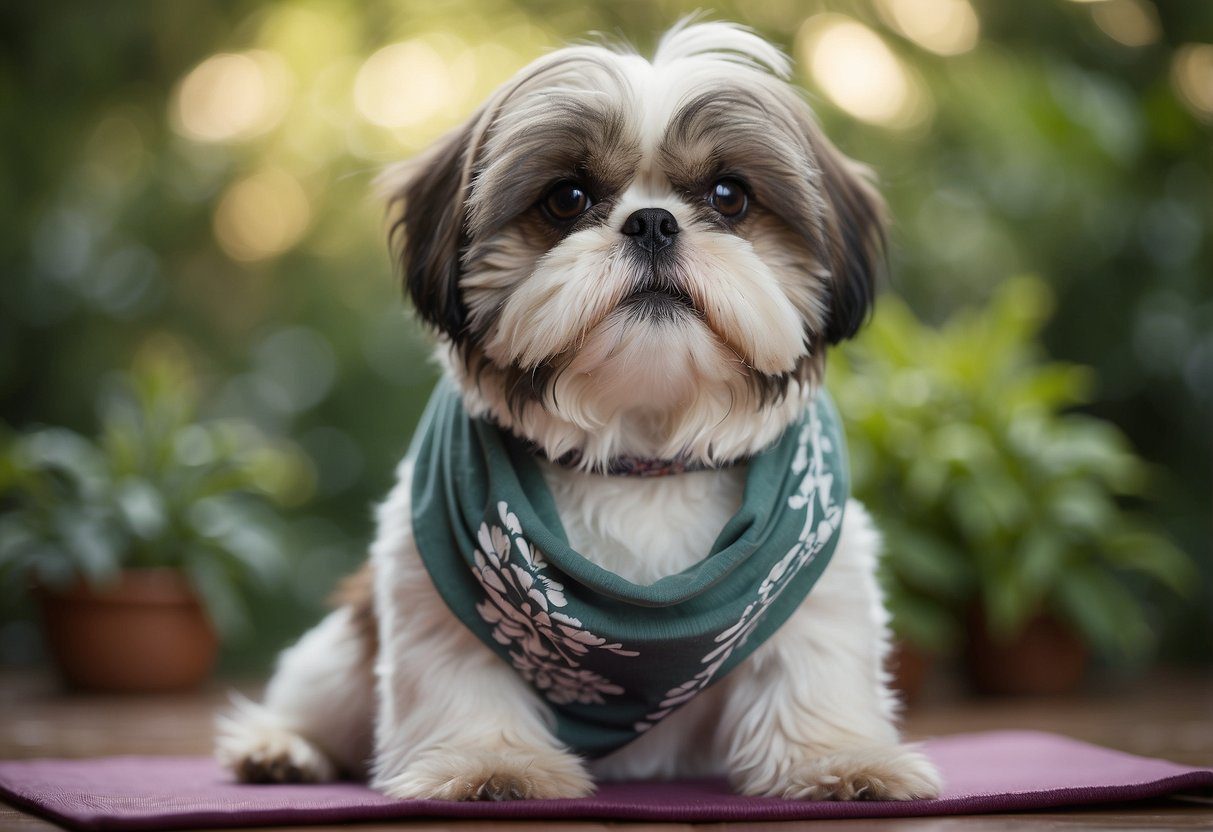
Shih Tzus are not a delicate breed, and many live well into their teens. But the problems they do get cluster tightly around two areas — the face and the eyes — and both are structural. Knowing that in advance is most of the battle, because it turns “bad luck” into things you can watch for.
What Actually Goes Wrong
Eyes first. Large, prominent and set in a flat face, they are exposed to scratches, ulcers and dry eye in a way a deep-set eye is not. Squinting, pawing at the face, or any coloured discharge is a same-week vet visit rather than a wait-and-see. The eye conditions the breed is prone to covers this properly.
Then breathing. The shortened muzzle narrows the airway, so heat, exertion and excitement all cost a Shih Tzu more than they cost a longer-nosed dog. Most cope fine; a minority need surgical help, and that is worth assessing early rather than late.
Beyond those two: ear infections, because dropped, heavily-feathered ears trap warmth and moisture; skin and allergy trouble, which usually shows as scratching and hot spots; dental crowding from the undershot jaw; and, less commonly but seriously, liver shunts and patellar luxation. The full list of breed health issues goes through each. Lifespan is generally good — weight is the factor most within your control.
Feeding
Small stomachs, so split the daily ration into two or three meals rather than one. Beyond that, the important number is not the brand on the bag but the amount in the bowl: this breed gains weight easily, and extra weight loads an airway that already has less margin than most. Treats count towards the daily total, and a Shih Tzu reaches the usual 10% ceiling fast.
Fresh water always available, and a flat-faced dog in warm weather should be checked on more often than you would think necessary. Any specific dietary change — a new protein for suspected allergies, a prescription diet, a supplement — is worth running past your vet first rather than diagnosing from a search result.
When to call a vet without waiting
Most of what a Shih Tzu owner deals with can wait for a normal appointment. These cannot:
- Laboured breathing, or wheezing that does not settle after rest.
- Refusing food for more than twenty-four hours.
- A swollen eye, persistent squinting, or green or yellow discharge.
- Vomiting or diarrhoea lasting longer than a day.
- Limping, or yelping when touched.
- Scratching, redness or hair loss that appears suddenly, which can point to an allergic reaction or parasites.
The breathing one matters more in this breed than in most. A shortened muzzle leaves less margin, so respiratory trouble can escalate quickly — that is the symptom least worth waiting out.
Behaviour and Temperament
Bred as a companion for centuries, and it shows: the Shih Tzu wants to be wherever you are. That is the breed’s great strength and the source of most of its problems.
What They Are Like to Live With
Affectionate, sociable and notably unbothered by strangers — this is not a suspicious breed. They are also less frantic than most toy dogs, content with short bursts of play and long stretches of lying somewhere warm. Two modest walks a day is enough, and in summer the limiting factor is heat rather than distance.
The flip side is that they do not cope well with being alone. Separation-related barking and destructiveness are the most common complaints owners raise, and they are not a training failure so much as the breed doing what it was made to do. How long is reasonable to leave one is worth settling honestly before you get one, not afterwards. They generally live well with cats and with other dogs.
More on what the breed is actually like day to day, and on how much of the day they spend asleep — which is more than most new owners expect.
Training
Shih Tzus get called stubborn. That is the wrong word — they learn quickly and simply have very little interest in obeying for its own sake, which is what you would expect from a breed never selected for biddability. Reward-based training works; repetition and correction do not.
House training is the hard part, and it takes most owners longer than they were led to expect. A small bladder, a low tolerance for going out in bad weather, and a habit of finding a quiet corner indoors all work against you. A fixed schedule beats supervision, and an enzymatic cleaner matters more than patience.
Socialisation while young is the thing that pays off most. It is an easy breed to socialise — they like people — but a Shih Tzu that never met much as a puppy can become a barker, and that is far harder to undo than to prevent.
Is a Shih Tzu Right for You?
The breed suits a narrower set of households than its popularity suggests. Worth being honest with yourself on all five of these before deciding.
A Shih Tzu probably suits you if
- Somebody is home most of the day. This is the single biggest predictor of whether the dog is happy.
- You want a companion rather than an activity partner — flat living is fine, a garden is optional.
- You are willing to either brush daily or keep the coat clipped short, and to budget for grooming if you do not do it yourself.
- You are comfortable with a dog that will need its eyes and face checked regularly, and a vet who knows brachycephalic breeds.
Look at another breed if
- The house is empty nine hours a day. It is the wrong dog for that, and no amount of training fixes it.
- You live somewhere reliably hot without air conditioning. Heat is this breed’s genuine risk.
- You want a jogging or hiking companion.
- You chose it because it is “hypoallergenic” — no breed is, and reactions to a Shih Tzu are perfectly possible.
- The grooming budget is the part you were hoping to skip. The real cost of ownership is mostly recurring, not the purchase price.
If it does sound like the right fit, it is worth looking at rescue before a breeder — the breed turns up in rescue more often than you would guess, frequently for exactly the reasons above. And if you are still weighing it against something similar, Shih Tzu vs Havanese is the comparison most people end up making.
Every Shih Tzu Guide, by Topic
The full set, grouped by what you are trying to work out. Nothing here repeats what is above — each one is the long answer.
Coat, grooming and shedding
- How much a Shih Tzu sheds and what drives it
- Keeping the coat long — the commitment it needs
- Going short — what changes when you clip it down
- Haircut styles, and which suit which owner
- Grooming the face — the fiddliest part, and where the eyes are
- Preventing mats before they need cutting out
- The grooming kit worth owning
- Which brush does which job
- Coat colours and how they change with age
- The hypoallergenic question, answered properly
Health and lifespan
- Health problems the breed is prone to
- Eye problems — the most common reason for a vet visit
- Lifespan, and what actually extends it
Size, growth and puppies
Temperament, training and daily life
- Temperament — what the breed is actually like to live with
- How trainable they are, and why “stubborn” is the wrong word
- Potty training, which is the hardest part for most owners
- Being left alone — how long is reasonable
- How much they sleep
- Living with cats
Getting one, and gear
- What a Shih Tzu costs, upfront and ongoing
- Rescuing rather than buying
- Shih Tzu vs Havanese — the comparison people weigh most
- Harnesses — a collar is the wrong choice for a flat-faced breed
FAQs
Shih Tzus are charming little dogs with unique traits and specific needs. From understanding their lifespan to managing their behavioral tendencies, knowing more about them can make your journey as a pet owner smoother.
What should I consider before deciding on the price of a Shih Tzu puppy?
Before buying a Shih Tzu puppy, consider factors like breeder reputation, puppy lineage, and health screenings. Well-bred, Kennel Club-registered Shih Tzu puppies can cost around £770, while non-registered ones average £530 UK Shih Tzu prices.
How long do Shih Tzu dogs typically live, and how can I maximize their lifespan?
Shih Tzus typically live between 10-16 years. To help them live longer, ensure they get regular veterinary care, a balanced diet, and plenty of exercise. Early detection and treatment of health issues are critical lifespan tips for Shih Tzus.
What are some behavioral tendencies of Shih Tzus that owners should be aware of?
Shih Tzus are known for their affectionate and friendly nature. They can be stubborn at times, and housebreaking can be a challenge. Their temperament makes them great companions but require patience and consistent training.
Can you list the prime advantages and disadvantages of owning a Shih Tzu?
Advantages:
They are small and adapt well to apartment living.
Their affectionate and loyal nature makes them great companions.
Disadvantages:
They require regular grooming due to their long coat.
They are prone to health issues like heat stroke due to their short muzzle. You can find health tips here.
How often does Shih Tzus need companionship to prevent separation anxiety?
Shih Tzus thrives on human interaction and can suffer from separation anxiety if left alone for too long. They prefer to be around their family most of the time.
Regular companionship and mental stimulation are key to keeping them happy.
What size and weight can I expect my Shih Tzu to reach as an adult?
An adult Shih Tzu usually weighs between 9-16 lbs (4.08-7.26 kg) according to the AKC breed standard. Pet Shih Tzu can sometimes weigh more, ranging from 7 lbs to 20 lbs or more Shih Tzu weight details.