As an Amazon Associate I earn from qualifying purchases.
To demat a dog without cutting, start by misting the mat with a dog-safe detangling spray. Hold the hair firmly at the skin, and use your fingers to pick the mat apart from the tips inward, then follow with a dematting comb and finally a slicker brush.
Work in short strokes. Never pull, and stop if the skin tents or turns red.
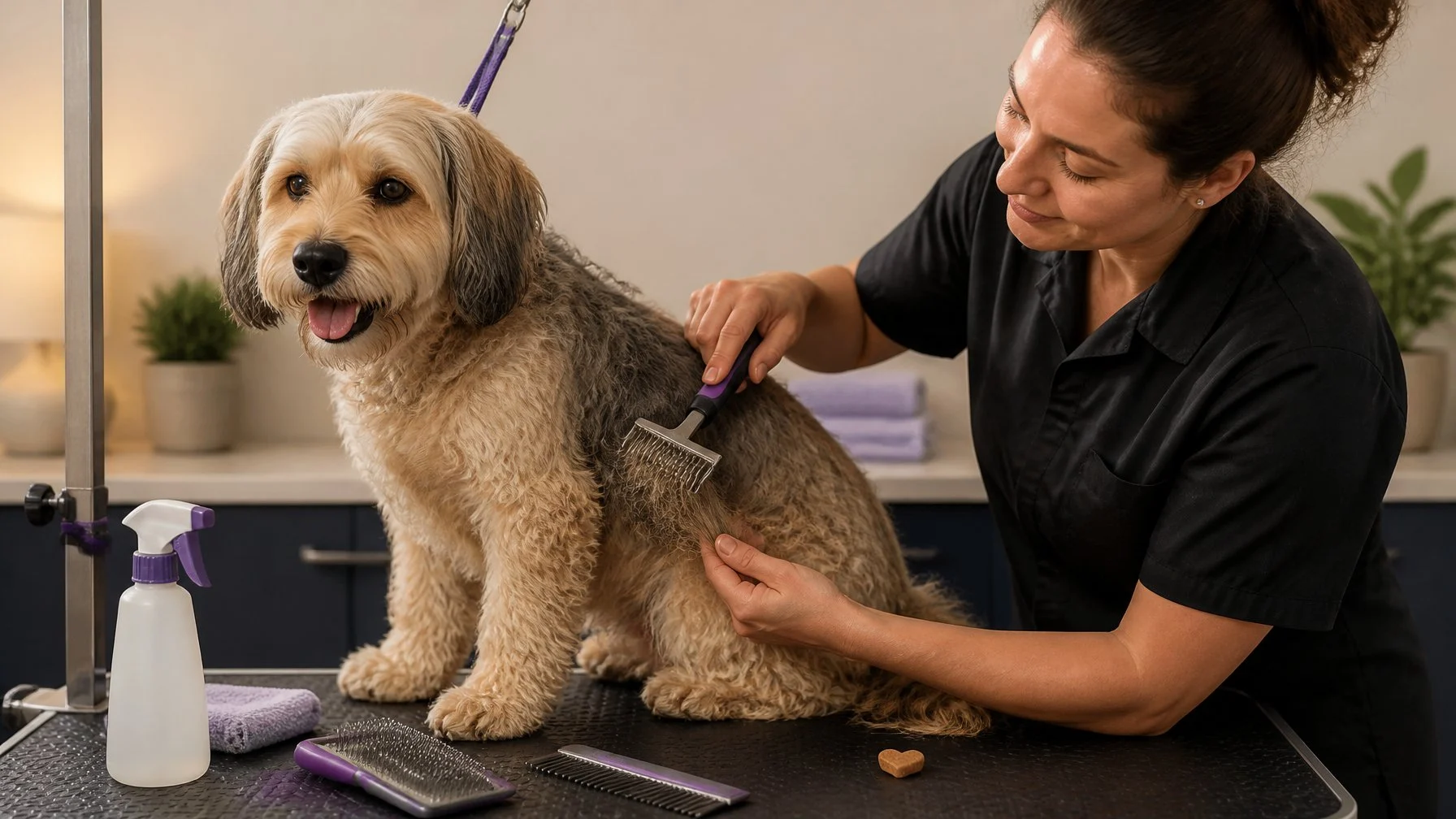
Most mats owners spot at home are still soft enough to fix. The key is knowing which mats you can handle, which tool to grab, and when to call it quits.
Dog Fluffy has spent years turning grooming questions like this into calm, research-informed steps for fluffy dog parents. This walkthrough even covers a section French Bulldog owners almost never see mentioned.
Check Whether the Mat Is Safe to Handle at Home
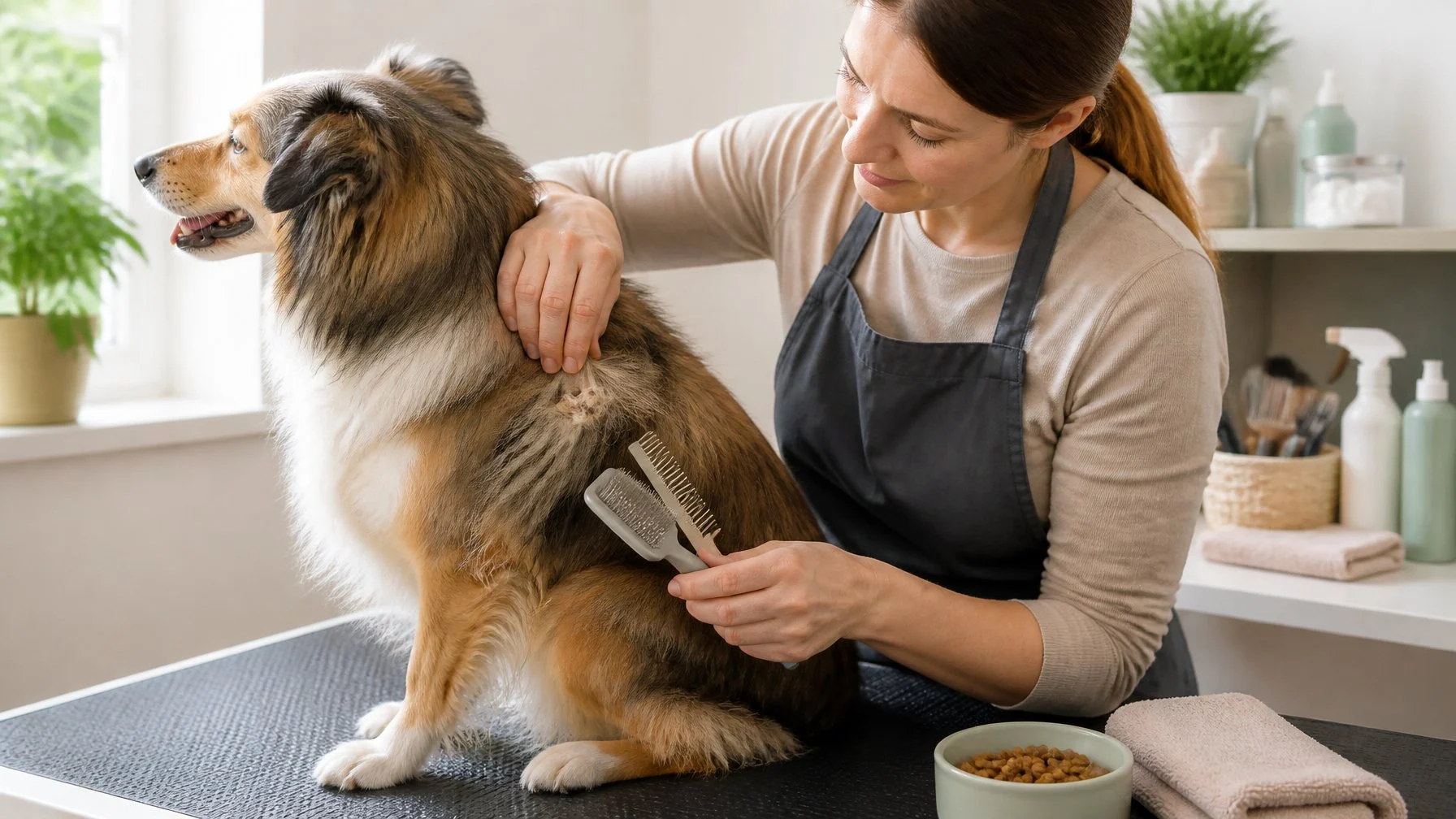
If you can slide a comb tooth under the mat, you can probably handle it at home. But if the mat’s stuck flat against the skin, sits over broken skin, or smells funky, leave it alone—scissors can turn a grooming session into a vet visit fast.
Signs of a Loose Tangle Versus a Tight Skin-Level Mat
A dog mat is a clump of dead and living hair twisted together into a dense knot that pulls on the skin underneath. Loose tangles feel spongy. Tight mats feel like felt.
The quickest test at home is the lift test:
- Slide two fingers between the mat and the skin. If they fit, you’ve got a workable mat.
- Lift the mat gently. If the skin comes up with it (skin tenting), it’s too tight.
- Press the mat. If it’s soft and airy, you can try. If it’s hard and flat, stop.
Loose tangles usually sit on the outer coat. Skin-level mats trap moisture and heat, and that’s where sores start.
Red Flags That Mean Stop and Call for Help
Some things just mean you’re done, no matter how patient you are:
- Red, damp, or broken skin under the mat
- A sour or yeasty smell
- The dog yelping, snapping, or freezing when touched there
- Mats joined together across the body like a shell
- Anything near the eyes, ear canal, armpits, or genitals
Pain changes a dog’s mind about grooming for months. One bad session costs more than a single groomer appointment.
Why Scissors and Force Can Injure a Matted Dog
Skin under a mat gets pulled upward into the knot. It’s thin, stretchy, and you can’t see it.
Cutting blind means you risk cutting skin. Lacerations from DIY mat removal are a common reason dogs end up at the clinic.
Force does damage even without blades. Ripping a comb through a mat pulls living hair from the follicle and bruises the skin. It also teaches your dog that brushes hurt. Slow always beats strong here.
Gather the Tools Before Your Dog Settles In
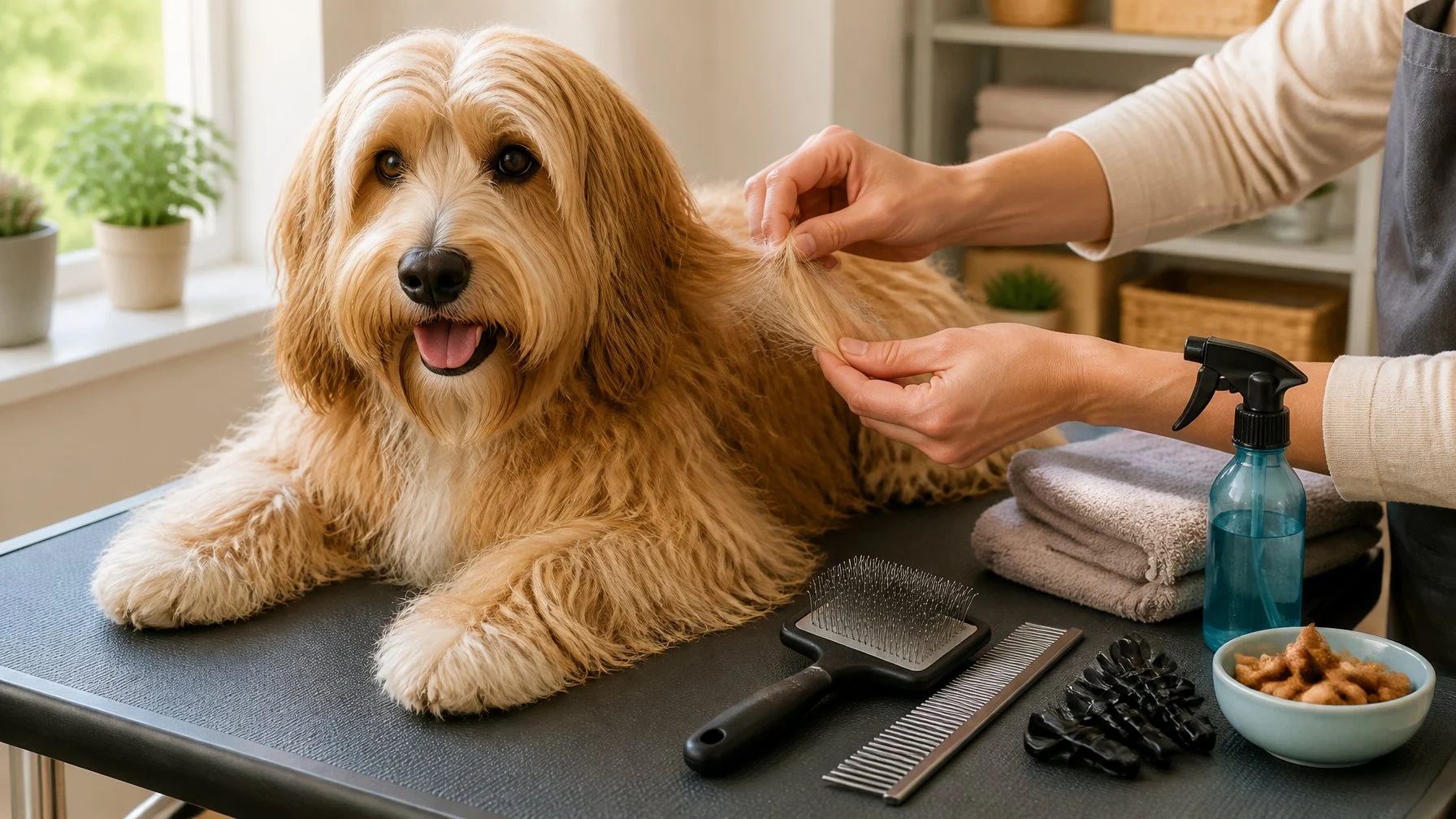
Three things decide if a mat comes out cleanly: slip (a detangling spray), the right comb for the stage, and a mat splitter used gently. Don’t skip any of them.
Dog-Safe Detangling Spray and Skin Support
Dry hair snaps. Slippery hair slides. A dog-formulated detangling spray or leave-in conditioner coats each strand so the mat loosens instead of tearing.
Spray the mat and let it sit for a minute or two before touching it. Rushing wastes the product and just makes things harder.
Quick ground rules:
- Use products made for dogs, not human stuff with strong fragrance
- Skip alcohol-heavy sprays on itchy or sensitive skin
- Cornstarch rubbed into a small dry knot can add grip and help fingers separate it
- Never brush a dog still damp from a bath—water tightens mats
Which Comb or Brush Fits Each Stage
Each tool has one job. Using them out of order just gets you stuck.
| Tool | Best stage | What it does |
|---|---|---|
| Fingers | First | Splits the mat into thinner sections without tension |
| Wide-tooth comb (wide-toothed comb) | Early | Tests how deep the tangle goes |
| Dematting comb | Middle | Works through the knot’s body in short strokes |
| Slicker brush | Middle to late | Lifts loosened hair and dead undercoat |
| Greyhound comb | Last | Confirms the coat is truly clear, root to tip |
If the greyhound comb glides from skin to tip with no snag, the mat is gone.
Why a Mat Splitter or Dematting Tool Needs Careful Use
A mat splitter has curved blades that slice a mat into strips, always from the outer edge outward. Used well, it turns one thick knot into several thin ones that comb out easily.
But it’s still a blade near skin. Always point it away from the body, take one strip at a time, and put it down the second your dog tenses up.
Follow the Gentle Dematting Sequence
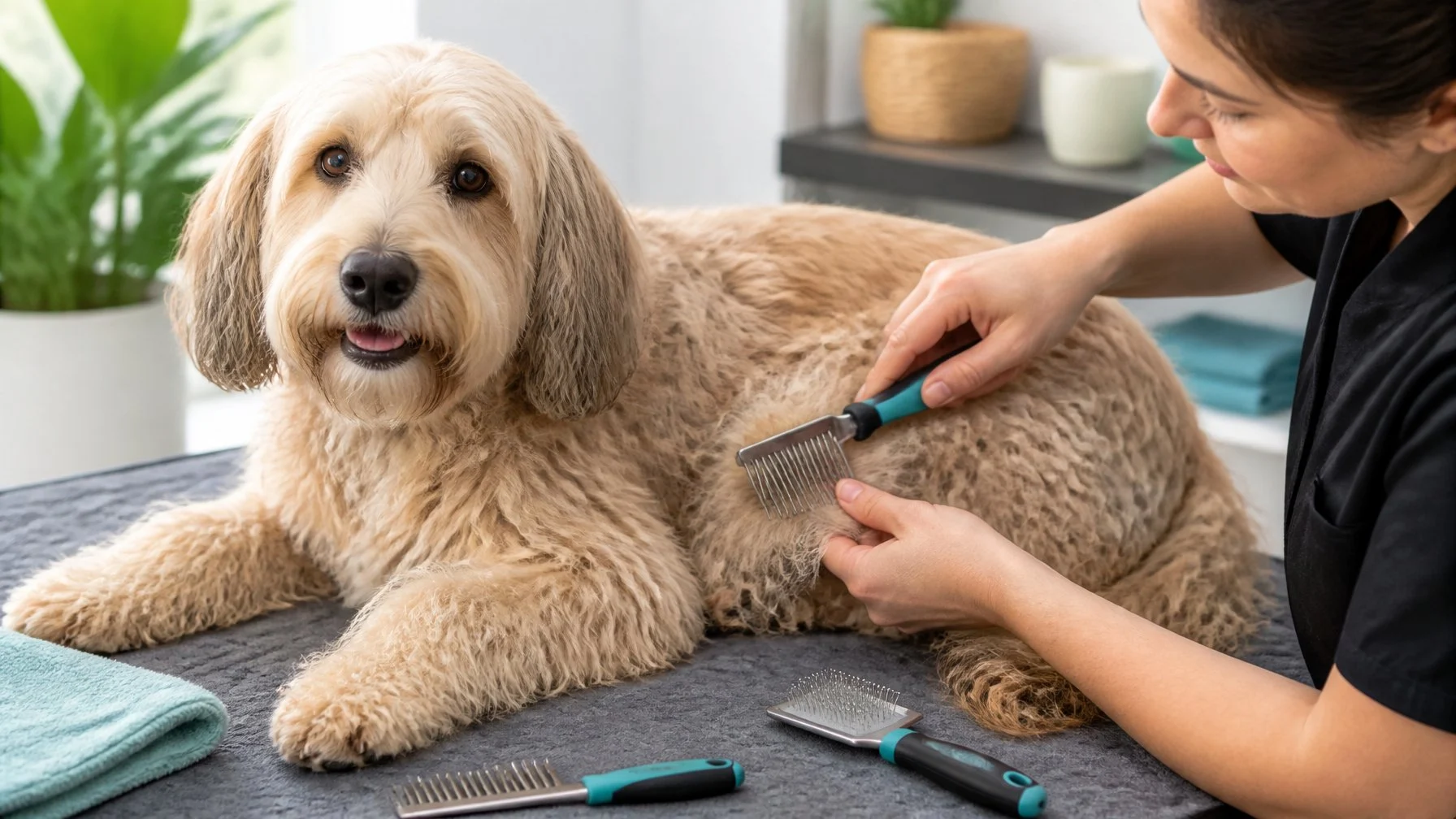
The whole process comes down to four moves: settle your dog somewhere stable, anchor the hair at the skin with one hand, pick from the ends inward, then check the coat with a fine comb. Don’t brush the same spot raw.
Set Up a Stable, Low-Stress Grooming Spot
Pick a non-slip surface at a comfortable height. A towel on a table, a rubber bath mat, or even a sofa cushion can work.
Short sessions are better than marathon ones. Ten to fifteen minutes with a break keeps your dog willing to come back tomorrow.
Keep treats within reach and make the room quiet. If your dog hears the doorbell or vacuum, they won’t hold still for delicate work.
Anchor the Hair at the Skin Before Each Stroke
This single habit prevents most grooming pain. Pinch the hair between the mat and the skin with your non-working hand, so every comb stroke pulls against your fingers, not the dog.
Here’s the sequence, step-by-step:
- Feel the whole coat with bare hands and mark every mat before picking up a tool.
- Mist each mat with detangling spray and wait 1 to 2 minutes.
- Pinch the hair firmly at the base of the mat, close to the skin.
- Use fingers to split the mat lengthwise into two or three thinner sections.
- Comb the loose tips first with a wide-tooth comb, holding the anchor the whole time.
- Switch to a dematting comb and take short, shallow strokes at the outer edge.
- Move 3 to 5 mm (about 1/8 to 1/4 inch) deeper only once the layer above releases freely.
- Finish the area with a slicker brush, then a greyhound comb to test it.
- Reward your dog and stop for the day if they’ve had enough.
Loosen the Outer Edges Before Working Closer to the Roots
Mats are tightest at the skin and loosest at the tips. Starting at the root means fighting the densest part first and pulling hardest on the follicle.
Working tips-first shrinks the mat from the outside in, until there’s almost nothing left at the base. It’s like unpicking a knot in a shoelace, not just hacking through it.
If ten minutes of patient work hasn’t shrunk a mat at all, it’s probably time to call in a pro.
Confirm the Coat Is Clear Without Over-Brushing
Over-brushing one spot leads to brush burn—red, tender skin from too many slicker strokes. Dogs often show it the next day, not during the session.
Test instead of repeating. Run a greyhound comb from skin to tip in three directions. If it passes clean, move on. Check the whole dog again in 48 hours, because loosened hair loves to re-knot.
French Bulldog Mats Need a Different Look
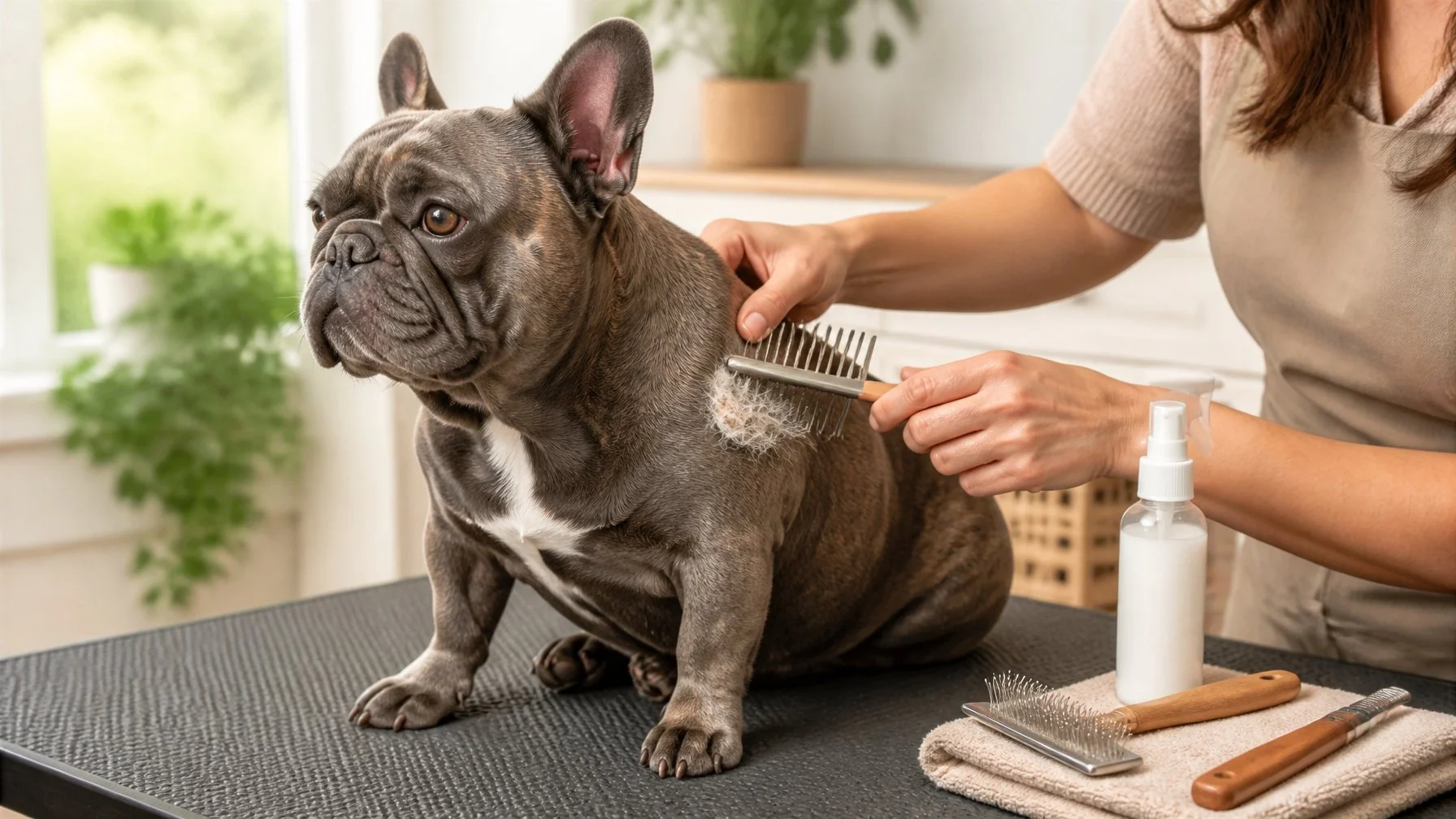
French Bulldogs don’t have the long, endlessly growing coats of Poodles, but they still get compact tangles where gear rubs, folds trap moisture, and shed hair gets stuck. Their sensitive skin and flat faces make grooming a bit different, honestly.
Where French Bulldogs Can Tangle Despite Short Hair
Frenchies shed year-round, and that loose hair doesn’t always fall away. It catches in the living coat and packs down into small, dense clumps, often no bigger than a pea.
Common spots owners miss:
- The line where a harness strap crosses the chest and shoulders
- Under a collar, especially a wide or padded one
- Around the tail pocket and rear
- Behind the elbows and in the armpits
- The base of the neck, where clothing or a coat sits
These mats stay small, but they sit right on skin that’s already prone to irritation, so they matter more than their size suggests.
Harness Lines, Skin Folds, and Other Friction Zones
Friction zones are spots where two surfaces rub—gear against coat, skin against skin, or leg against body. Moisture just makes it worse.
For a Frenchie, the routine looks a bit different than for a long-coated dog.
- Take the harness off indoors so the same strap line doesn’t get compressed all day.
- Dry facial and body folds after eating, drinking, or walking in rain.
- Check the tail pocket weekly, since debris and damp love to collect there.
- Use a soft rubber curry or a fine-tooth comb, not an aggressive dematting rake.
Skin folds can hide more than tangles. If you spot redness, damp patches, or a weird smell in a fold, that’s irritation—time for the vet, not a comb.
Keeping a Flat-Faced Dog Cool and Comfortable During Grooming
Brachycephalic dogs overheat fast. They struggle to cool down by panting, and grooming stress can raise their body temperature just like exercise does.
Keep sessions under about ten minutes. Work in a cool room, and stop at the first sign of loud or labored breathing.
Don’t hold a Frenchie on their back for long, and definitely skip hot dryers. A cool room and a towel do the trick.
Build a Routine That Stops New Mats Early
Prevention mostly comes down to three habits: match brushing frequency to coat type, dry the coat properly after it gets wet, and give curly and double coats the extra attention they need.
Brush and Comb Checks Based on Coat Type
The brush isn’t the point. The check is. A quick hands-on pass through the coat catches a tangle before it turns into a problem.
| Coat type | Example breeds | Suggested check |
|---|---|---|
| Curly / continuously growing | Poodles, Goldendoodles | Daily comb-through, line brushing |
| Long silky | Shih Tzus | Daily brush, focus behind ears |
| Double coat | Samoyeds, Huskies, Golden Retrievers | 2 to 3 times weekly, more in shedding season |
| Short single coat | French Bulldogs, Bulldogs | Weekly check of friction zones |
Use a slicker brush to lift and separate, then a wide-tooth comb to check if the coat is clear.
Brushing alone can hide mats under a smooth surface.
Drying After Baths, Rain, and Swimming
Water is the fastest mat-maker out there. Wet hair swells, then shrinks as it dries, twisting loose hairs into knots.
Three rules that prevent most bath-day mats:
- Comb the coat out fully before the bath, never after soaking tangled hair.
- Towel-dry and blow-dry to the skin, not just the surface.
- Brush while drying, section by section, so the coat dries straight.
Wet dogs after rain or a swim need the same treatment, even if it’s just five minutes with a towel and a comb.
Extra Coat Care for Poodles and Double-Coated Dogs
Poodles and doodle crosses barely shed, so dead hair stays in the coat until you comb it out. That’s why they mat faster than almost anything else.
Line brushing helps: part the coat, brush the exposed layer from the skin outward, then move the part up a few millimeters and repeat.
Double-coated dogs like Samoyeds and Huskies mat differently. Their dense undercoat packs down, especially behind the ears, under the collar, and along the trousers.
Gently use an undercoat rake during shedding season to clear out the dead layer before it compacts.
Know When a Professional Should Take Over
Certain mats need a professional groomer or a vet from the start. Anything near delicate areas, coats that have gone pelted, and knots that just won’t separate no matter how much spray or patience you throw at them—those are jobs for the pros.
Mats Near Eyes, Ears, Genitals, or Damaged Skin
Thin skin, moving parts, and no margin for error—that’s the combo in these areas.
Hand the job over when a mat sits:
- Against the eyelid or in the hair around the eye
- Inside or at the edge of the ear flap
- Around the genitals, anus, or in the tail pocket
- On top of a hot spot, scab, or damp patch
- Over a lump, wart, or old scar
Groomers can’t always see a skin tag hidden inside a mat either, which is exactly why they work slowly with tools most owners don’t have.
Pelted Coats and Mats That Will Not Separate
A pelted coat means individual mats have fused into a solid layer that moves as one piece across the dog’s body.
Pelting can’t be brushed out. The kind thing is a short clip under the pelt, done by someone who can feel where the skin sits.
Signs a coat has pelted:
- The coat lifts away from the body in a sheet
- Skin underneath looks pale, damp, or has a smell
- The dog resists being touched in that whole area
What a Professional Groomer or Veterinarian Can Safely Do
A groomer brings clipper blades, a mat splitter, a high-velocity dryer, and thousands of hours of feel for where the skin sits under a knot. That combo removes in twenty minutes what would take an owner an afternoon—and a lot less discomfort for the dog.
A vet steps in when there’s already skin damage, infection, maggot risk in warm climates, or when the dog needs sedation to be handled safely. Severe cases sometimes need both. That’s not a failure on the owner’s part. It’s just the right call.
From Fluffy’s Bowl: set a timer before you start, not after you are frustrated. Ten minutes on one mat, then stop — whatever it looks like. The damage in dematting almost never happens in the first ten minutes; it happens in the twenty after you decided you were nearly there.
The Kit For This Job — And One Tool To Treat Carefully
Everything here supports working a mat loose rather than cutting it out. The third item is the one this article warns about, and it is included with that warning intact.
TropiClean Dematting and Detangling Leave-In Spray, 16oz
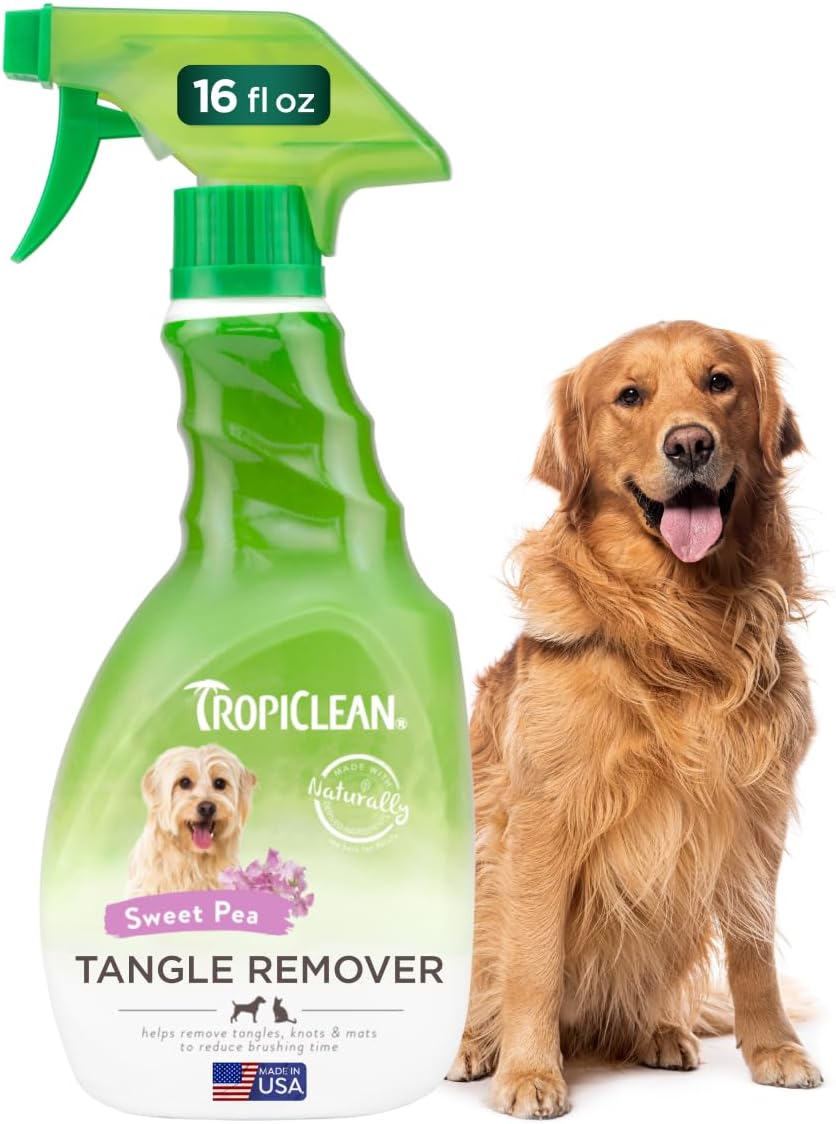
The slip that makes the whole gentle sequence possible. Check price on Amazon
| Things We Like | Things We Don’t Like |
|---|---|
| Adds enough slip for a comb to pass without tearing hair | Cannot loosen a tight, skin-level mat on its own |
| Leave-in, so it keeps working through a long session | Coat needs drying afterwards, as described above |
| Large bottle for repeated dematting work | A scented product some dogs object to |
Master Grooming Tools Fine/Coarse Steel Greyhound Comb
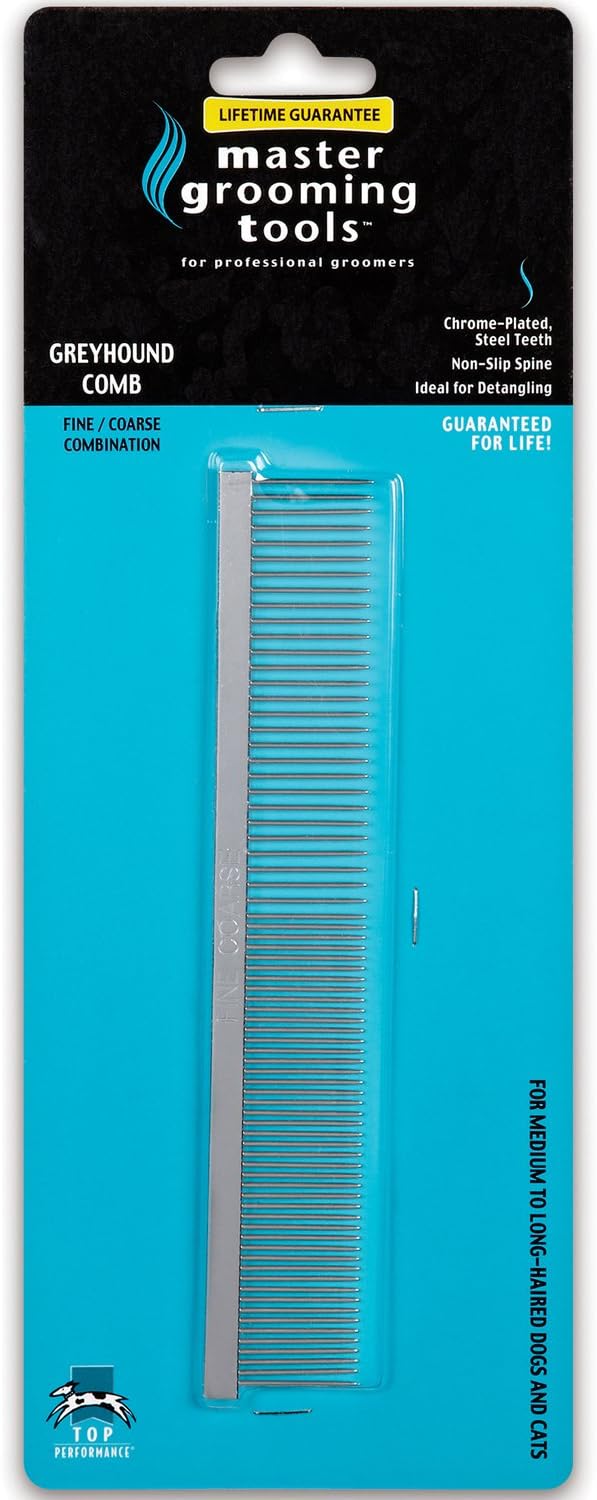
The comb for the edges — where this article says to start. Check price on Amazon
| Things We Like | Things We Don’t Like |
|---|---|
| Coarse end for the outer edge of a mat, fine end to confirm | Slow, deliberately so |
| Solid steel that will not flex past a knot | No handle to grip when a dog shifts |
| Small enough to work one line at a time | Not the tool for the middle of a dense mat |
Andis 68545 Stainless Steel Dematting Comb, 10in

A dematting comb. Read the section above before using one of these. Check price on Amazon
| Things We Like | Things We Don’t Like |
|---|---|
| Serrated blades cut through a mat rather than dragging it | These are cutting edges — the careful-use warning above is the point |
| Long handle gives control over each stroke | Easy to reach skin with, especially on a loose-skinned dog |
| Faster than a comb on a mat that will not open | Removes coat permanently, so it is not a no-cut tool in the strict sense |
Frequently Asked Questions
How can someone safely remove matted fur from a dog without using scissors?
Mist the mat with a dog-safe detangling spray. Pinch the hair at the skin, and split the mat into thin strips with your fingers. Comb the loose tips first with a wide-tooth comb. Then take short strokes with a dematting comb, working inward. Finish with a slicker brush and a greyhound comb to check if the coat is clear.
Is it better to work on dog mats when the coat is dry or damp?
Work on mats when the coat is dry. Water swells hair and then tightens knots as it dries, so bathing a matted dog just makes things worse. Use a light detangling spray for slip instead of soaking. Always comb the coat out fully before any bath, never after.
What tools help loosen tangles without pulling a dog’s skin?
Fingers do most of the work, followed by a wide-tooth comb for testing depth. A dematting comb helps with the body of the knot, and a slicker brush lifts loosened hair. A greyhound comb checks if the coat is clear. A mat splitter can help on thicker mats, just keep it pointing away from the skin.
Can detangling spray or conditioner help with badly matted dog hair?
Spray helps mild and moderate mats by adding slip so hairs slide apart instead of tearing. It won’t rescue a dense, skin-level mat or a pelted coat. If ten minutes of patient work hasn’t visibly loosened a mat, product isn’t the missing piece. That mat needs a professional groomer.
When are dog mats too severe to remove at home?
Stop when the skin tents as the mat lifts, when fingers won’t fit between mat and skin, when mats have fused into a sheet, or when there’s redness, damp, odor, or broken skin. Mats near eyes, ears, or genitals also belong to a professional. Pain in one session can make a dog fear grooming for months.
Do mats hurt a dog, and when should someone contact a groomer or vet?
Yes, mats can hurt a dog. They pull on the skin, make it tough for your dog to move, and trap moisture that can cause sores or infections. If you notice tight, widespread, or pelted mats, it’s time to call a groomer. But if the skin looks broken, smells bad, oozes, or your dog can’t be handled without pain, reach out to your vet. Where does your dog get the worst tangles—behind the ears, under the harness, or maybe somewhere else? Drop your answer in the comments so others can relate (or commiserate). This isn’t veterinary advice, just general guidance. Always check with your vet about your dog’s specific needs.