As an Amazon Associate I earn from qualifying purchases.
Line brushing means parting a dog’s coat into thin layers and brushing each layer from the skin outward, one small section at a time. It reaches the undercoat where mats actually start, instead of just skimming the top.
Surface brushing makes a dog look tidy; line brushing keeps the coat tangle-free all the way down to the skin.
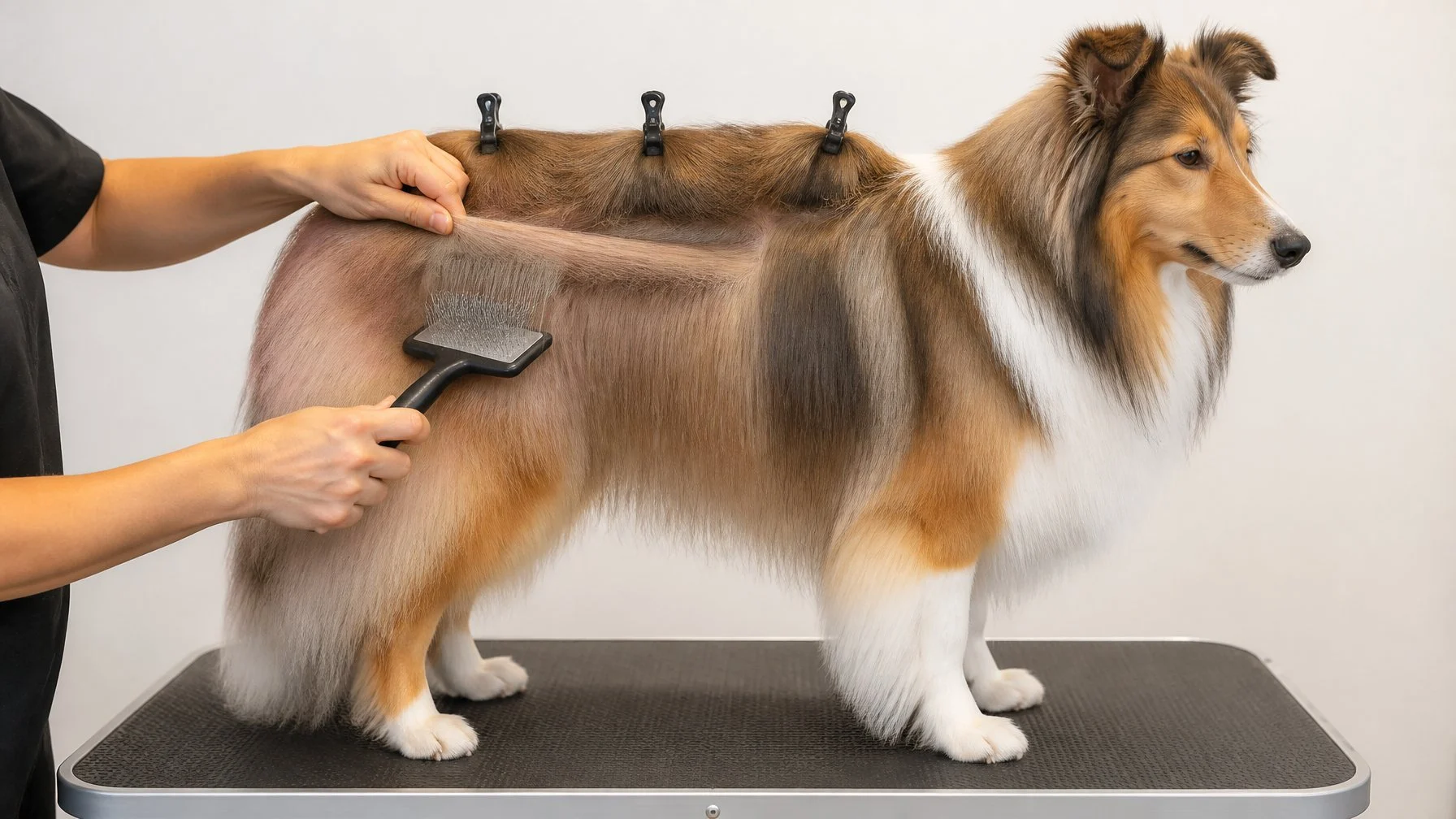
So why do so many well-brushed dogs still show up at the groomer with hidden mats? The tangles form at the root, quietly, under a fluffy-looking surface.
Dog Fluffy focuses on gentle, prevention-first coat care. This walk-through covers the tools, the skin-to-tip motion, the friction spots that mat first, and the moment brushing should stop instead of pushing through.
What Line Brushing Reaches That Surface Brushing Misses
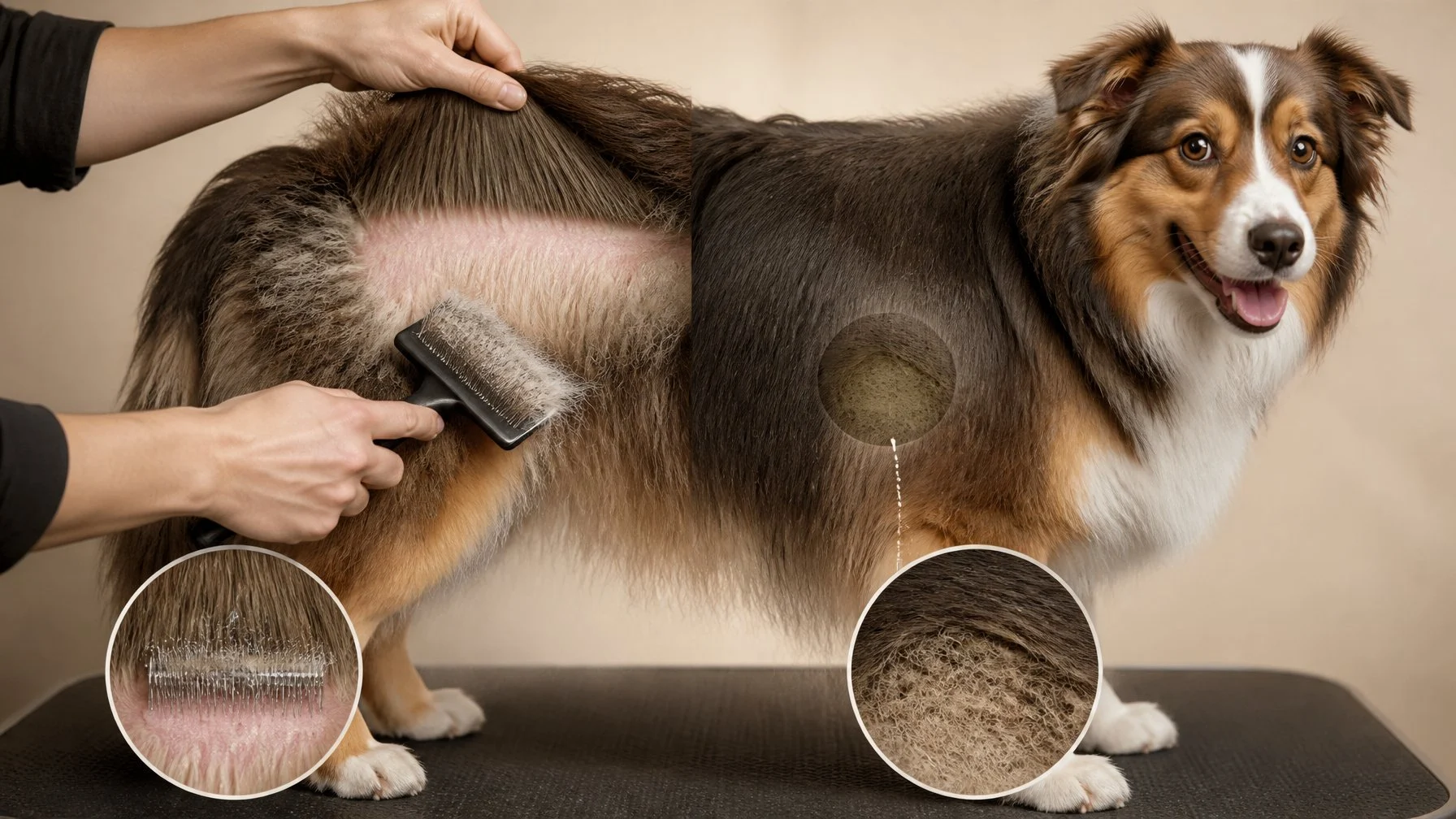
A brush that glides over the top of the coat never touches the bottom 2 cm [about 0.8 in] where mats begin. Curly, dense, and double coats need the layered approach.
Short smooth coats like a French Bulldog’s don’t need line brushing at all.
The Skin-to-Tip Difference
Surface brushing moves the outer hair. The base stays untouched, and dead undercoat keeps building up down there.
Line brushing is the professional method of parting a dog’s coat into finger-width sections and brushing each one from the skin outward to the tips.
That’s really it. As one grooming breakdown of line brushing puts it, when only the surface gets brushed, the hair closest to the skin stays untouched and moisture, friction, and shed hair do the rest.
Coats That Benefit Most
Some coats mat fast. Others barely tangle at all.
Here’s a rough guide based on coat-type brushing frequency:
| Coat type | Examples | Suggested frequency |
|---|---|---|
| Curly or dense | Poodle, Bichon, Doodle | 3x per week |
| Double coat | Husky, Pomeranian, Samoyed, Collie | 2 to 3x per week |
| Long coat over 4 cm [1.5 in] | Goldendoodle, Shih Tzu, Old English Sheepdog | 3x per week |
| Short single coat | Boxer, Labrador, Greyhound | 2x per month |
The longer and denser the coat, the shorter the gap between sessions should be.
Why French Bulldogs Usually Need a Different Routine
French Bulldogs have short, smooth, single-layer coats. There’s nothing long enough to knot, so parting lines just wastes time.
A soft rubber curry or bristle brush once or twice a week does the job. It lifts loose hair and spreads skin oils.
Frenchie owners should spend their grooming minutes on skin folds, not on tangles.
Wipe and dry the folds, check the tail pocket, and watch for redness. That’s where their real coat problems hide.
Set Up for a Calm, Safe Grooming Session
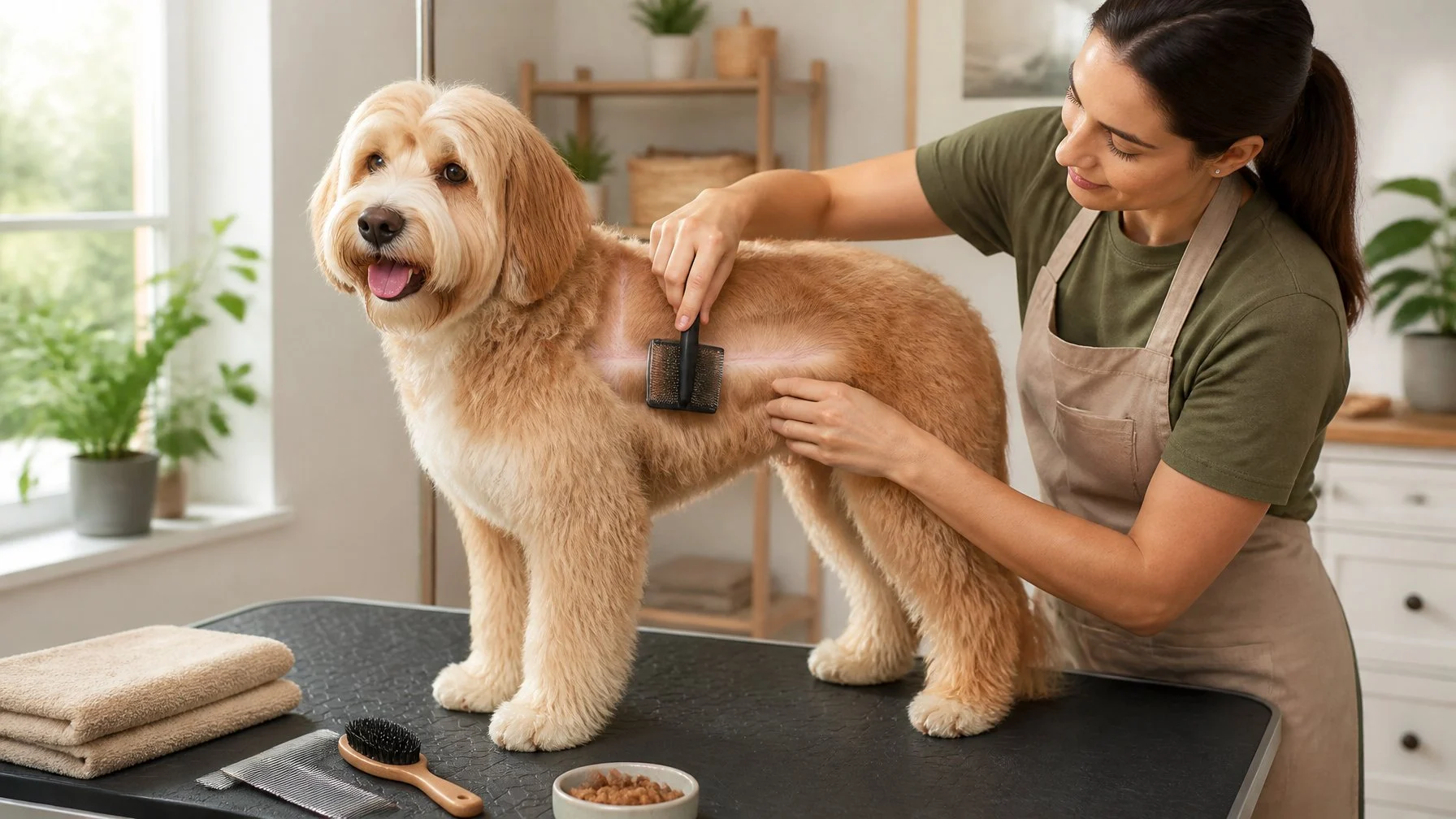
A steady surface, bright light, and three or four correct tools can turn a 40-minute wrestling match into a calm 20 minutes. A quick skin and coat check before the first stroke saves pain later.
Choose a Stable Surface and Good Light
Slippery floors make dogs tense. A non-slip mat on a table, a bath mat on the floor, or a grooming table with a safety loop all work.
Good light matters more than most owners expect, because the skin line has to be visible through the parted hair. A window seat or a clip-on lamp is usually enough.
Small dogs can sit on a raised surface at hip height. Big dogs are usually easier lying on their side.
Never leave a dog alone on a raised table, even for a second.
Pick Tools That Match the Coat
Four tools cover almost every fluffy coat:
- Slicker brush with fine, close-set bristles for the main brushing
- Metal or steel comb with medium teeth on one end, fine on the other, for the check pass
- Pin brush for very long, straight coats where a slicker is too harsh
- Soft bristle brush for short, smooth coats like Frenchies
- Detangling or coat spray to cut static and reduce breakage
Skip rubber-backed pin brushes and any tool with sharp, unpolished tips.
Check the Coat and Skin Before Brushing
Run both hands over the dog before any tool touches the coat. Fingers find things eyes miss.
Look for scabs, hot spots, ticks, flea dirt, burrs, and firm lumps of matted hair close to the skin. Brushing over an inflamed patch or a tick can hurt a dog badly, so map the trouble spots first.
Follow This Skin-to-Tip Brushing Method
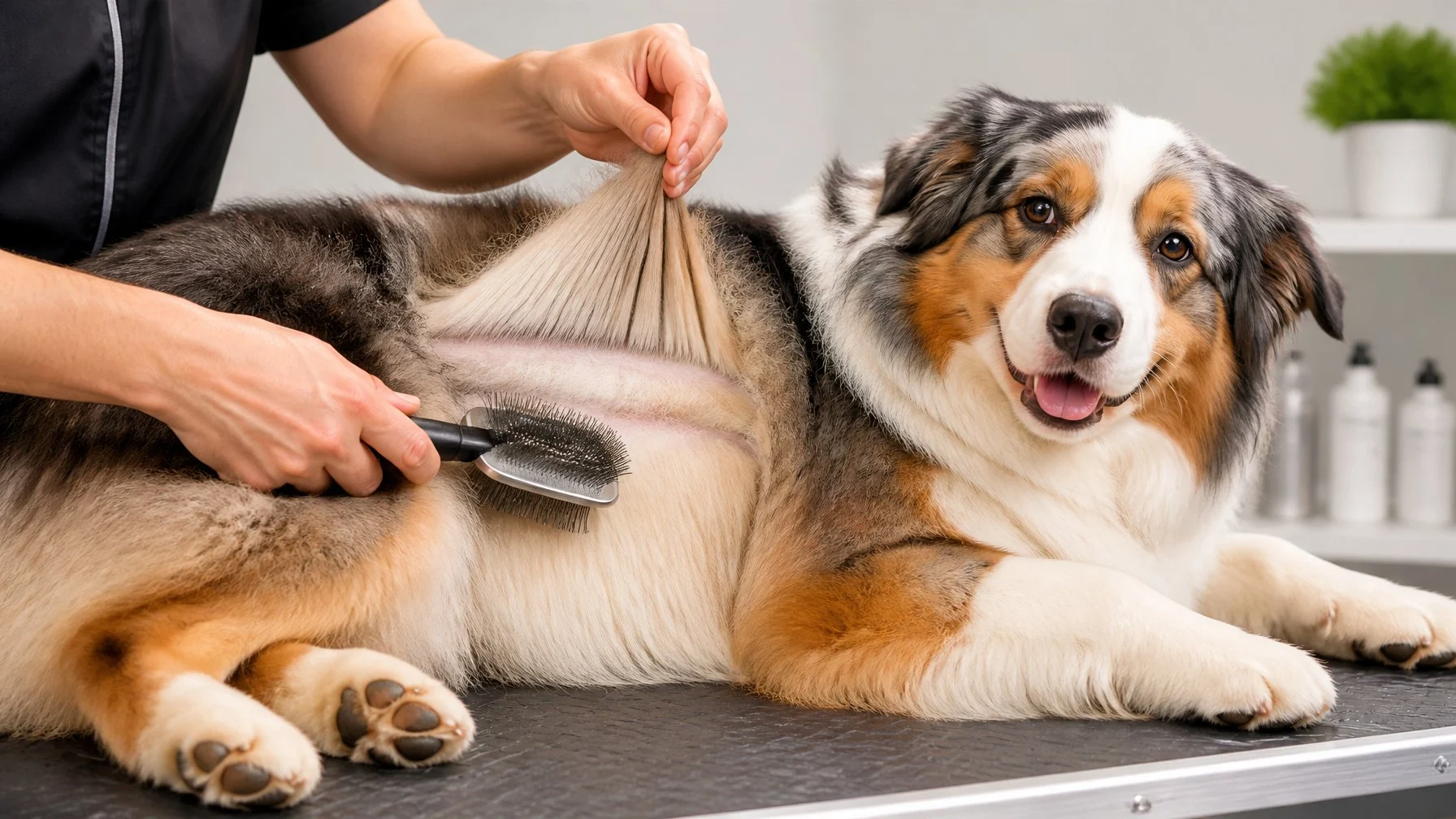
The pattern is simple: start low, part a line no wider than one finger, brush outward with a flat arm motion, then comb the same spot before moving up. Repeat until the whole body is done.
Start at the Lowest Part of the Coat
Begin at a paw, lower leg, or thigh and work upward toward the spine. Working bottom to top means each finished layer falls neatly over brushed hair, so nothing gets missed or brushed twice.
Starting at the back or shoulders feels faster. It isn’t. The lines get lost and whole patches go untouched.
- [Settle the dog](https://www.dogfluffy.com/how-to-calm-dog-for-grooming) on the non-slip surface and let it sniff the brush.
- Start at the lowest point of the coat, usually a hind leg.
- Lift the hair upward with one hand until the skin is visible, creating a part about 2.5 cm [1 in] wide.
- Mist that exposed strip lightly with detangling spray.
- Set the slicker flat at the skin line and brush outward in a straight stroke.
- Comb the same strip with the medium teeth, then the fine teeth.
- Drop the layer, lift the next line of unbrushed hair just above it, and repeat to the spine.
Part Small Lines and Support the Hair
Wide sections are the number one reason home line brushing fails. Keep each part about a finger wide.
Hold the hair above the line with the free hand. That support hand takes the tension, so a snag pulls against the fingers instead of the dog’s skin.
Brush Gently Before Moving Upward
The stroke should come from the shoulder and elbow, flat and straight. No wrist flicking.
Flicking drives the bristle tips into skin and causes brush burn. Brush in the direction the hair grows, not against the grain.
If the brush stops, stop with it. Tease the tangle apart with fingers first.
Use the Comb Check Before Leaving Each Area
The comb is the referee, not the brush. If a fine-toothed metal comb slides from skin to tip with no catch, that section is genuinely finished.
Any snag means another slicker pass.
Give Friction Zones Extra Time
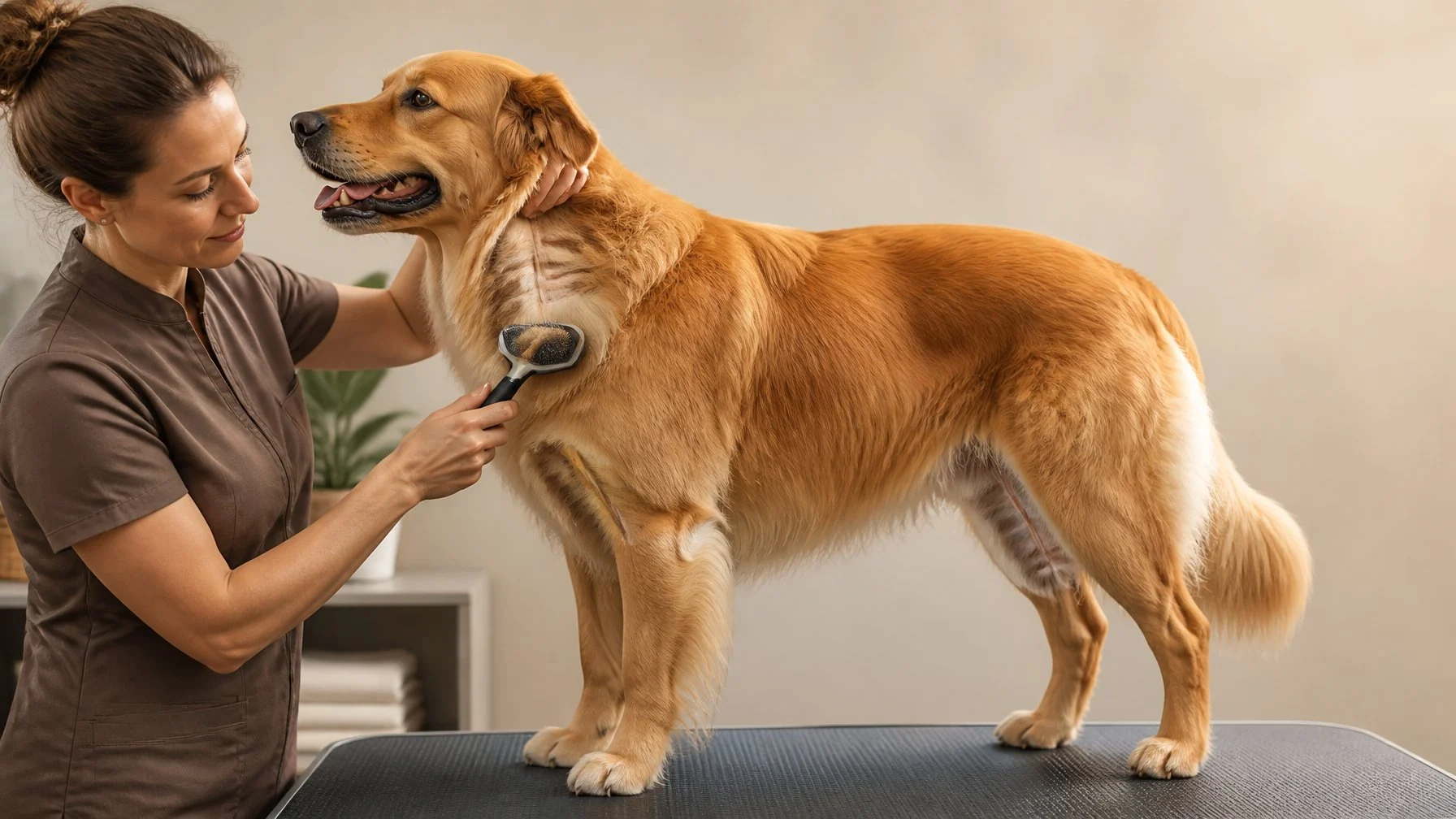
Mats don’t form evenly. They start where hair rubs against hair, harness straps, or the ground: behind the ears, under the collar, in the armpits, along the belly, and deep in curly doodle coats.
Behind the Ears and Around the Collar
The hair behind the ear flap is fine, soft, and constantly moving. Add a collar rubbing all day and knots form within days.
Slide the collar off before brushing that zone, then lift the ear flap and work in small lines underneath it.
Miss this spot for two weeks and a pea-sized knot turns into a plate-sized mat.
Armpits, Legs, Belly, and Tail
Armpits and the groin are skin-on-skin friction zones. Legs pick up grass seeds.
Tails drag through everything. A quick order for these areas:
- Armpits and chest first, while the dog is still patient
- Inner thighs and groin next, with very light pressure
- Rear legs and hocks
- Tail last, brushing from the base outward in layers
Thin skin sits under all these spots, so pressure should stay lighter than on the back.
Curly and Dense Doodle Coats
Doodle and Poodle coats grip their own shed hair instead of dropping it. That’s why they mat so fast.
Curly coats usually need line brushing every other day, and daily if the coat mats easily, according to a doodle grooming guide.
Daily brushing on the friction zones plus a full line-brushing session two or three times a week keeps most doodles out of the clipper chair.
Know When Brushing Should Stop
Loose tangles usually come apart with fingers and patience. Tight mats fused to the skin won’t, and forcing them causes brush burn, bruising, and a dog that dreads the brush.
How to Handle a Loose Tangle Without Pulling
Start from the outside of the tangle and work your way in. Never go straight through the middle.
Hold the hair between the tangle and the skin so nothing tugs or pulls.
- Mist the tangle with detangling spray. Let it soak for a minute.
- Split the tangle into smaller bits with your fingertips.
- Pick at the outer edge using the end teeth of a comb.
- Use short slicker strokes on the part you just loosened.
- Run a comb through to check if the tangle’s actually gone.
If ten minutes of gentle work gets you nowhere, that’s a mat and you’ll need a different approach.
Signs of Brush Burn or Skin Discomfort
Stop brushing if the skin turns pink or red, if your dog flinches, licks the spot, or turns to look at the brush. Yawning, lip licking, or stiffening up are early signs of stress too.
Brush burn is skin irritation from too much pressure or too many brush strokes in one spot. Stopping early is always better than brushing through pain or panic, and honestly, the coat will still be there tomorrow.
When a Groomer or Veterinarian Should Take Over
Some coats are just beyond home care. A pelted coat, where mats join into a solid layer, usually needs a pro with clippers for a shave-down.
Book a groomer when mats sit flat against the skin, when a comb can’t reach the skin anywhere, or if your dog won’t let anyone near a certain spot. Call a vet if you find red, weeping, or smelly skin under a mat, spot fleas or ticks, or feel any lump while brushing.
From Fluffy’s Bowl
From Fluffy’s Bowl: line brushing is a two-hand job and that is the whole trick. One hand holds the coat up and out of the way, the other works the line underneath it. If you find yourself brushing one-handed you have stopped line brushing and gone back to skimming the top, which is how a coat looks brushed and mats anyway.
The Two Tools This Method Needs
Line brushing only works with something that reaches the skin and something that proves you got there. That is genuinely all it takes.
Large Slicker Brush for Doodle and Poodle Coats
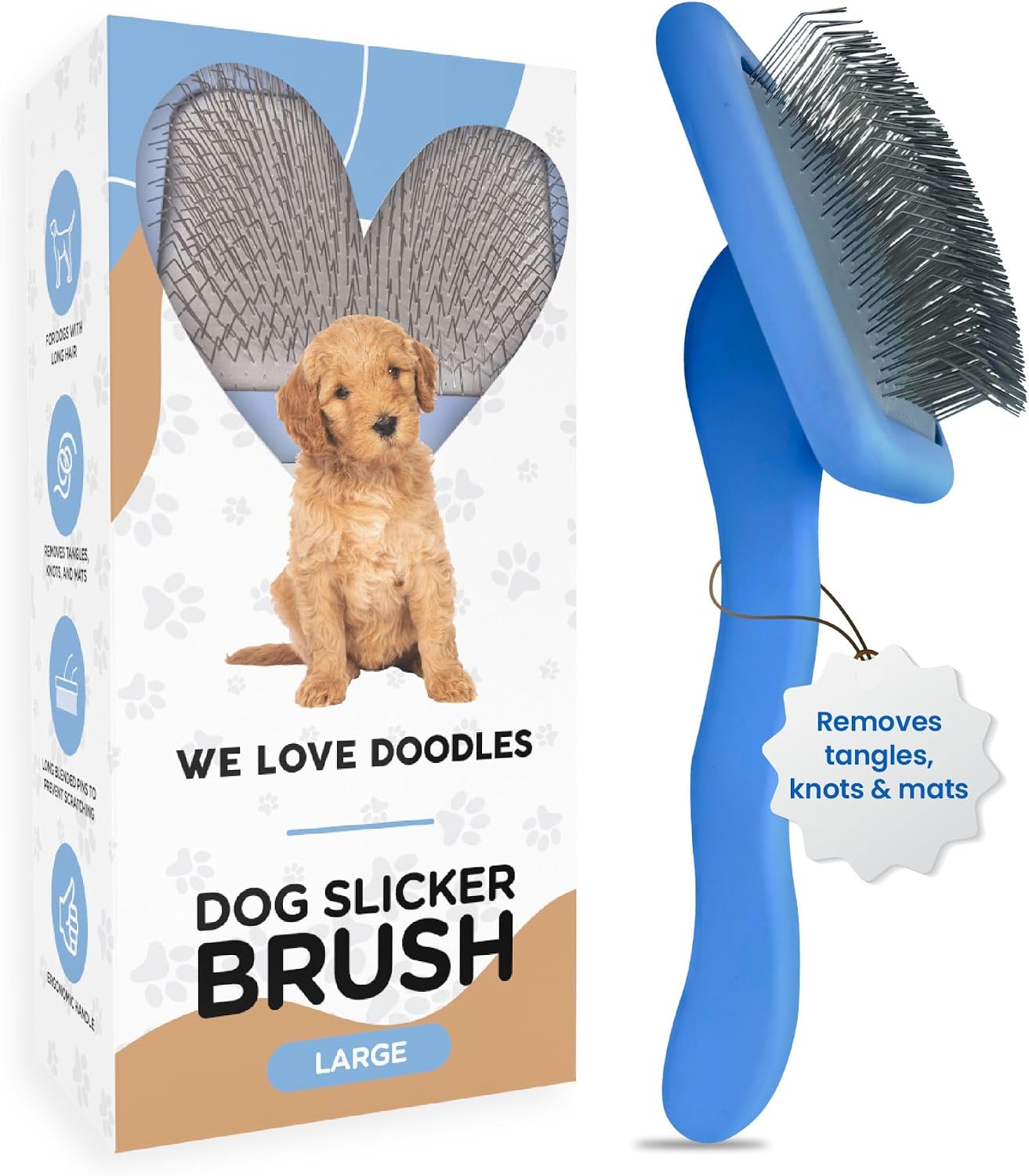
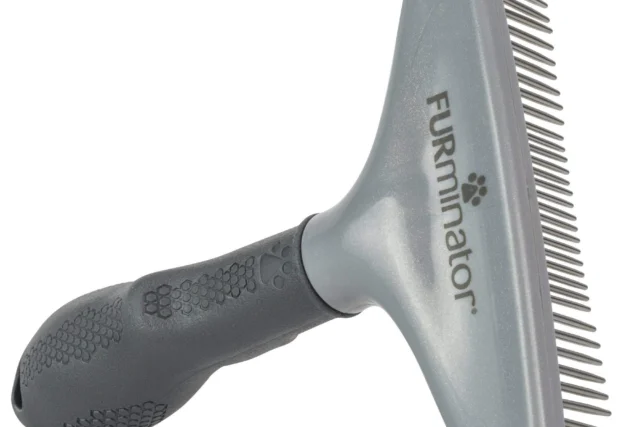
The brush for the sectioning work described above. Check price on Amazon
| Things We Like | Things We Don’t Like |
|---|---|
| Long pins reach through a dense coat to the skin | Too much brush for a short, smooth coat |
| Large head covers ground quickly on a big dog | Pressed too hard it will scrape skin — the brush burn warned about above |
| Bent pins lift the hair rather than dragging over it | Needs clearing of hair often to keep working |
Master Grooming Tools Fine/Coarse Steel Greyhound Comb
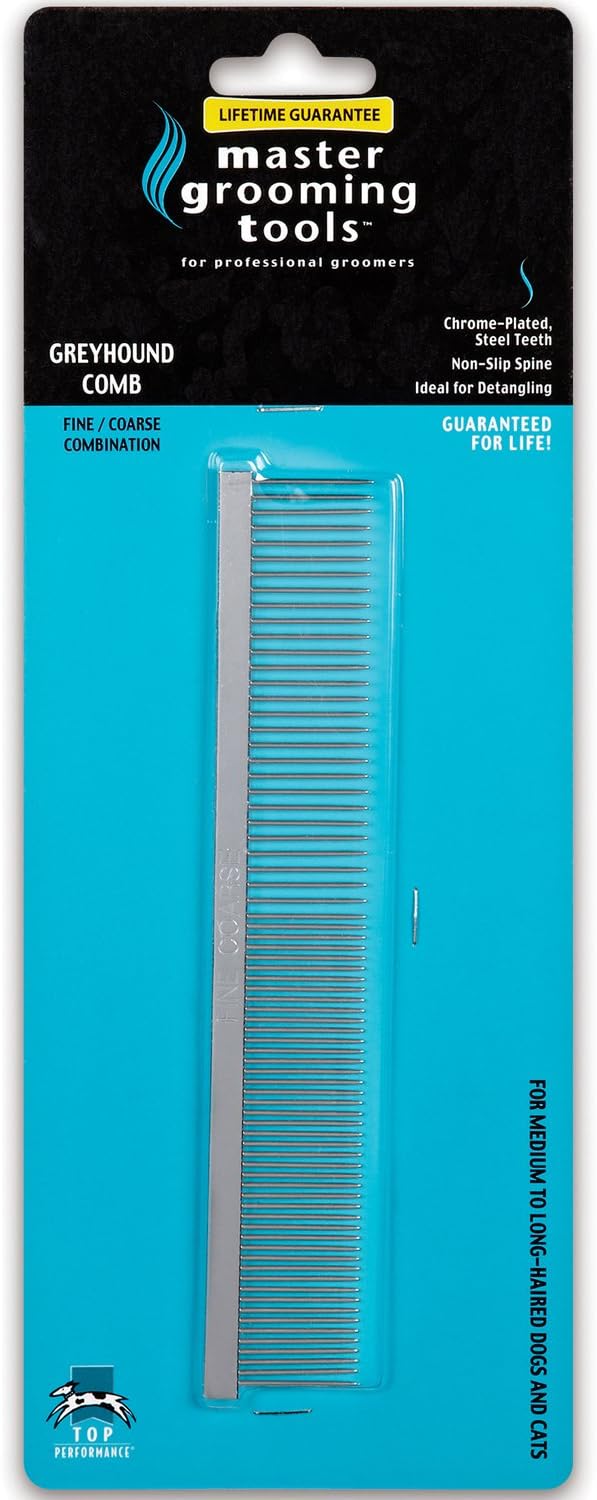
This is the comb check. If it slides through, the section is done. Check price on Amazon
| Things We Like | Things We Don’t Like |
|---|---|
| Fine and coarse ends in one comb, so one tool does the whole check | No handle, which some people find awkward at first |
| Solid steel with no join to catch hair | Will pull if used to force a mat instead of finding one |
| Finds the mat a brush has skimmed over | Small enough to lose easily |
Frequently Asked Questions
What is line brushing, and why does it help prevent mats?
Line brushing means parting the coat into thin, finger-width lines and brushing each one from the skin outward. Mats start at the root, not the surface, so this method actually gets to the problem spots. Normal brushing just skims the top and leaves dead undercoat packed at the skin, where it turns into a mat in just a few days.
Which brushes and combs are needed to brush a dog down to the skin?
For most fluffy coats, you’ll want three tools: a slicker brush with fine bristles, a two-sided metal comb (medium and fine teeth), and a light detangling spray. Very long straight coats do better with a long-pin pin brush. The comb isn’t optional—it’s the only way to really know if a section is clear.
Should a dog’s coat be brushed when it’s dry or slightly damp?
Line brush a dry coat. Wet hair stretches and snaps, and damp mats tighten as they dry. A light mist of detangling spray on each section is fine and helps with static, but always blow-dry a soaked coat before brushing.
How can someone line brush a doodle, Cockapoo, or Shih Tzu without pulling?
Keep sections thin and support the hair above the line with your free hand. Let the brush or comb do the work—don’t force it. Mist each strip first. If the brush gets stuck, use your fingers before trying again. Short, frequent sessions with breaks are way better than one marathon session that leaves everyone stressed.
How often should thick or curly-coated dogs be brushed to stop tangles?
Curly and dense coats usually need line brushing three times a week. Quick daily passes over friction spots like behind the ears and armpits help too. Double coats do well with two or three sessions a week. Coats longer than 4 cm (about 1.5 inches) mat faster, so brushing more often makes a difference.
What can someone do if a dog won’t sit still for brushing?
Try breaking the job into two- or three-minute sessions. Focus on just one body part at a time, and end each little session with a treat while your dog’s still calm. Brushing after a walk can help, since most dogs have less energy then. Puppies especially do better with super short, positive sessions to build up their tolerance before their coat gets long enough to mat. Which part of your dog’s coat gives you the most trouble—ears, armpits, tail, or something else entirely? Drop it in the comments, and if you know someone with a doodle heading for a shave-down, maybe send this their way. This is just general guidance, not veterinary advice. Always check with your vet about your own dog’s situation.