As an Amazon Associate I earn from qualifying purchases.
Only bags with a third-party compost certification actually compost. Look for TÜV Austria OK Compost HOME, ASTM D6400, EN 13432, or NF T51-800 printed on the box.
Bags labeled just “biodegradable,” “oxo-degradable,” or “landfill friendly” don’t have a verified breakdown timeline and usually just break into microplastics.
That’s the short version. The longer story matters more, honestly, because even a certified bag doesn’t mean the dog waste inside is safe to compost, and the rules are all over the place between the US, UK, and EU.
This Dog Fluffy comparison sorts five popular options by what their certifications actually prove. It also looks at how thick the film is, how easily the roll opens with cold hands, and where the bag can legally go afterwards.
Best for verified home-compost certification: G.A.S Certified Home Compostable Dog Poop Bags
Best for larger loads and multi-dog yards: Codirom Certified Home Compostable Poop Bags
Best bulk value in a plant-based bag: moonygreen Compostable Poop Bag Rolls, 240 Count
Best everyday strength (recycled, not compostable): Earth Rated Unscented Refill Rolls
Best thickest film for tidy pickup: Pawtria Home Compostable Poop Bag Rolls
G.A.S Certified Home Compostable Dog Poop Bags
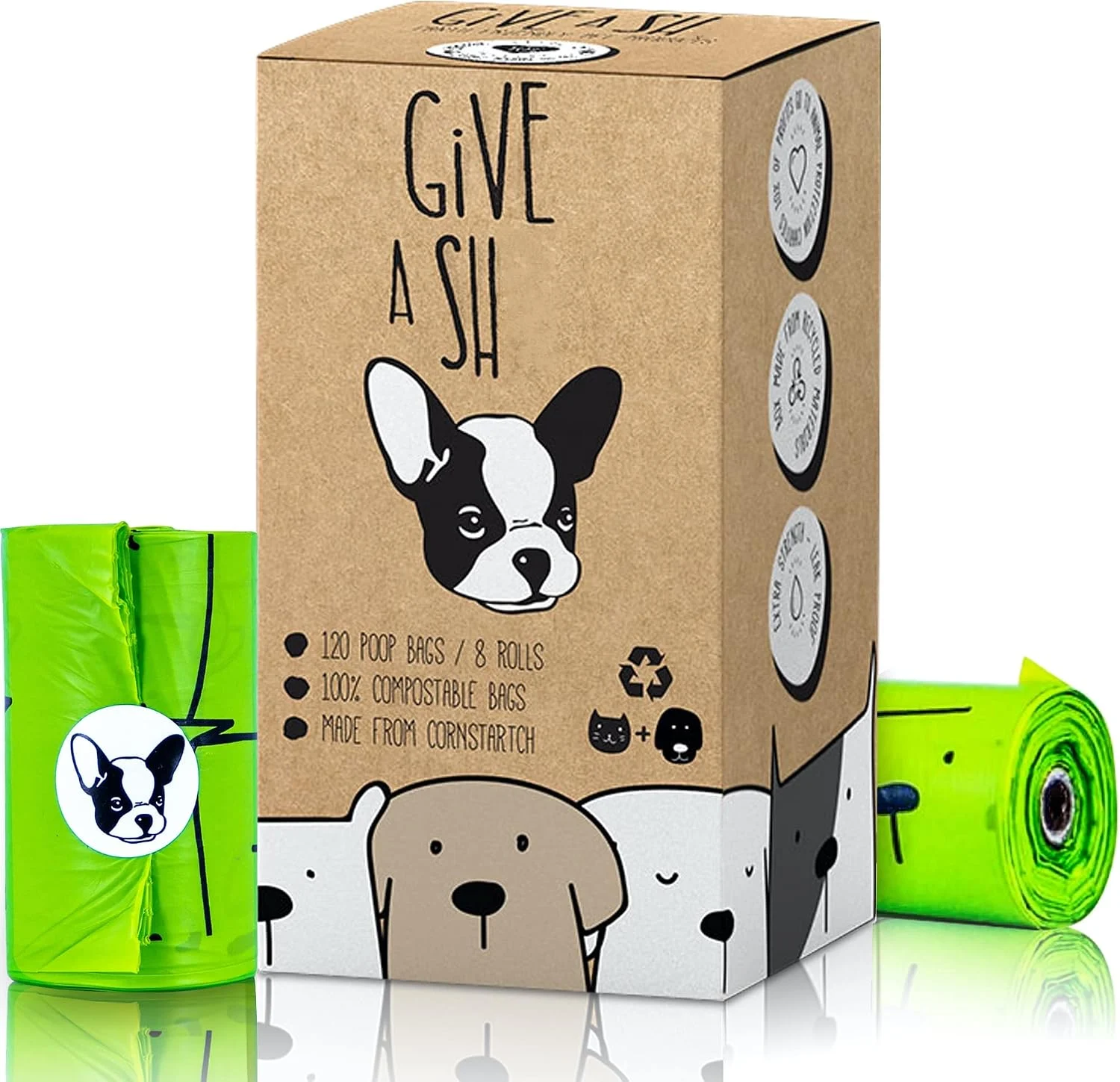
These are a solid default for Frenchie owners who want real certification paperwork, not just a green leaf on the box.
| Things We Like | Things We Don’t Like |
|---|---|
| TÜV Austria Home Compost certified, references ASTM D6400, EN 13432 and NF T51-800 | Some owners say the film doesn’t fully mask odor |
| Cornstarch, PBAT, and glycerin film at 18 microns | |
| Recycled cardboard box and roll cores |
- Shelf life is shorter than plastic
- 120 bags per box goes fast with daily walks
The listing names four separate standards, which is more transparency than most sellers offer.
That mix of home-compost and industrial certification is the best sign a bag will actually break down, not just shatter into fragments.
Reviewers mention the tear line is easy to spot and the bag opens without the finger-licking dance. A few say the walls are thin enough that stronger smells get through, so double-bagging on hot days might not be a bad idea.
Size is fine for a French Bulldog’s output, with room left to knot. The brand donates a share of profits to the Soi Dog Foundation.
Two walks a day and one bag each is 120 bags gone in about two months, which is the arithmetic I use when I am choosing between this and a bulk pack. It is worth resisting the bigger box. Compostable film has a shelf life, and a roll that has sat in a warm cupboard for a year will split on you at the worst possible moment. Two dogs halves the figure, so buy smaller and buy more often.
Codirom Certified Home Compostable Poop Bags
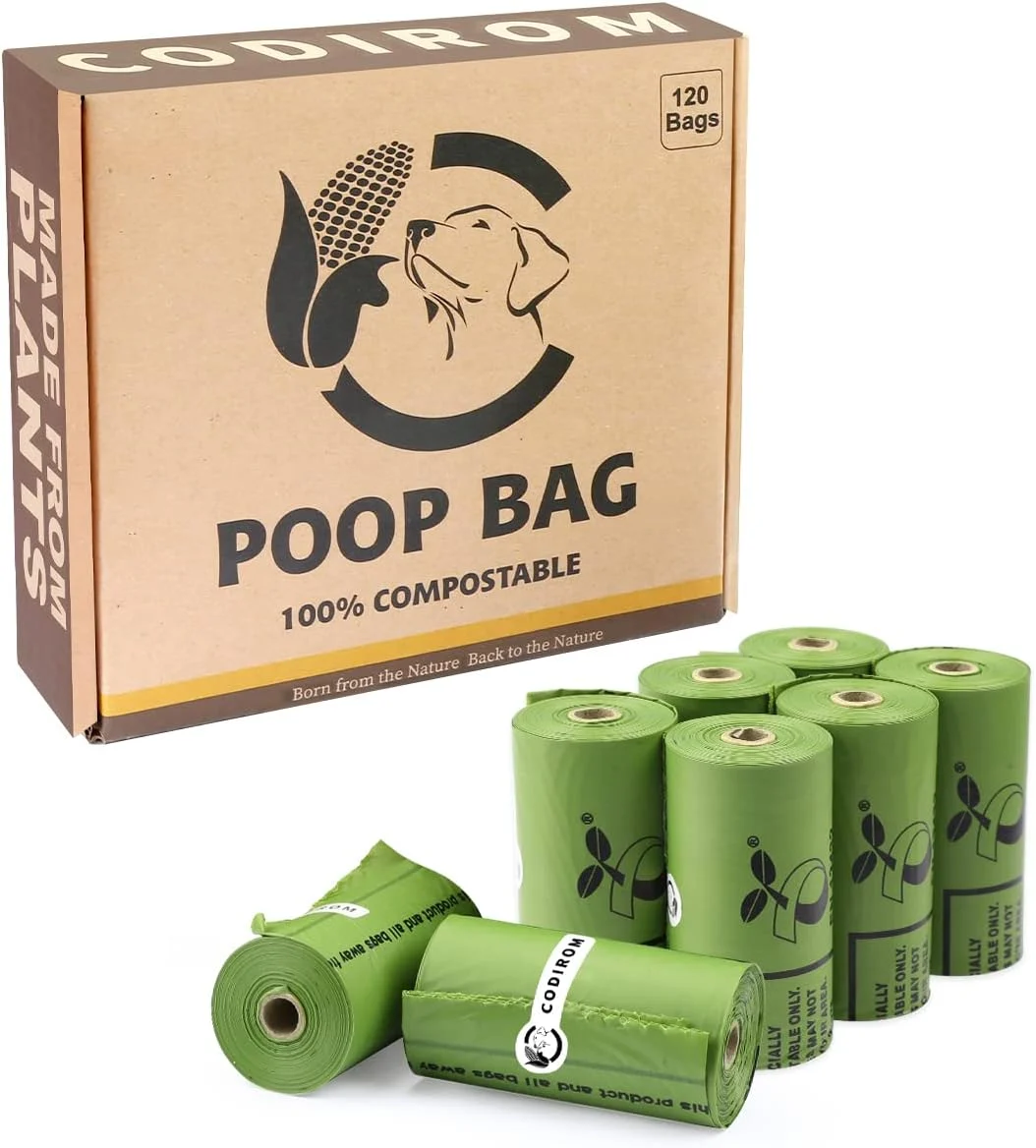
Worth buying if you want a bigger 23 x 33 cm (9 x 13 in) bag and don’t mind a little more effort opening.
| Things We Like | Things We Don’t Like |
|---|---|
| TÜV Austria Home Compost certified, meets ASTM D6400 and EN 13432 | Some owners find the bags stiff to open |
| Corn, vegetable oil, and PBAT construction | About 12-month shelf life, so don’t buy too many at once |
| Roomy enough for multi-dog or litter-box duty | Opaque green color isn’t for everyone |
Codirom says these break down in 90 to 180 days under home-composting conditions, leaving water, CO₂, and humus. That’s a realistic window, not the “vanishes overnight” stuff some brands claim.
The recurring complaint is opening friction, and yeah, it’s fair. More than one reviewer suggests peeling a bag open before leaving the house, which is good advice if your Frenchie is already tugging at the leash.
The brand is clear about storage: keep them cool, dry, and out of sunlight. Heat will degrade plant-based film early.
moonygreen Compostable Poop Bag Rolls, 240 Count
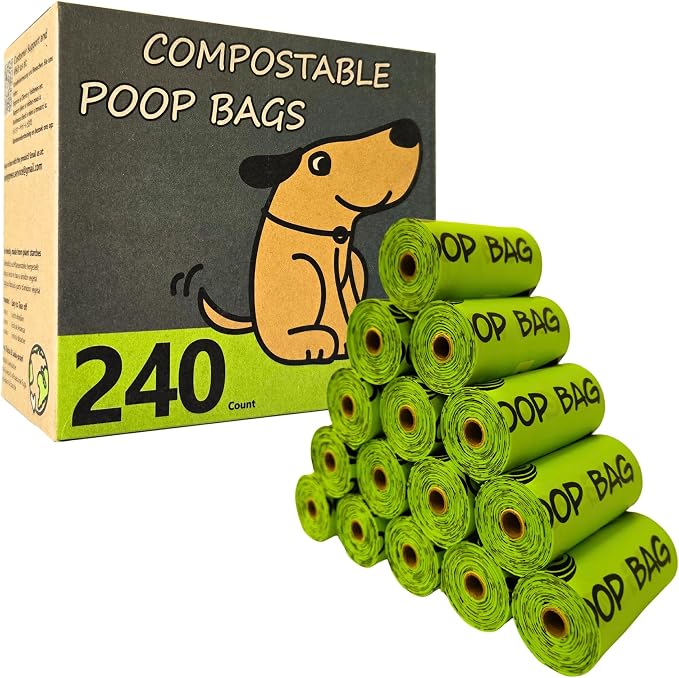
This is the best count-per-box here, but the “landfill friendly” wording in the title deserves a closer look.
| Things We Like | Things We Don’t Like |
|---|---|
| 240 bags, the largest compostable pack in this roundup | Marketed as “landfill friendly,” which isn’t a real certification |
| ASTM D6400, EN 13432, and OK Compost Home certification claimed | Some reviewers find the bags stiff to open |
| Thick, soft film that owners say feels silky, not crinkly | Busy printed design isn’t everyone’s favorite |
Here’s the issue. A bag can be genuinely compost-certified and still be described as “landfill friendly,” but that phrase means nothing technically, since nothing really composts in a sealed landfill. The certifications listed are what matter.
Owners in several countries praise the strength and the ease of separating bags from the roll. The 23 x 33 cm (9 x 13 in) size is generous for a Frenchie, though a few wish there was a smaller option for tiny breeds.
No added fragrance, which matters for dogs with sensitive skin or touchy airways.
Earth Rated Unscented Refill Rolls
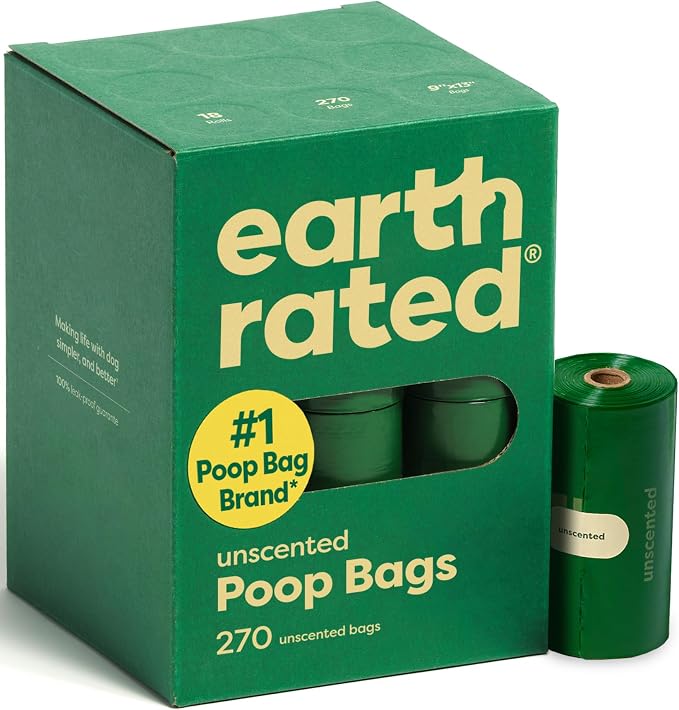
Buy these for strength and value, not for composting. This refill listing describes recycled plastic content, not compost certification.
| Things We Like | Things We Don’t Like |
|---|---|
| Made with 65% certified post-consumer recycled plastic | Not compostable; don’t put these in a compost bin |
| Highly reviewed for leak resistance and thickness | Recycled content still means plastic |
| “3 bags left” sticker on every roll | Bag width runs a bit under the stated 23 cm (9 in), according to some owners |
Recycled content and compostability are totally different environmental claims. This listing only makes the first one.
What they do well is hold up. Reviewers with large dogs and big hands mention no blowouts, easy tear-off, and a sensible unscented option that doesn’t add perfume near a flat-faced dog’s nose.
If you don’t have any compost route available, a strong recycled-content bag going to landfill might be the honest choice.
You can feel the difference between the two materials, and it is not subtle. Recycled polythene stretches; cornstarch film barely gives at all, so it tears rather than yields. That is the material behaving as it should rather than a fault, but it does change what thickness is worth paying for. On compostable bags I would not go below about 18 microns, and 20 is better — the splitting complaints you read almost always trace back to the thinnest films rather than to the plant-based part.
Pawtria Home Compostable Poop Bag Rolls
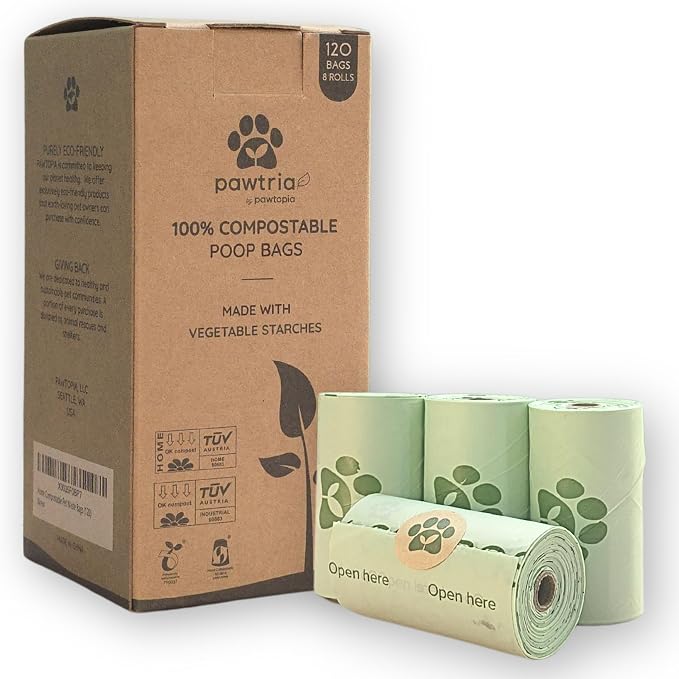
This one has the thickest compostable film in the group and the clearest disposal guidance on the label.
| Things We Like | Things We Don’t Like |
|---|---|
| 20-micron film, thicker than most plant-based bags | Smallest review base of the five |
| TÜV Austria OK compost HOME and INDUSTRIAL, plus BPI Certified Compostable | Some owners find the bags shallower than expected |
| Brand clearly warns against using pet-waste compost on food crops | Plant-based film needs cool, dry storage |
Three certifications on one product is unusual, and BPI certification is the standard most US composting facilities recognize.
Pawtria is also one of the few brands here that says flat-out not to use pet-waste compost on anything edible, which is exactly the guidance owners need.
Reviewers often mention how easily the bags open, which is the single biggest complaint about compostable film in general. Several use them for cat litter too.
At 23 x 33 cm (9 x 13 in), they fit standard leash dispensers and suit a Frenchie’s small, frequent deposits.
Buying Guide
Choosing a compostable poop bag really comes down to three things. What does the certification logo actually prove? Will your home compost pile or municipal bin accept the bag? And is the film thick enough to survive a walk without a nasty surprise?
What The Certifications Actually Prove
A compostable bag has certification to break down into water, CO₂, and biomass within a set time under specific composting conditions, leaving no toxic residue. Biodegradable means nothing unless there’s a timeframe.
| Standard | What it covers | Where it applies |
|---|---|---|
| TÜV Austria OK Compost HOME | Breaks down in a backyard pile at ambient temperature | Home composting |
| ASTM D6400 | Breaks down in a hot industrial facility | North America |
| EN 13432 | Industrial compostability | Europe |
| NF T51-800 | Home compostability | France |
| BPI Certified Compostable | Accepted by many US municipal facilities | North America |
Here’s the catch. Industrial certification doesn’t guarantee the bag will break down in a garden heap, since home piles rarely hit those high temperatures.
What The FTC Says About These Claims
In February 2015 the US Federal Trade Commission wrote to 20 manufacturers and marketers of dog waste bags, warning that their biodegradable and compostable claims may be deceptive. What the regulator actually objected to is worth knowing, because it changes how you should read the label.
On biodegradable: under the FTC’s Green Guides, an unqualified claim tells a shopper the product will completely break down “within one year after customary disposal”. The agency’s point was that most waste bags end up in landfill, where “no plastic biodegrades in anywhere close to one year”. An unqualified “biodegradable” on a poop bag is close to meaningless.
On compostable the verdict was harder. Because dog waste is generally not safe to compost at home and very few facilities accept it, the FTC concluded that “compostable claims for these products are generally untrue”.
That reads like it demolishes the whole category, and it is the one thing to get straight before buying anything on this page. It does not — but it does narrow what a certification is telling you. A home-compostable certification is a claim about the bag, not about the bag plus its contents. It means this film, on its own, breaks down in a home compost environment within a defined time. It says nothing about the dog waste inside, which is a separate disposal problem with separate rules that no logo on the packaging addresses.
So the honest reason to pay for certification is to avoid a bag that fragments into plastic in the ground, not because a certificate makes the contents compostable. Note the FTC’s own caveat to the industry, too: marketers who did not receive a letter should not assume their claims are fine. The staff warning is public and worth two minutes if you buy these regularly.
The Disposal Route Matters More Than The Bag
Certification is only useful if there’s an actual disposal route. Most municipal food-waste programs in the US, UK, and EU refuse dog waste, no matter what bag you use.
- Look for a certification body and a standard number on the box, not just the word “compostable.”
- Check your local council or waste authority website for “pet waste” to see what’s allowed.
- If you’re composting at home, use a pet-waste digester or a separate pile—never add it to the veggie heap.
- Never spread pet-waste compost on food crops, herbs, or anything edible.
- If you can’t compost it, just bin the bag. Sometimes landfill is the only honest answer.
Thickness, Size And Opening Ease For A Frenchie
French Bulldogs are compact, so a 23 x 33 cm (9 x 13 in) bag feels generous. Film thickness between 18 and 20 microns works best for compostable material.
Unscented bags are worth seeking out. Frenchies have sensitive skin and short muzzles, so added fragrance near the face doesn’t really help anyone.
Check the shelf life, too. Plant-based film can start to degrade in storage, so buying two years’ worth at once often leads to waste.
From Fluffy’s Bowl: keep the spare roll indoors rather than in the car. Heat ages this film faster than anything else, and the roll that has spent a hot month on a parcel shelf is the one that splits. I also open a new roll before the old one runs out rather than after — compostable film that has gone brittle gives no warning at all, and you find out at precisely the wrong moment.
Frequently Asked Questions
Certification labels, home-bin reality, breakdown timelines, the biodegradable-versus-compostable gap, council food-waste rules, and which logos you can actually trust—these all come up a lot.
Which poop bags are certified compostable, not just labeled biodegradable?
Bags with TÜV Austria OK Compost HOME, BPI Certified Compostable, EN 13432, or NF T51-800 marks have passed third-party testing. In this roundup, G.A.S, Codirom, moonygreen, and Pawtria bags all reference recognized standards. Earth Rated’s refill rolls use recycled-content plastic, not compostable film. Always check the printed box, not just the listing headline.
Do compostable dog poop bags break down in a home compost bin?
Only bags with home-compost certification like OK Compost HOME or NF T51-800 will actually break down at home. Industrial-only certifications like ASTM D6400 need high heat that a backyard pile just doesn’t reach. Even with the right bag, dog waste should go in a dedicated pet-waste digester, not the general compost heap, and never touch food crops.
How long do certified compostable poop bags take to decompose?
Manufacturers usually quote 90 to 180 days under proper home-composting conditions. Industrial facilities move faster. Real-world timing depends on moisture, temperature, oxygen, and how often you turn the pile. In a sealed landfill, almost nothing breaks down, including certified compostable bags, because there’s no oxygen or microbial activity.
Are biodegradable poop bags the same thing as compostable bags?
Nope. “Biodegradable” doesn’t have a legal timeframe, so a bag could take decades and still count. Some oxo-degradable plastics just break into microplastics. “Compostable” means the bag meets specific standards with timelines, conditions, and residue limits, and it requires third-party testing. If a listing says biodegradable but doesn’t name a standard, it’s just marketing.
Can dog waste and a compostable bag go in a council food-waste bin?
Usually not. Most councils and municipal programs in the US, UK, and EU exclude pet waste from food and garden bins because of pathogen risk, even if the bag is certified. A few areas run separate pet-waste schemes. Check your local waste authority’s website before assuming a compostable bag qualifies.
What certifications should dog owners look for on compostable poop bags?
Check for TÜV Austria OK Compost HOME if you want to compost in your backyard. For US municipal composting, BPI Certified Compostable is the one to look for.
EN 13432 applies to European industrial composting. ASTM D6400 covers North American industrial composting.
If you’re in France and composting at home, NF T51-800 is the standard. A clear certification number or logo on the packaging matters much more than any vague promises in an Amazon listing.
How does disposal work where you live? Does your local council even accept pet waste?
Drop your thoughts in the comments if you want—I’m honestly curious.
This is just general info, not veterinary advice. Always check with your vet if you’re unsure about your own dog’s situation.