As an Amazon Associate I earn from qualifying purchases.
The best training pads for an apartment puppy are the ones that match the floor, the dog, and the mess. For a French Bulldog puppy, that usually means a 56 x 61 cm (22 x 22 in) disposable pad with a leak-proof plastic backing for daily use, plus a washable pad for the crate or playpen corner. Grass trays suit balconies.
Frenchies come with their own set of rules. They’re low, wide, and busy, they spin before they squat, and their flat faces make midday summer walks a bad idea. That means the indoor potty setup has to work harder than it would for a leggy terrier. Dog Fluffy compared five popular pads on absorbency, leak protection, odour control, grip on hardwood, crate-corner fit and how annoying they are to clean up — from published specifications, materials and the pattern in owner reports, rather than from hands-on use.
Best for everyday disposable use: Amazon Basics Leak-Proof Puppy Pads
Best for pads that stay put on hardwood: Pogi’s Puppy Pads with Sticky Tabs
Best for crate and overnight use: Pitpet Washable Pee Pads (2-Pack)
Best for playpen floors and whelping boxes: Sunheir Washable Pee Pads (2-Pack)
Best for balconies and outdoor transition: Ottomanson Artificial Grass Pad with Tray
Dog Fluffy uses Amazon Associate links. Buying through them costs nothing extra.
Amazon Basics Leak-Proof Puppy Pads (50-Count)
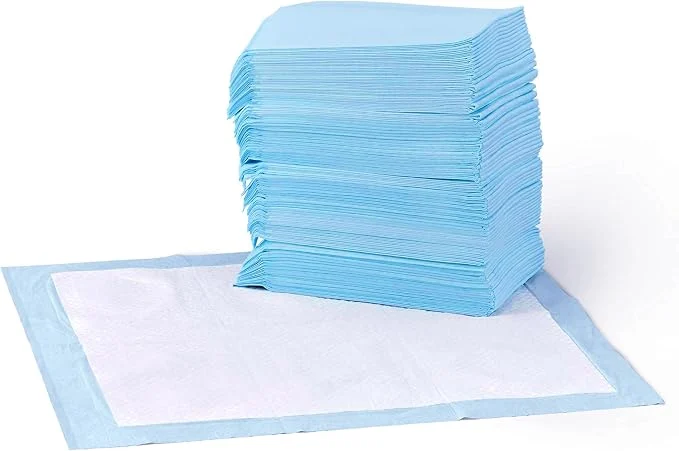
Buy these if the goal is high-volume, low-cost disposables for a puppy who’s still figuring out where the toilet lives.
| Things We Like | Things We Don’t Like |
|---|---|
| Five layers with a gel core that locks liquid fast | No adhesive tabs, so a bouncy Frenchie can drag them |
| Plastic border on all four sides cuts overflow onto hardwood | 56 x 56 cm (22 x 22 in) gets tight once a puppy hits four months |
| Built-in attractant helps guide a puppy to the spot | Waste adds up quickly in a small flat bin |
The absorbency does the heavy lifting here. Liquid turns to gel on contact, which matters when a Frenchie steps back through the puddle on their way out. Less tracking, fewer paw prints down the hall.
The weak point is grip. With no sticky tabs, the pad slides on tile and laminate, and puppies love shredding a pad that moves. A cheap plastic pad holder solves it for a few pounds or euros.
The centre pad measures 48 x 48 cm (19 x 19 in), with a 4 cm (1.65 in) border. Aim for the middle. Reviewers using them for smaller pets note they hold roughly one full wee before needing a swap, which is honest sizing for a “regular” pad.
A 22×22 pad looks generous next to an eight-week-old Frenchie and stops looking generous surprisingly fast. Mine was fine on that size for about the first two months. What changes is not really the dog’s size — a Frenchie is not a leggy breed — it is that a puppy starts circling before it settles, and the circle is wider than the pad. The tell is not overshooting the edge; it is finding the mess an inch or two outside a pad that is otherwise untouched. That is the point to go up a size rather than buy more of the same.
Pogi’s Puppy Pads with Sticky Tabs (40-Count)
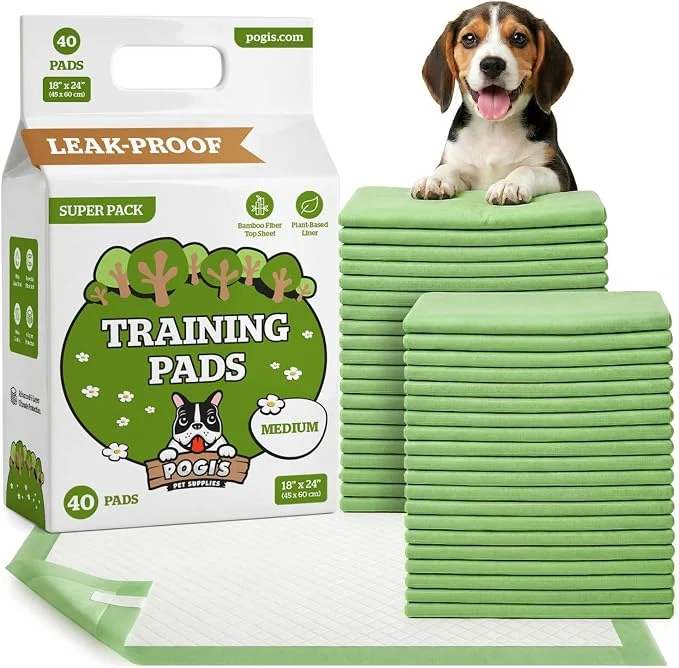
Worth the extra spend if the pad keeps sliding, keeps bunching, or keeps ending up as a chew toy.
| Things We Like | Things We Don’t Like |
|---|---|
| Adhesive corner tabs stick to wood, tile, carpet, and crate bases | Costs more per pad than basic disposables |
| Six layers with bamboo top sheet and plant-based liner | 46 x 61 cm (18 x 24 in) is rectangular, so it may not centre neatly in a square crate |
| Honey-scented attractant instead of a chemical smell | Some owners report leaks when a pad is pushed past one or two uses |
The sticky tabs are the whole point. A Frenchie puppy circles, paws, and sometimes plays before squatting, and an anchored pad survives that routine. Owners using them in balcony setups say the tabs stop pads blowing around.
Odour control is the second reason to pick these. The gel core traps smell rather than masking it, which matters in a one-bedroom flat where the pad sits three metres from the sofa.
Long-term users report years of consistent quality, including owners of small breeds and senior dogs. The plant-based liner also makes them a softer landing for anyone uneasy about plastic-heavy disposables.
Pitpet Washable Pee Pads (2-Pack, 18 x 24 in)
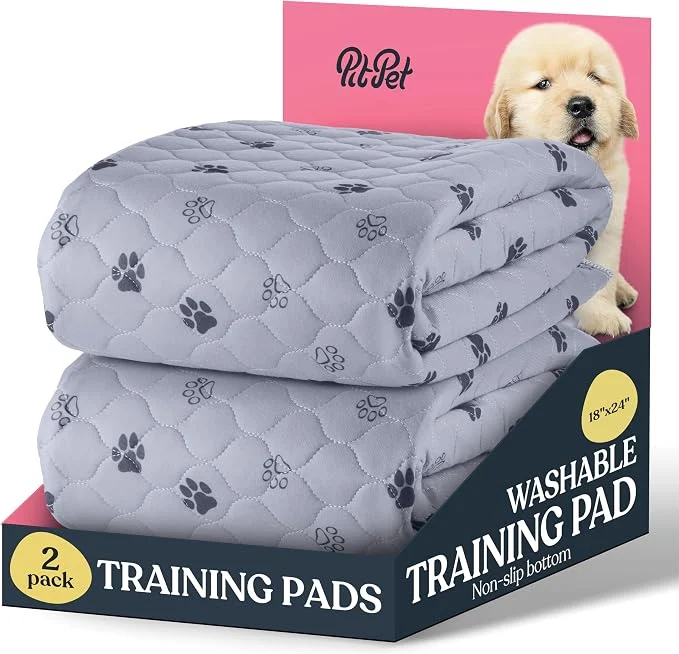
Get these for crate nights, car trips, and senior-dog accidents, where washing beats binning.
| Things We Like | Things We Don’t Like |
|---|---|
| Non-slip gel backing keeps the pad flat under a wriggly puppy | Needs washer access, which not every flat has |
| Four layers with a waterproof middle membrane | Absorbency drops if the pad is left soaked for hours |
| Machine wash and tumble dry without fraying | Two pads isn’t enough rotation on its own |
Non-slip backing is the standout. A Frenchie puppy braking hard in a crate will bunch a cheap fabric pad into a rope. This one stays put, which reviewers repeatedly mention for crate and playpen use.
Treat “20-30 uses” as marketing, not a schedule. In practice, one heavy overnight wee is the sensible limit before washing. A handful of owners report seepage onto carpet when a pad is overloaded, so put a towel underneath during the learning phase.
Owners of post-surgery and incontinent dogs rate these highly for softness and smell control after washing. Buy two packs so there’s always a dry one in the pen.
Four, and I arrived at that number the hard way after buying a two-pack. The arithmetic is simple once you see it: one is in use, one is in the wash, one is drying, and one is the spare for the moment all three of those are true at once — which is exactly the moment a puppy needs a pad. Washables dry slower than you expect, especially indoors in winter, and that drying time is the constraint, not how many accidents there are. Two packs of two is the honest starting point.
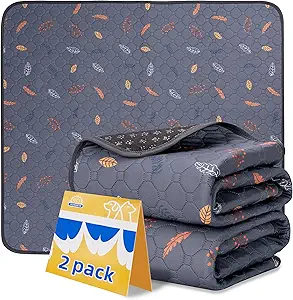
Sunheir Washable Pee Pads (2-Pack, Leaf Print)
| Things We Like | Things We Don’t Like |
|---|---|
| Silicone paw-print base grips floors and carpet | Corners can stay damp after tumble drying |
| Thick enough to cushion joints during pen time | Roughly 20 uses claimed, but overnight is the realistic ceiling |
| Patterned designs blend into a living room | Bottom fabric can feel slightly damp after several hours |
A good pick for lining a playpen or whelping box when the pad will be seen every day and shouldn’t look medical.
Thickness is what separates these from thin fabric pads. Owners using them under rabbits and small dogs note the cushioning, which suits a Frenchie puppy’s short legs and heavy front end during long pen sessions.
Drying is the trade-off. Several owners mention corners holding moisture after a dryer cycle, so hang-drying the edges saves grief. Not ideal if the flat has no airing space.
They cover 46 x 61 cm (18 x 24 in), which lines the corner of a standard playpen neatly. Two packs gives a proper rotation without a daily wash.
Ottomanson Artificial Grass Potty Pad with Tray
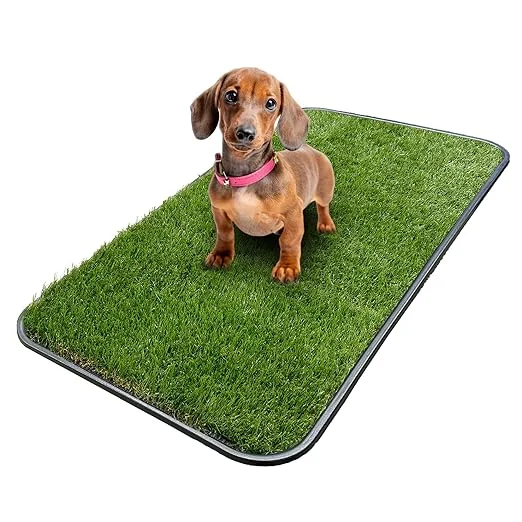
Choose this if there’s a balcony, patio, or bathroom floor, and the plan is teaching the puppy that grass equals toilet.
| Things We Like | Things We Don’t Like |
|---|---|
| Grass surface bridges the gap to outdoor toileting | 38 x 76 cm (15 x 30 in) is narrow for a squatting adult Frenchie |
| Rubber tray catches liquid and rinses clean with soapy water | Needs rinsing after every use or it smells fast |
| No ongoing pad cost after purchase | Tray can slide on smooth floors |
The training logic is the real selling point. A puppy who learns to wee on turf transitions to a park lawn far more smoothly than one trained on paper. That’s useful for Frenchies whose walks get delayed by vaccinations or by heat.
Maintenance is non-negotiable. Urine sits in the tray, and in a warm flat it turns sour within a day. Rinse daily, dry the tray, air-dry the turf.
Best placed on a balcony or in a bathroom with a drain nearby. Carrying a full tray through a carpeted hallway is a one-time mistake.
How To Pick The Right Pad For A Small Flat
Choosing a pad comes down to four things: how much liquid it holds, whether it stays put on the floor, how the waste gets handled, and whether the size still works when the puppy doubles in weight.
Absorbency And Leak Protection
A pad’s absorbency only matters if the backing holds. Look for a plastic or membrane layer that blocks liquid completely, plus a raised or sealed border on disposables.
Definition: A leak-proof training pad has a waterproof backing layer that stops urine reaching the floor even when the absorbent core is fully saturated.
Multi-layer pads that gel on contact beat flat paper pads on two counts: less tracking and less smell.
Grip, Tabs, And Crate Fit
Frenchie puppies move like small tanks, so a pad that slides becomes a toy. Adhesive corner tabs on disposables and silicone or gel backing on washables both solve this.
Measure the crate or pen floor first. A rectangular 46 x 61 cm (18 x 24 in) pad lines a pen edge well, while a square 56 x 56 cm (22 x 22 in) pad suits an open floor spot.
Disposable Versus Washable Cost
| Factor | Disposable | Washable |
|---|---|---|
| Upfront cost | Low | Higher |
| Ongoing cost | Continuous | Detergent and water |
| Bin space needed | High | None |
| Best for | Daytime, travel, illness | Crate, pen, overnight |
| Cleanup time | Seconds | Wash cycle |
Most flats end up running both. Disposables during the day, washables in the crate.
The Pad Training Process
- Pick one fixed spot, away from food, water, and the bed.
- Put the puppy on the [pad after waking](https://www.dogfluffy.com/potty-training-a-shih-tzu), eating, drinking, and play.
- Wait quietly. No talking, no petting until they go.
- Praise and treat within two seconds of finishing.
- Clean accidents with an [enzyme cleaner](https://www.dogfluffy.com/fluffy-frenchie-coat-care-routine), never ammonia-based products.
- Once they’re reliable, move the pad 30 cm (12 in) per day toward the door.
- Shift to outdoor toileting when vaccinations and temperature allow.
Frenchies overheat fast, so early morning and late evening walks are the safe windows in summer. Pads cover the middle of the day without forcing a flat-faced puppy into the heat.
What worked was moving the pad rather than removing it — and moving it far less each day than felt sensible. the American Kennel Club’s potty-pad guidance describes exactly this: move the pad a small distance at a time so the puppy is not confused, get it outside, then shrink it. The part I got wrong first time was jumping the pad from the hallway to outside the front door in one go, which simply reset us. A slow crawl toward the door, then onto the step, worked. The other half was timing: taking her out after every nap and every meal rather than waiting for a signal, because the signal only appears once the habit already exists.
Fluffy is a French Bulldog, and flat-faced puppies give you less warning than most — there is no long, obvious circling routine, just a brief pause. The habit that saved the floor was putting the pad where she already chose to go rather than where I wanted it, and only then moving it. Fighting a puppy’s chosen spot is a fight you lose slowly; starting there and relocating by inches is a fight you win.
When Pads Are the Right Call — and How to Stop Using Them
Pads are not a compromise for everyone, and it is worth knowing which situation you are in. the American Kennel Club’s potty-pad guidance names the cases where they earn their place: very young puppies need frequent trips outside, which “might be too challenging for elderly owners or apartment dwellers”, and where the only toilet area is a public one, you may want to limit exposure “until they’re fully vaccinated”. A third-floor flat with a lift and an unvaccinated eight-week-old is precisely that case.
The transition off pads has a documented method, and it is more gradual than most owners attempt. The AKC’s sequence is to teach a potty cue, then “move the potty pad outside” — “only a small distance each day so you don’t confuse your puppy” — and once it is outdoors, “decrease the size of the potty pad” until the puppy is using the ground instead.
Two honest caveats. Pad training and outdoor training are different habits, so a puppy fluent in one is not automatically fluent in the other — expect the transition to take weeks rather than days. And if house-training stalls despite a consistent routine, that is worth raising with your vet rather than escalating the training: a urinary tract infection produces exactly the pattern owners read as stubbornness.
Frequently Asked Questions
Sizing, attractants, washables versus disposables, change frequency, and smell control are where most apartment owners get stuck.
What are the most absorbent pee pads for a puppy in an apartment?
Five- and six-layer disposables with a gel core absorb the most per pad. They convert liquid to gel on contact, which stops pooling and tracking. Washable pads hold a decent volume too, but they perform best over one overnight session rather than several wees stacked up. For a Frenchie puppy, one heavy wee per pad is a realistic limit.
Do puppy training pads with attractant help puppies learn faster?
They can help in the first few weeks by steering the puppy to the right surface. The scent acts as a signal, not a command. Attractant works best combined with a fixed pad location, tight supervision, and immediate praise. Without those, the scent alone won’t build the habit.
Are washable pee pads better than disposable pads for apartment potty training?
Neither wins outright. Washables cost less over time, produce no bin waste, and grip the floor better, but they need laundry access and drying space. Disposables are faster to deal with and better for travel or illness. Most small flats run disposables during the day and washables in the crate at night.
How often should apartment puppy owners change training pads?
Change a disposable after each wee during active training, and at least twice daily otherwise. Washables should go in the machine after one overnight use or one heavy accident. Leaving a soaked pad down teaches the puppy that a dirty toilet is acceptable, and the smell settles into soft furnishings quickly in a small space.
What size pee pad works best for a growing puppy in a small flat?
Start with 56 x 56 cm (22 x 22 in) or 46 x 61 cm (18 x 24 in). A Frenchie puppy circles before squatting, so extra edge space catches misses. By six months, many owners size up or lay two pads side by side. Measure the crate or pen floor before ordering.
How can a puppy be potty trained with pads without making the whole apartment smell?
Use pads with odour-locking gel, change them promptly, and bin used pads in a sealed container outside the living area. Clean accidents with an enzyme cleaner rather than bleach or ammonia. Keep the pad station on hard flooring, away from rugs and soft furniture, and rinse grass trays daily. What’s worked in your flat? Drop it in the comments. This is general guidance, not veterinary advice – always check with your vet for your own dog’s situation.