The Bichon Frise breed runs into a handful of health problems more often than many other small dogs. The most common Bichon Frise health issues include allergies and itchy skin, dental disease, eye conditions like cataracts, patellar luxation, bladder stones, and endocrine problems such as Cushing’s disease.
Bichon Frises are generally healthy companion dogs with an average lifespan of 12–15 years, but they are genetically predisposed to patellar luxation, allergic dermatitis, canine urolithiasis (calcium oxalate bladder stones), and early periodontal disease. Routine orthopedic evaluations, prophylactic dental hygiene, and preventive urinalysis mitigate their primary clinical risks.
Bichon Frise Clinical Health Matrix: Common Conditions & Screening
| Condition | Primary Symptoms | Typical Onset | Clinical Risk Level | Diagnostic Gold Standard |
|---|---|---|---|---|
| Patellar Luxation | Intermittent skipping, bunny-hopping gait, hind-limb stiffness | 1–3 years | Moderate (Grade I–IV) | Orthopedic palpation & bilateral stifle radiographs |
| Atopic Dermatitis | Obsessive paw licking, ventral erythema, recurrent otitis externa | 6 mos–3 yrs | High (Chronic pruritus) | Intradermal allergy testing / elimination diet trial |
| Canine Urolithiasis | Dysuria, hematuria, stranguria, frequent accidents in house | 4–9 years | High (Emergency obstruction in males) | Abdominal radiography, ultrasound & urinalysis |
| Periodontal Disease | Halitosis, gingival inflammation, calculus build-up, loose teeth | 2+ years | Very High (Bacteremia risk) | Awake gingival inspection & full-mouth dental radiographs |
Most of these can be managed if you catch them early.
The Bichon is one breed where knowing what to watch for truly changes outcomes.
This article walks through each major health risk, the joint issues that sneak up on young dogs, a simple home-check routine you can start today, and how breed club resources fit into the picture.
The Problems To watch For First
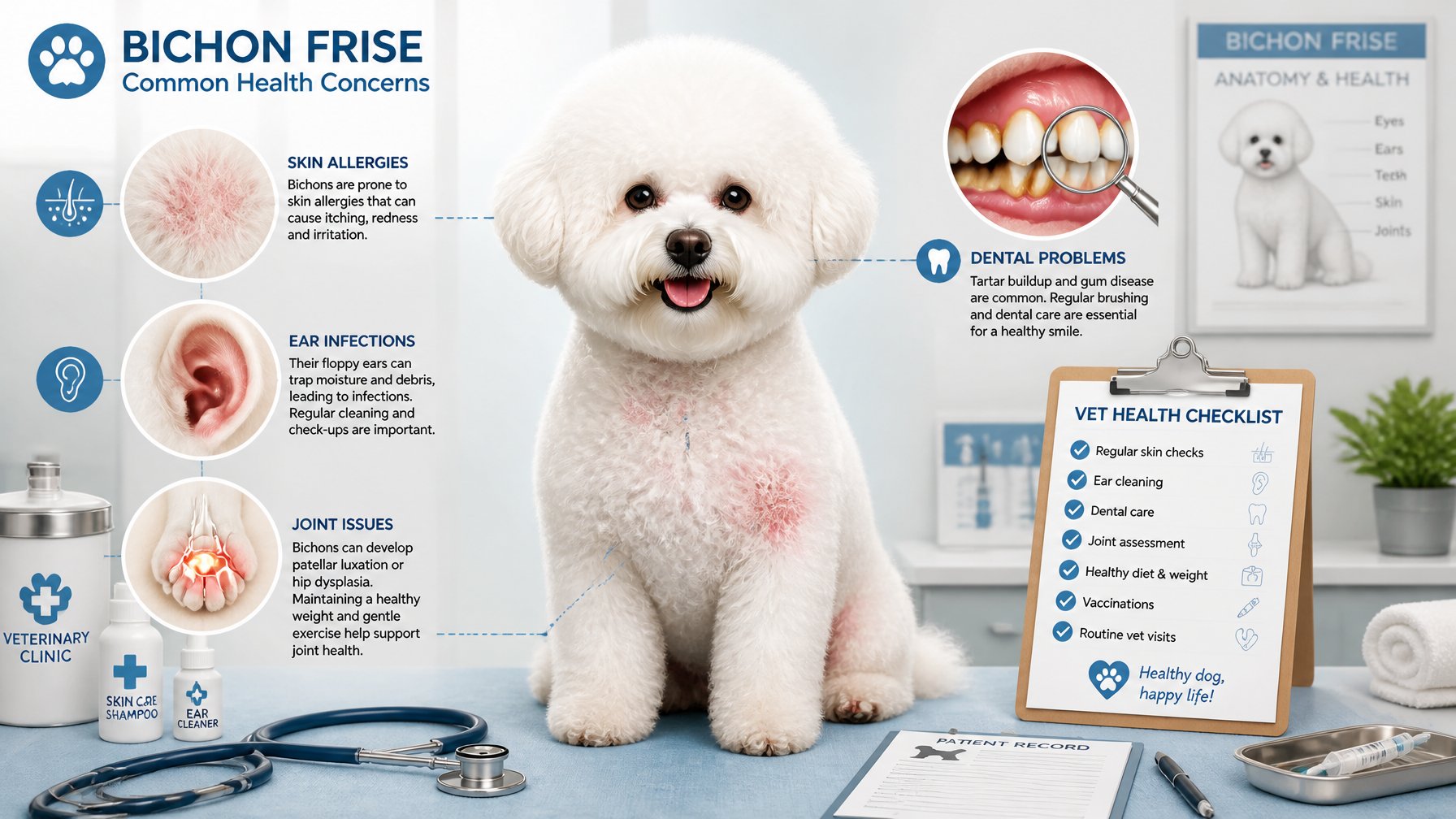
Bichon Frise health problems tend to cluster around five systems: skin and ears, teeth, eyes, the urinary tract, and hormones. Each one has early warning signs that most Bichon owners can spot at home before a vet visit confirms it.
Itchy Skin, Allergies, And Ear Trouble
Allergies are the number-one reason Bichon Frises end up at the vet. The breed is genetically prone to atopic dermatitis, which means their immune system overreacts to pollen, dust mites, or certain proteins in food.
You’ll see scratching, licking paws, red belly skin, or a funky smell from the ears. Ear infections often tag along with skin allergies.
That thick Bichon coat traps moisture inside the ear canal, creating a perfect spot for yeast and bacteria. As noted by veterinary sources in the UK, Bichons are especially susceptible to recurring otitis when allergies go unmanaged.
Signs to watch:
- Head shaking or tilting
- Brown or yellow ear discharge
- Constant paw chewing, especially between the toes
- Red, flaky patches on the belly or armpits
If your Bichon’s scratching comes and goes with seasons, environmental allergies are likely. If it’s year-round, food could be the trigger.
A vet-guided elimination diet is the most reliable way to sort it out.
Dental Disease And Early Tooth Loss
A Bichon Frise’s small jaw creates crowded teeth, and crowded teeth collect plaque fast. Dental disease is one of the most common Bichon Frise health problems, often starting as early as age two.
By the time the vet looked, one tooth was already loose.
The progression usually goes like this:
- Plaque builds along the gumline within 24–48 hours of eating.
- Plaque hardens into tartar that brushing alone can’t remove.
- Gums become inflamed (gingivitis), causing bad breath and redness.
- Infection reaches below the gumline, loosening teeth and sometimes spreading to organs.
Brushing your Bichon’s teeth three to four times a week is the single best prevention step. Use a dog-specific enzymatic toothpaste.
If your dog won’t tolerate a brush, dental wipes are a decent backup. Professional cleanings under anesthesia every 12–18 months can catch what home care misses.
Yes, anesthesia on a small dog feels scary. But untreated dental disease causes far more damage than a well-monitored cleaning.
Eye Changes Like Cataracts, Glaucoma, And Dry Eye
The Bichon Frise breed carries a higher-than-average risk for several eye conditions. Cataracts are a clouding of the eye’s lens that can appear in Bichons as young as two to three years old.
Some are inherited; others develop alongside diabetes. Glaucoma, which involves increased pressure inside the eye, is less common but more urgent.
If your Bichon’s eye suddenly looks red, swollen, or hazy, that’s a same-day vet call. Untreated glaucoma can cause permanent vision loss within hours.
Dry eye (keratoconjunctivitis sicca) is another one. It happens when the tear glands don’t produce enough moisture.
You’ll notice thick, sticky discharge and your Bichon squinting or rubbing at their face. A simple tear test at the vet confirms it, and most dogs do well on prescription eye drops.
- Any cloudiness or blue-gray tint in the pupil
- Excessive tearing or tear staining that suddenly worsens
- Redness in the whites of the eyes
- Squinting or pawing at one eye
Tear stains are common in white-coated breeds and often cosmetic. But a sudden increase in staining or a shift to yellowish discharge can signal an underlying issue worth checking.
Bladder Stones, Infections, And Bathroom Changes
Bichon Frises are one of the breeds most prone to bladder stones, particularly calcium oxalate and struvite types. According to breed health research, urinary issues have consistently ranked among the top concerns in BFCA health surveys.
The signs are easy to miss if you’re not paying attention to bathroom habits. Watch for:
- Straining to pee or only producing small amounts
- Blood-tinged urine (even a faint pink counts)
- Accidents in the house from a previously housetrained dog
- Frequent squatting without much output
A urinary tract infection can look almost identical to stones, and sometimes both are present. A vet can distinguish them with a urinalysis and X-ray.
Water intake matters more than most bichon owners realize. Keeping fresh water available at all times, and even adding a splash of water to kibble, helps dilute the urine and reduce stone formation risk.
Some vets also recommend specific diets formulated to prevent crystal buildup.
Hormone Problems Like Hyperadrenocorticism
Hyperadrenocorticism, commonly called Cushing’s disease, is an overproduction of cortisol by the adrenal glands. Bichon Frises are among the breeds with an elevated risk for this condition, especially after age six.
The symptoms are sneaky because they mimic normal aging:
- Drinking way more water than usual
- Needing to pee constantly
- A pot-bellied appearance
- Thinning coat or hair loss on the body (not the head or legs)
- Increased appetite with weight gain
By the time they tested, the cortisol levels were already high.
A blood panel and low-dose dexamethasone suppression test are the standard diagnostics. Treatment usually involves daily medication (trilostane is the most common) and regular veterinary care to monitor cortisol levels.
It’s manageable, but it does require ongoing attention. As one veterinary-reviewed guide notes, Bichons can also develop diabetes mellitus, which sometimes shows up alongside Cushing’s, so testing for both makes sense if the symptoms overlap.
Joint And Mobility Signs You Shouldn’t Ignore
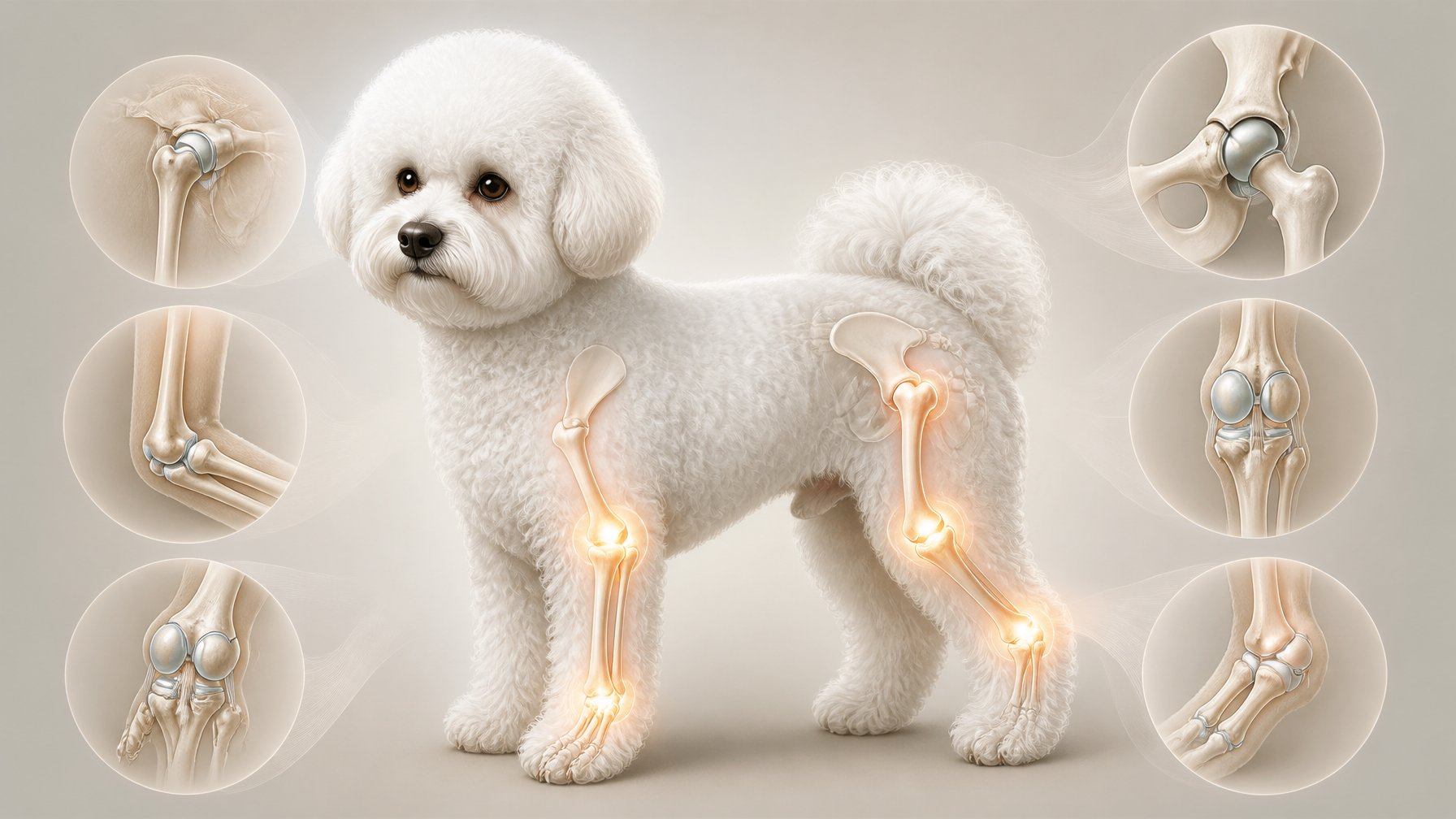
Three joint conditions affect Bichon Frises more than most owners expect: luxating patella causes a visible skip in the back legs, Legg-Calve-Perthes disease destroys the hip joint in puppies under a year old, and elbow dysplasia shows up rarely but still deserves a mention.
Luxating Patella And The Classic Skipping Step
Luxating patella is a condition where the kneecap slides out of its normal groove, causing a sudden skip or hop in the back leg. It’s one of the most common joint problems in the Bichon Frise breed.
You’ll recognize it instantly once you’ve seen it. Your Bichon is trotting along, then suddenly lifts one back leg for a stride or two, then puts it down and walks normally again.
That’s the kneecap popping out and popping back in. Vets grade luxating patella on a scale of 1 to 4:
- Grade 1: Kneecap can be manually pushed out but goes right back.
- Grade 2: Kneecap pops out on its own sometimes, then returns.
- Grade 3: Kneecap stays out most of the time but can be pushed back.
- Grade 4: Kneecap is permanently displaced.
Grades 1 and 2 often don’t need surgery. Weight management and controlled exercise can keep things stable.
Grades 3 and 4 usually require surgical correction.
The recovery took about six weeks.
Legg-Calve-Perthes Disease In Young Dogs
Legg-Calve-Perthes disease is a deterioration of the femoral head (the ball part of the hip joint) caused by reduced blood supply. It typically shows up in small-breed puppies between five and eight months old.
The first sign is usually limping on one back leg that gets progressively worse over a few weeks. Your puppy might cry when you touch the hip area or refuse to put full weight on the leg.
Unlike luxating patella, this one doesn’t come and go. It’s a steady decline.
X-rays confirm the diagnosis. The femoral head will look irregular or collapsed compared to the healthy side.
Surgery to remove the damaged bone (called a femoral head ostectomy) is the standard treatment for Bichons with significant limping.
Most small dogs recover well and walk normally using the surrounding muscle for support. If your Bichon puppy starts favoring a back leg before their first birthday, don’t write it off as a sprain.
Get X-rays.
Why Elbow Dysplasia Matters Less But Still Deserves A Mention
Elbow dysplasia pops up way more in big breeds—think Labradors and German Shepherds. Bichon Frises rarely develop significant elbow dysplasia, but hey, it’s not impossible.
The condition means the elbow joint doesn’t form quite right. That leads to pain, lameness, and arthritis in the front legs.
If a Bichon gets it, you’ll probably notice reluctance to extend the front leg, stiffness after rest, or a limp that gets worse with exercise.
Usually, it’s just a soft tissue tweak or maybe even a thorn hiding in the paw pad.
If the limping keeps up for more than a few days, get an X-ray. That’ll rule out elbow dysplasia and other joint problems.
How To stay Ahead Of Problems At Home

Catching Bichon health issues early is mostly about four habits. A monthly hands-on check, grooming sessions that double as health scans, tracking weight and food, and knowing which symptoms mean “call the vet today” instead of “wait and see.”
A Simple Monthly Health Check Routine
Pick one day a month to do a quick nose-to-tail check on your Bichon. No need to overthink it. You’re just looking for anything new or weird compared to last month.
- Run hands over the whole body, feeling for lumps or sore spots.
- Lift each ear and sniff—if it smells yeasty or sour, that’s a problem.
- Look at both eyes for cloudiness, redness, or odd discharge.
- Open the mouth, check gum color (should be pink), and peek for tartar.
- Check between the toes and paw pads for redness, cracks, or swelling.
- Watch your dog walk across the room—any limp, skip, or stiffness?
After a couple months, she actually sat still for the whole thing.
Grooming Habits That Catch Skin, Eye, And Ear Issues Early
Bichons need regular grooming anyway, so why not turn each session into a mini health check? Every brushing is a shot at spotting skin changes before they get worse.
- Skin color: Pink is normal. Red, flaky, or dark patches can mean allergies or infection.
- Coat texture: Dry, brittle, or thinning fur might point to hormonal issues like Cushing’s.
- Eye area: Tear stains or crusty stuff around the eyes.
- Ear hair: Bichons grow hair inside the ear canal. Keeping it trimmed (or asking your groomer to pluck it) helps prevent moisture and infection.
Honestly, grooming is one of our main topics at Dog Fluffy because so many health problems in fluffy breeds show up in the coat first. Owners who groom at home at least once a week just notice things sooner than folks who only see a groomer every month or so.
Weight Control, Food Tracking, And Vet Visits
An overweight Bichon has more joint wear, higher diabetes risk, and extra strain on a small frame. Most adult Bichons should weigh between 12 and 18 pounds, but your dog’s build matters too.
- Weigh your Bichon once a month. A kitchen scale works for little dogs.
- Track food and treats—guessing usually means overfeeding.
- Vet visits: once a year for healthy adults, twice a year for dogs over seven.
Turns out, training treats bumped her daily calories by 15%. The weight came off in about six weeks.
When A Symptom Means Call Your Vet Now
Most Bichon health changes can wait for a regular appointment. Some can’t.
Call your vet the same day if you see any of these:
- Sudden eye swelling, redness, or a blue-gray haze
- Straining to pee with no output or blood in the urine
- Drinking way more water and having frequent accidents
- Sudden refusal to use a leg
- Seizures, collapse, or acting confused
These can signal glaucoma, urinary blockage, Cushing’s, fractures, or something neurological. Waiting even a couple days can turn a fixable problem into something permanent.
Related reading: health log and anything weird.
Vet Costs, Planning, And Pet Insurance
Most of what goes wrong with a Bichon isn’t a single dramatic bill. It’s a small one that arrives every month for the rest of the dog’s life. Allergies are the clearest example — they usually show up young, they don’t get cured, and they get managed.
That shape of cost is exactly what insurance is good at, and exactly what it refuses once it has already started. If your Bichon has been scratching, licking paws or getting ear infections before the policy begins, an insurer can treat every allergy claim afterwards as pre-existing. Not the treatment you asked about — the whole condition, for life.
Bladder stones work the same way. Bichons are one of the breeds most prone to them, and a dog that has formed stones once will often form them again — so the number that matters isn’t one surgery, it’s however many the dog needs over its life.
What Bichon problems actually cost
- Bladder stone surgery — roughly $1,500 to $4,000, and it can happen more than once.
- Luxating patella surgery — roughly $1,500 to $5,000 per knee, averaging around $3,200. Both knees are common.
- Allergy medication — around $90 to $100 a month for a drug like Apoquel, so roughly $360 to $600 a year for a dog this size. Every year.
Ask your own vet what these run locally — city practices tend to sit well above national averages, and that’s the number that will actually apply to you.
And what insuring one costs
The good news is that a Bichon is a cheap dog to insure compared with the flat-faced and giant breeds. Quotes vary a lot — commonly around $40 to $70 a month for a healthy Bichon, with some averages quoted nearer $90 depending on where you live and how old the dog is when you enrol.
Set that against a single knee surgery and the arithmetic is not subtle. But the honest version is that insurance is a bet, you may pay it for years and claim nothing, and only you know whether that trade suits you.
What to check before you sign anything
- How are chronic conditions handled year to year? This is the big one for a Bichon. Some policies cap a condition for life; others reset the limit each year. For something like allergies, that difference decides whether you are covered at year eight.
- Are hereditary conditions included? Luxating patella and bladder stones both have a breed component.
- Is dental covered, and to what extent? Bichons lose teeth early and dental is one of the most commonly excluded categories.
- What counts as pre-existing, and how far back do they look? Ask specifically about notes on your vet record, not just diagnoses.
Coverage varies by insurer, plan, and where you live, and none of this replaces reading the policy wording or talking to your vet about your own dog. Prices and availability differ by country — if you’re outside the US, check what’s offered where you are.
What Responsible Breed Health Sources Can And Can’t Tell You
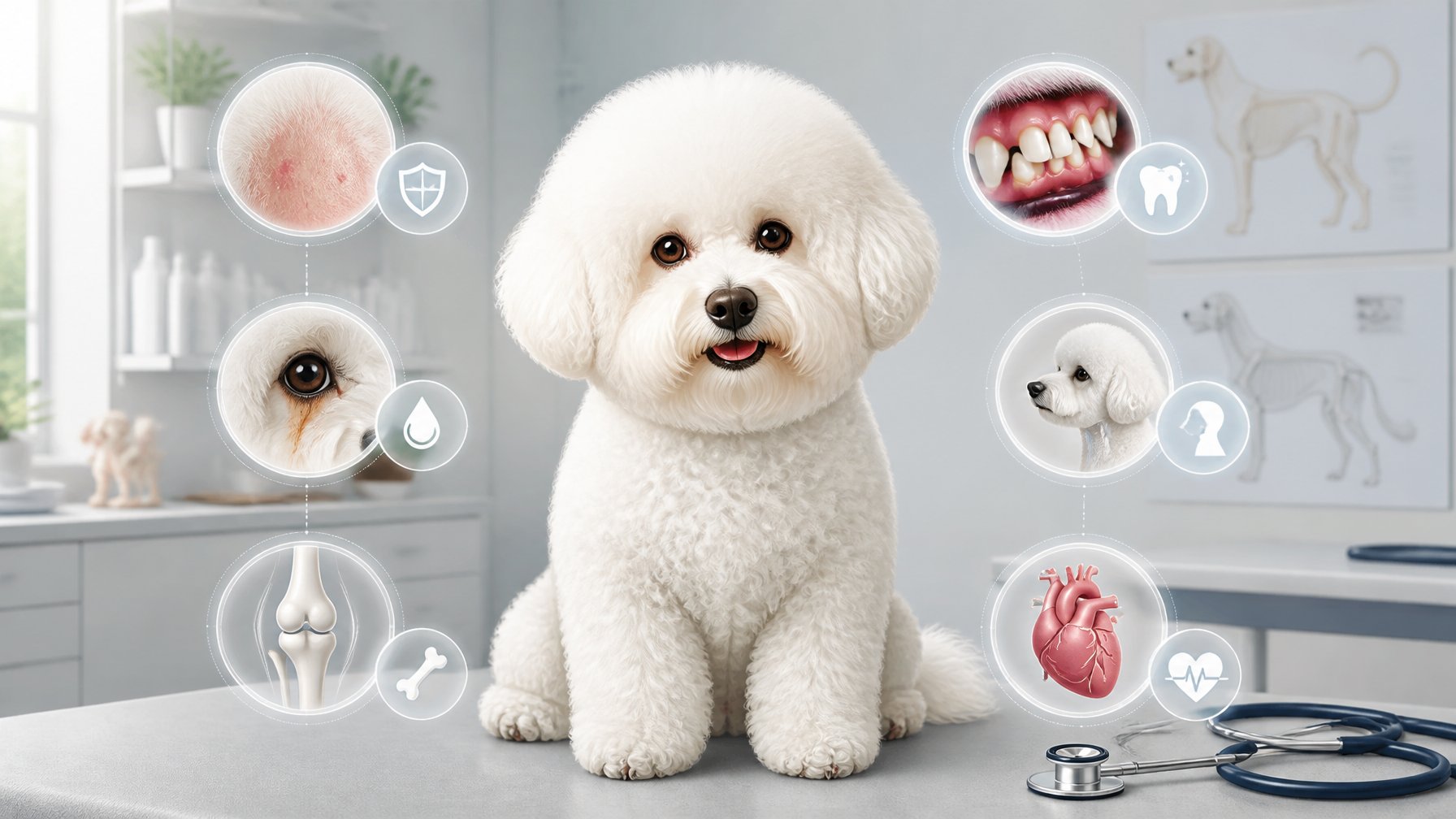
The Bichon Frise Club of America shares health info and data that generic pet sites just don’t have. Their health committee tracks breed patterns, but their data only tells you what’s possible, not what’s happening with your specific dog.
How The Bichon Frise Club Of America Helps Owners
The BFCA is the AKC parent club for Bichons in the US. They keep a breeder directory, publish health articles, and push for responsible breeding.
For owners, the best part is the educational content. Their health section covers breed-specific issues, recommended tests for breeding dogs, and links to veterinary research.
If you’re buying a Bichon puppy, the BFCA breeder directory is a good place to start. Breeders there agree to a code of ethics that includes health testing.
What The BFCA Health Committee Focuses On
The BFCA Health Committee has run several health surveys of Bichon owners over the years. According to their research page, they’ve tracked breed health trends since the late 1900s, with a big follow-up survey in 2007.
These surveys help spot which conditions are rising or falling in the breed. The committee focuses on things like allergies, liver shunts, autoimmune stuff, and orthopedic problems. Their data is one of the few breed-specific sets not filtered by commercial interests.
Of course, survey data isn’t perfect. Owners have to report cases, so mild stuff gets missed and dramatic stories get repeated.
Why Breed Risk Lists Aren’t A Diagnosis
Here’s the thing. Seeing that Bichons are prone to cataracts, Cushing’s, or bladder stones doesn’t mean your dog will get any of them. A breed predisposition is a statistical tendency, not a personal prediction.
Use breed health info as a screening guide. Know what to watch for. Ask your vet to add breed-relevant tests to annual checkups. But don’t let a risk list keep you up at night. The best thing you can do is pay attention to your own dog, every day.
Frequently Asked Questions
What health problems should I watch for as my Bichon gets older?
Senior Bichons are most likely to develop cataracts, dental disease, Cushing’s, and arthritis from earlier joint issues like luxating patella. If your Bichon starts drinking more or peeing more after age six, get a blood panel to check cortisol and glucose.u003cbru003eTwice-yearly vet visits get especially important after age seven.
Why does my Bichon keep getting itchy skin and ear infections?
Recurring itchiness and ear infections in Bichons almost always trace back to atopic dermatitis—an allergic skin thing triggered by food or stuff in the environment. Their dense coat traps moisture in the ears, which just makes infections more likely.u003cbru003eA vet can help figure out the allergen with elimination diets or allergy testing and prescribe something targeted.
What are the most common reasons a Bichon might pass away?
Bichons most often pass from old age, cancer, or complications from Cushing’s or organ failure. The breed usually lives u003ca href=u0022https://vethelpdirect.com/vetblog/2024/02/22/are-bichon-frise-dogs-healthy/u0022u003e12 to 15 yearsu003c/au003e.u003cbru003eRoutine vet care, weight control, and catching chronic issues like diabetes or kidney disease early can add quality years.
How can I tell if my Bichon’s allergies are food-related or something in the air?
If symptoms come and go with the seasons, it’s probably environmental. If your Bichon itches year-round, food is a likely culprit.u003cbru003eThe best way to know is a strict elimination diet for 8 to 12 weeks under a vet’s guidance. Blood tests for food allergies exist, but honestly, they’re not as reliable as an elimination trial.
Are female Bichons more likely to have certain health problems?
Female Bichons do have a slightly higher risk for urinary tract infections and some bladder stones, partly because their urethra is shorter.
What treatments actually help with tear stains, eye gunk, and eye issues in Bichons?
If stains keep coming back, it’s smart to ask your vet about possible issues like blocked tear ducts, eye infections, or dry eye.u003cbru003eYour vet might suggest prescription drops if there’s something like keratoconjunctivitis sicca going on. Drop it in the comments. Always check with your vet for your own dog’s situation.u003c/emu003e